
1534-1592·Feast October 11
St. Alexander Sauli
Barnabite Bishop, the Apostle of Corsica
Overview
Alexander Sauli, born in Milan on 15 February 1534 to an illustrious Lombard family — his father Marquis of Pozzuolo and assistant to Duke Francesco II Sforza — was a Barnabite friar, scholar, superior general, and bishop, remembered as the Apostle of Corsica. Educated at Pavia and made a page at the court of Emperor Charles V, he asked at seventeen to join the Barnabites, then a struggling new congregation; when the Fathers advised him to try richer orders instead, they tested his vocation by having him, on the Vigil of Pentecost 1551, walk Milan's streets in the dress of an imperial page bearing a weighty cross, and preach at the Piazza dei Mercanti — after which he was received as a postulant. Professed in 1554 and ordained at twenty-two in 1556, he served at Pavia, where he built a famous student 'academy', taught philosophy and theology with methods a century ahead of his time, earned his doctorate in 1563, and published catechetical works anonymously. Elected superior general of the Barnabites at thirty-three, he governed through the implementation of Trent's reforms. In 1570 he was named bishop of Aléria in Corsica, a poor, malaria-ridden, feud-torn diocese he visited entirely, gathered into annual synods, and rebuilt — founding a seminary at Bastia and moving his see to Cervione, where he built the cathedral of Saint-Erasme. Transferred to Pavia in 1591, he fed the poor through a famine and died on 11 October 1592 at Colosso d'Asti, mid-pastoral-visit, saying that if he had it to do over he would do it again.
The Complete Life
A Marquis's Son of Milan
Alexander was born in Milan on 15 February 1534 — some sources give 1535 — to Dominic and Tommasina Spinola Sauli, both of ancient and noble Genoese families. His father held the marquisate of Pozzuolo in the Tortona region and served as an assistant to Duke Francesco II Sforza, enjoying the emperor's esteem; the status offered the boy a brilliant career, and it began on schedule: educated at Pavia, he entered the court of Emperor Charles V in Milan as a page in 1551, at seventeen. The same year brought the turn. He sought admission to the Congregation of the Barnabites — the Clerics Regular of St. Paul, established in 1533 — at a moment when the congregation was living out the precariousness of its first years: dire poverty, bitter trial, and an expulsion from the Republic of Venice barely two months earlier. The Fathers, sensibly, advised him to consider the Dominicans, the Franciscans, or the Capuchins, orders rich in outstanding men. Sauli stayed at the door.
The Cross in the Piazza
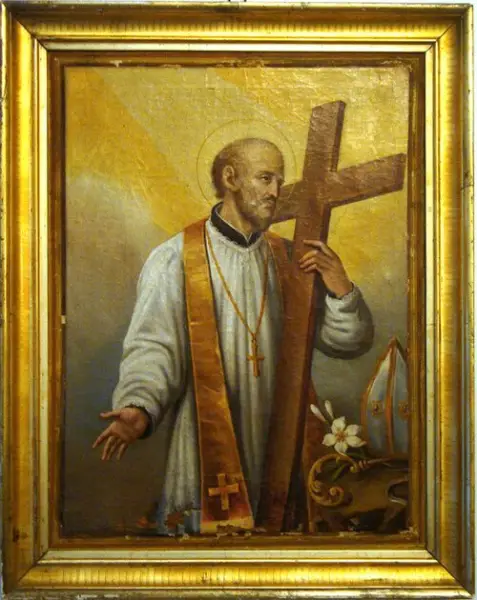
The Barnabites' answer to the young marquis's persistence was a test worthy of the age: on Saturday, 17 May 1551, the Vigil of Pentecost, they required him to walk the streets of Milan with a large cross on his shoulder, clothed as an imperial page, and preach in public on the love of God and the renunciation of the world. Bearing the weighty cross across the city, he reached the Piazza dei Mercanti, borrowed a vendor's stand, set the cross upon it, and spoke to the crowd about honoring God and loving one's neighbor. When he returned to the residence he was received as a postulant; he received the habit on the feast of the Assumption, 15 August 1551. The years that followed included the humiliations novices were given — a later chapter criticized him for ineptitude in the sacristy, bourgeois attitude, and lukewarmness, in minutes written by a Father who may simply have disliked him — and the substance of formation: vows in 1554, subdiaconate and diaconate, and priestly ordination on 21 March 1556 at twenty-two, by special dispensation for his age.
The Academy at Pavia
Sauli's first field was Pavia, where the Barnabites staffed the new Canepanova church, built on a vow of Bona of Savoy after the recovery of her son. Familiar with the city and its university, he preached, encouraged frequent communion and the Forty Hours devotion, founded schools of religious instruction, lectured on the letters of Saint Paul, and organized the students. Out of their requests for help he created an 'academy', opened with a Mass of the Holy Spirit on 2 February 1560: weekly conferences on the Apostle, daily repetition of university subjects in three groups, and ample room for disputation. His methods were a generation early: Aristotle in the original Greek, Aquinas integrated with Bonaventure and the Fathers, geometry to make the heart attentive and orderly, and law for a litigious world. He earned his bachelor's degree by defending 150 theological theses over three days, and his doctorate on 28 May 1563 — the examiners senior professors, the private examination dispensed. Then he handed his philosophy chair to a younger man and kept teaching in the order's own house of studies, publishing his catechetical works anonymously until a bishop revealed his name.
Superior General and the Discipline of Trent
In 1567, at thirty-three, Sauli was elected superior general of a congregation whose members were somewhat elderly — Premoli's 1904 biography preserved the frame of his governance: to be superior meant, above all else, to guide the congregation in the Rule's strict observance and in heroic fidelity to the vows. His generalate coincided with the implementation of the Council of Trent, and he did that work concretely: he defended the motherhouse of St. Barnabas against a claimant through Charles Borromeo to Pope Pius IV, called an extraordinary chapter in 1568 to adopt Pius V's new breviary, he drafted rules for the novices together with curricular guidelines covering sacred and profane studies as well as preaching; and he served as the religious superior of the Angelic Sisters of St. Paul, guiding the congregation of women the Barnabites had long sheltered. His writing, almost all of it catechetical and all of it published anonymously until a bishop revealed his name, shows the same grain: instruction made simple enough for the poor, ordered enough for the seminary, and faithful to the council then reshaping the Church.
The Angel of Corsica
In 1570 Alexander was named bishop of Aléria in Corsica — one of the poorest sees of the church, in an island of factional enmity, famine, drought, and vendetta. He established himself in precarious and humble dwellings, visited the whole diocese, and by the end of August held a synod with 150 priests, which became an annual three-day event he personally paid for, eating and talking with his priests and teaching them by cases of conscience. He founded a seminary at Bastia, corrected abuses, rebuilt churches, and — escaping the malaria-ridden swamplands around Aléria — moved his see to Cervione, where he raised the cathedral of Saint-Erasme in 1578. He suffered malaria and fevers that several times brought him near death; an attempt was made on his life; and the pacification of vendettas became so central a part of his pastoral activity that the people called him the Angel of Peace and the Guardian Angel and Apostle of Corsica. When Genoa sought him as coadjutor of its archbishop, the Corsicans petitioned the Pope with a long list of praises and kept him seven more years. In 1591 Gregory XIV — who had used him as spiritual director at Pavia — made him bishop of Pavia; Corsica wept him to the boat. In Pavia a famine had put wheat out of reach, and his first Sunday's promise to be the father of the poor released a chain reaction of giving. A year later, on pastoral visitation, he preached, confirmed, and met souls at Colosso d'Asti on 1 October, fell ill that night with fever and gout, refused to trouble the parish priest, and died at his friend Count Roero's castle on Sunday, 11 October 1592.
Canonization
Sauli's reputation for holiness spread at once and kept on growing; the canonical process opened at Pavia in 1623, and he was beatified by Benedict XIV on 23 April 1742 and canonized by Pope Pius X on 11 December 1904, the two certified miracles being the 1899 cure of the twenty-year-old Maria Canessa at Bastia and the 1741 cure at Monza of Carlo Riva, paralyzed for a year, which took place amid the celebrations of his beatification. The road to canonization then stalled for a very long stretch amid the political and religious upheavals of the 1700s and 1800s, and resumed only after the Barnabites' own founder had reached the altar in 1897. What the process testified to was above all his heroic charity, the famine and pestilence years in Corsica in which he fed and nursed his people at the risk of his own life, and the unanimous devotion that followed his coffin from Colosso d'Asti to Pavia.
Legacy
Barnabite seminarians count Alexander Sauli as their patron saint. with his feast kept on 11 October. The Barnabites carried his cult with them — an altar dedicated to him stands in St. Michael's Church in Vienna from 1626 — and the historiography of the order, especially Premoli's biography written for the canonization, fixed the image that holds: the scholar who left the university to bury himself in Corsica, the superior who wanted, against Borromeo's judgment, to leave his bones there, and the bishop who died on visitation, persuaded that if he had his life to do over he would do it over again. For the Barnabites he remains the model of what their congregation exists to produce: a scholar who governed, a superior who begged to be sent to the poorest see available, and a bishop who died with his boots on, walking his diocese. For the Barnabites he remains the model of what their congregation exists to produce, and his image in their houses shows the bishop walking his diocese.
Timeline
- 15 Feb 1534
Born in Milan to Dominic and Tommasina Spinola Sauli, an illustrious Lombard family
§ Early life
- 1551
Became a page at the Milanese court of Emperor Charles V at the age of seventeen
§ Early life
- 17 May 1551
Carried a cross preaching through Milan as a test of vocation and was received as a Barnabite postulant
§ Religious formation
- 15 Aug 1551
Received the religious habit and began three years of novitiate
§ Religious formation
- 29 Sep 1554
Professed his vows in the Congregation of the Barnabites
§ Religious formation
- 22 Dec 1554
Received the subdiaconate
§ Religious formation
- 8 Jun 1555
Ordained to the diaconate
§ Religious formation
- 21 Mar 1556
Ordained priest at twenty-two after a special dispensation for his young age
§ Religious formation
- 2 Feb 1560
Opened his Pavia apostolate with a Mass of the Holy Spirit and weekly conferences on Saint Paul
§ First ministry in Pavia
- 28 May 1563
Graduated doctor and joined the College of Professors of Theology at Pavia
§ First ministry in Pavia
- 1567
Elected superior general of the Barnabites at thirty-three
§ Superior General (1566–1569)
- 10 Feb 1570
Provided by Pius V to the ancient see of Aléria in Corsica in consistory
§ Bishop
- 12 Mar 1570
Consecrated bishop in the cathedral of Milan by Cardinal Charles Borromeo
§ Bishop
- Apr 1570
Landed in Corsica with four confreres to take up a diocese without a bishop for seventy years
§ Apostle of Corsica (1570–1590)
- Aug 1570
Held a diocesan synod of some 150 priests that became an annual three-day event
§ Apostle of Corsica (1570–1590)
- 1578
Built the cathedral of Saint Erasmus at Cervione, having moved the see from malarial Aléria
§ Apostle of Corsica (1570–1590)
- 1591
Named Bishop of Pavia by Pope Gregory XIV, his former spiritual directee
§ Bishop of Pavia (1591–1592)
- 19 Oct 1591
Took possession of the diocese of Pavia after two weeks in Rome, Genoa and Milan
§ Bishop of Pavia (1591–1592)
- 11 Oct 1592
Died at Calosso in the Duchy of Savoy while on pastoral visitation of his new diocese
§ Death and veneration
- 1623
Canonical process toward his sanctification initiated in response to widespread devotion
§ Death and veneration
- 23 Apr 1742
Beatified by Pope Benedict XIV
§ Death and veneration
- 11 Dec 1904
Canonized by Pope Pius X and inscribed among the saints of the universal Church
§ Death and veneration
In Their Own Words
Don't think that I am dying because of the efforts of this pastoral visit; be convinced that this is the hour fixed by God. If I should start all over what I have done, I would do it over again.
The Record
- Major works
- Simplified edition of the Roman catechism·Treatise on Marriage·Enchiridion for professors and ordinands·Manual of Moral Decisions·Adaptation of Savonarola's Confessionale to the documents of Trent (all published anonymously)
- Patron of
- Corsica·Barnabite seminarians·Peacemakers in feuds and vendettas
- Symbols
- Bishop's vestments·Cross carried through the streets
- Canonization
- Beatified 23 April 1742 by Pope Benedict XIV; canonized 11 December 1904 by Pope Pius X
Prayer
Profile text adapted from the Wikipedia article, licensed CC BY-SA 4.0.
Pray with this saint every day
Save St. Alexander Sauli to your favorites, read the full profile, and get feast-day reminders in the Saints app.
Get the Saints AppFree on the App Store for iPhone and iPad