
1448-1533·Feast April 17 and August 30
St. Alexander Svirsky
Monk and Hegumen, Wonderworker of the Russian North
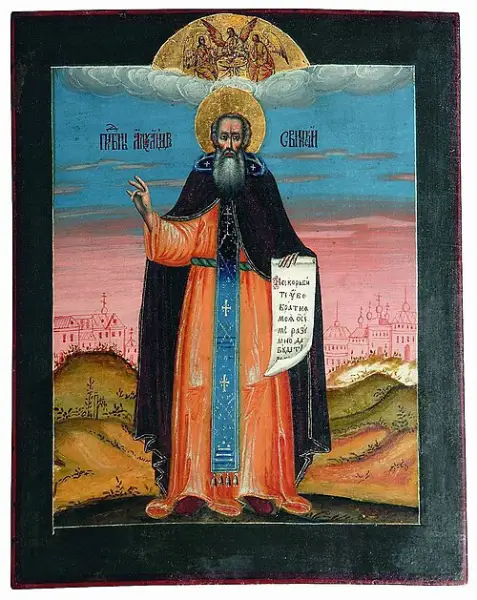
Overview
Alexander Svirsky, born Amos around 1448 into a peasant family at Mandera east of Lake Ladoga in the Novgorod Republic, was a Russian monk and the founder-higumen of the Alexander-Svirsky Monastery. His parents, Stefan and Vassa, took monastic vows late in life under the names Sergiy and Varvara. At twenty-six he left home for the famous Valaam Monastery on Lake Ladoga and became a monk there. Once his parents had died, he went back to the lands around Novgorod and took up life as a hermit close to Olonets, in the forests of Svir, where disciples gathered around him and a community grew. In 1506 Serapion, archbishop of Novgorod, appointed him hegumen of the Trinity Monastery, later known from him as the Alexander-Svirsky Monastery. His Life, written in 1545 by his disciple Herodion Kochnev with the blessing of Metropolitan Macarius of Moscow and Archbishop Feodosiy of Novgorod, records a righteous and contemplative life and the appearances to him of the Trinity and of the Virgin Mary with the Holy Child. He died on 30 August 1533, and the Russian Church canonized him in 1547; his incorrupt relics were found on 17 April 1641.
The Complete Life
A Peasant of the Novgorod Land
Amos, the future Alexander, was born around 1448 into a peasant family at Mandera, in the Obonezhskaya pyatina of the Novgorod Republic, the country east of Lake Ladoga. His parents, Stefan and Vassa, were simple country people who ended their lives in monasticism, taking the names Sergiy and Varvara, a detail the Life preserves because the whole family shared the vocation of the age: the late-medieval Russian longing for the northern monasteries. At twenty-six, over what the tradition presents as parental reluctance followed by consent, Amos left home for Valaam, the great monastery on the islands of Lake Ladoga, the strictest school of northern Russian monasticism, and there received the tonsure and the name Alexander. He lived at Valaam through the formed years of his manhood, learning the discipline that would later make him a father of monks, and only after the deaths of his parents did he return to the Novgorod region, seeking a solitude of his own.
§ Life
The Hermit of the Svir
Alexander settled near Olonets, on the river Svir, in a forest country that was then the very edge of Christian settlement, and lived there as a hermit in the tradition of the northern elders. Disciples found him, as disciples always did, and a community grew around his cell, so that the hermitage became a monastery in fact before it became one in name. In 1506 Serapion, archbishop of Novgorod, appointed him hegumen of the Trinity Monastery, the house that later took his name as the Alexander-Svirsky Monastery, and the former solitary spent his last decades as an abbot, governing the brothers he had gathered without abandoning the contemplative life that had gathered them. The Life written by his disciple Herodion Kochnev in 1545, with the blessing of Metropolitan Macarius of Moscow and Archbishop Feodosiy of Novgorod, records above all the mystical substance of those years, including the appearances to him of the Holy Trinity and of the Virgin Mary with the Holy Child, the visions for which the Russian Church chiefly remembers him.
§ Veneration
Death and Relics
Alexander died on 30 August 1533, an old man who had spent some sixty years in monastic life. His veneration began immediately, in the ordinary Russian way, at his tomb in his own monastery, and the formal canonization followed within a generation: in 1547 the Russian Orthodox Church numbered him among the saints, in the great series of canonizations under Metropolitan Macarius that fixed the calendar of the Russian north. On 17 April 1641 his relics were found and, according to his vita, discovered incorruptible, and they were placed in the monastery church for veneration. The later history of the relics is a miniature of Russian church history: on 22 October 1918, the year of the revolution's assault on the monasteries, the coffin was opened by the Soviet authorities, who reported finding a wax doll; the monks present, and a later commission directed by Grigory Zinoviev, demonstrated that a human body, not a wax figure, lay in the coffin. The relics survived the century and have been restored to veneration.
§ Veneration
Veneration
Alexander's canonization in 1547 places him in the Macarian flowering, the systematic glorification of the Russian saints that accompanied the consolidation of the Muscovite church, and his double feast, 17 April and 30 August, marks the finding of his relics and the day of his death. His monastery on the Svir became one of the major houses of the Russian north, and his cult spread through the Olonets land and the monastic network of Karelia and beyond. The visions of the Trinity gave him a particular place in Russian iconography, where the appearance to Alexander, showing the three angels as at Mamre, is one of the standard subjects of northern icon painting. His Life by Herodion, written with archiepiscopal and metropolitan blessing within twelve years of the saint's death, is among the more reliable of the northern vitae, close enough to living memory that its outline has been generally trusted by the Church.
§ Veneration
Legacy
Alexander Svirsky's legacy is the monastic colonization of the Russian north embodied in one long life: a peasant's son from a village by Ladoga, formed at Valaam, hermit on the Svir, and abbot of the house that bears his name. The monastery he founded survived him by almost five centuries, was closed and desecrated in the Soviet years, one of its ugliest uses being as a prison camp, and has been revived as a living monastery again, so that his cult has twice been rebuilt from ruin. In the calendar he stands beside Sergius of Radonezh and the other northern fathers as a wonderworker and contemplative, and the accounts of his visions of the Trinity and the Theotokos keep him in Russian spiritual memory as a man to whom the central mysteries were drawn near. Pilgrims to the Svir country still come to his relics, as they have, with interruptions, since 1641.
§ Veneration
Timeline
- 1448
Born into a peasant family at Mandera in the Novgorod Republic and named Amos at baptism
§ Life
- 1474
Leaves home aged twenty-six for Valaam Monastery, where he becomes a monk
§ Life
- 1506
Appointed hegumen of the Trinity Monastery, later the Alexander-Svirsky Monastery, by Archbishop Serapion of Novgorod
§ Life
- 30 Aug 1533
Dies at the monastery he founded on the river Svir
§ Life
- 1545
His disciple Herodion Kochnev writes his vita with the blessing of Metropolitan Macarius of Moscow
§ Veneration
- 1547
Canonized as a saint by the Russian Orthodox Church
§ Veneration
- 27 Apr 1641
His relics are found, reported incorruptible according to his vita
§ Veneration
- 22 Oct 1918
Soviet authorities open his reliquary coffin; witnesses confirm a human body lies within
§ Veneration
The Record
- Patron of
- The Russian north·Alexander-Svirsky Monastery
- Symbols
- Hermit of the Svir forests·Appearances of the Trinity and the Theotokos·Incorrupt relics
- Canonization
- Canonized in 1547 by the Russian Orthodox Church; relics found incorrupt in 1641
Prayer
Bibliography
Show 12 sources
- 1 2 3 Veretennikov, Zhuravleva & Polyakova 2000 , pp. 536–537.
- ↑ "Venerable Alexander the Abbot of Svir" . oca.org . Retrieved March 13, 2018 .
- 1 2 3 4 5 6 Veretennikov, Zhuravleva & Polyakova 2000 , p. 536.
- ↑ "Краткая история Александро-Свирского монастыря" . svirskoe.org (in Russian). Archived from the original on December 18, 2019 . Retrieved March 13, 2025 .
- ↑ "«О, чадо, видиши ли, яко место сие зело скорбно есть…»" . valaam.ru (in Russian) . Retrieved March 13, 2025 .
- ↑ (in Russian) Orthodox church calendar, "Pravoslavie" web-site
- ↑ Александр Свирский, преподобный — прославление // Смирнов С. И. Жития русских святых.
- ↑ Кашеваров А. Н. Церковь и власть: Русская Православная Церковь в первые годы Советской власти . — М.: Изд-во СПбГТУ, 1999. — С. 222.
- ↑ Отчёт VIII-го Отдела Народного Комиссариата Юстиции Съезду Советов // Революция и церковь : журнал. — № 9—12. — 1920. — С. 70—82.
- ↑ Гидулянов, Павел Васильевич . / Отделение церкви от государства в С.С.С.Р. : полный сборник декретов, ведомственных распоряжений и определений Верхсуда Р.С.Ф.С.Р. и других советских социалистических республик: У.С.С.Р., Б.С.С.Р., З.С.Ф.С.
- ↑ S.A. Smith, "Bones of Contention: Bolsheviks and the Struggle against Relics 1918–1930." Past & Present Vol. 204: 1, (2009): 156-57
- ↑ МИХАИЛ ШКАРОВСКИЙ. АНТИРЕЛИГИОЗНАЯ КАМПАНИЯ ИЗЪЯТИЯ МОЩЕЙ В СОВЕТСКОЙ РОССИИ
Profile text adapted from the Wikipedia article, licensed CC BY-SA 4.0.
Pray with this saint every day
Save St. Alexander Svirsky to your favorites, read the full profile, and get feast-day reminders in the Saints app.
Get the Saints AppFree on the App Store for iPhone and iPad