
1872-1918·Feast July 17 (with the family of Nicholas II)
St. Alexandra Romanova of Russia
Tsaritsa, Passion-Bearer
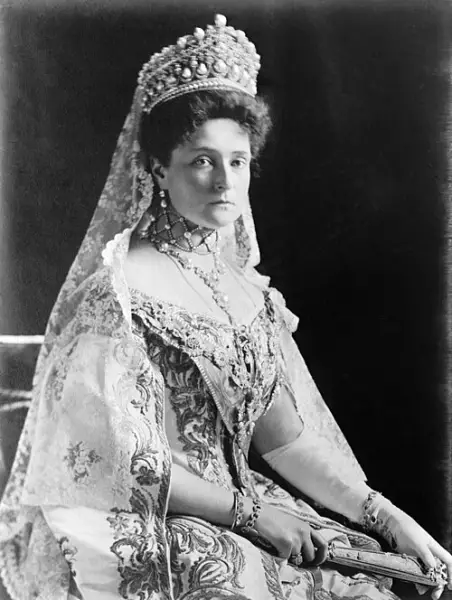
Overview
Alexandra Feodorovna — born Princess Alix of Hesse and by Rhine, christened Alice Victoria Helena Louise Beatrice, on 6 June 1872 at the New Palace in Darmstadt — was the last empress of Russia: she was Nicholas II's wife from their wedding on 26 November (Old Style 14 November) 1894 until the abdication he was forced to sign on 15 March (Old Style 2 March) 1917, and she is honored as a canonized saint of the Russian Orthodox Church. Granddaughter of Queen Victoria through her mother, Princess Alice of the United Kingdom, she first met Nicholas in 1884 at the wedding of her sister Elisabeth to Grand Duke Sergei in Saint Petersburg. His proposal came at Coburg in April 1894, and although her first answer was no — a wife for the Russian heir had to give up Lutheranism for Orthodoxy — she soon said yes, and the wedding came only weeks before he took the throne. Their five children — Olga, Tatiana, Maria, Anastasia, and the Tsarevich Alexei — included a son with hemophilia whose illness shaped her relationships with religious advisers and healers, above all Grigori Rasputin, first brought to the family's attention by the Grand Duchesses of Montenegro and trusted by Alexandra for his help to Alexei — an association that became the target of political criticism and public speculation. She supported the preservation of the autocracy and opposed some proposed reforms; her political influence and responsibility remain subjects of historical debate. After the abdication the family was held under house arrest and taken to Yekaterinburg; early on 17 July 1918, inside the Ipatiev House, Bolshevik forces shot Alexandra and Nicholas and all five of the children — Olga 22, Tatiana 21, and Maria 19, then Anastasia 17 and Alexei 13 — along with members of the household and the family's dogs. Canonized as a passion-bearer in 2000, she was laid to rest beside Nicholas and three of the couple's children at Saint Petersburg's Peter and Paul Cathedral in 1998.
The Complete Life
Princess of Hesse
Alix of Hesse and by Rhine arrived on 6 June 1872, born at Darmstadt's New Palace as the sixth child of Louis IV, Grand Duke of Hesse, and Princess Alice of the United Kingdom — Queen Victoria's second daughter. Her childhood was marked by loss: her mother and her sister May died of diphtheria when Alix was six, a catastrophe that left her grave and withdrawn. Her sister Elisabeth married Grand Duke Sergei of Russia in 1884, and at that wedding in Saint Petersburg Alix, aged twelve, first met the sixteen-year-old Nicholas, heir to the Russian throne. The affection that began there lasted a decade of courtship against the objections of both families — Queen Victoria among them.
§ Introduction
Conversion and Marriage
In April 1894 Nicholas traveled to Coburg for the wedding of Alix's brother Ernest Louis and proposed to her. She declined at first — the one obstacle was conversion, since the wife of the Russian heir had to be Orthodox, and Alix was a convinced Lutheran. Her sister Elisabeth, and her own conscience, turned her; she accepted, was received into the Russian Orthodox Church as Alexandra Feodorovna, and married Nicholas on 26 November 1894 — weeks after the death of Alexander III put her husband on the throne. She was crowned with him in Moscow on 26 May 1896. The marriage itself was famously devoted; her adoption of Orthodoxy was, by all accounts, equally wholehearted, the convert's intensity that marked her later life.
§ Introduction
Empress and Mother
Alexandra's public life as empress was shadowed from within. After four daughters — Olga, Tatiana, Maria, Anastasia — the longed-for heir, Alexei, born in 1904, had hemophilia, inherited through her from Queen Victoria's line. The disease was concealed from the public and incurable, and the empress's search for help shaped her religious associations: Grigori Rasputin, first brought to the family's attention by the Grand Duchesses Militza and Anastasia of Montenegro, was believed by Alexandra to help Alexei during his hemorrhages, and her trust in him became, whatever its basis, a political catastrophe — fueling criticism of the court and speculation about the empress's influence. In politics she supported the preservation of the autocracy and opposed reforms; the extent of her influence over Nicholas remains a genuine subject of historical debate. She nursed her daughters and son through the war years as the dynasty collapsed around them, working as patroness of hospitals after 1914 with the Grand Duchesses.
§ Introduction
Arrest and Martyrdom
After the abdication of 15 March 1917, Alexandra chose to share Nicholas's captivity — the family held first at Tsarskoye Selo, then Tobolsk, and finally Yekaterinburg, where they were confined in the Ipatiev House, the 'house of special purpose.' In the small hours of 17 July 1918, inside the cellar of the Ipatiev House, Bolshevik guards murdered the entire family — Alexandra and Nicholas with all five children, Olga (22), Tatiana (21), and Maria (19), then Anastasia (17) and Alexei (13) — together with their doctor, their servants, and the others who had shared their captivity. Alexandra, shot as she made the sign of the cross, died a widow's and mother's death beside her children. The bodies were hidden in the forest; two of the children's remains were found only decades later.
§ Imprisonment (1917–1918)
Canonization
The Russian Orthodox Church Outside Russia canonized the imperial family as martyrs in 1981; the Moscow patriarchate, after long debate over whether political questions should weigh, canonized them in 2000 as passion-bearers — saints who died in a Christ-like manner without themselves being killed expressly for the faith. Alexandra's relics, with Nicholas's and three of their daughters', were solemnly reburied in the Peter and Paul Cathedral in Saint Petersburg on 17 July 1998, eighty years to the day after the murder. Her feast is kept on 17 July with the family.
§ Introduction
Legacy
Alexandra's legacy is fiercely contested in history and settled in liturgy. Historians still argue her responsibility for the fall of the dynasty — her politics, her dependence on Rasputin, her effect on her husband — and the argument is legitimate. What the church canonized is the other Alexandra: the wife who chose captivity with her family, the mother whose faith survived her son's incurable disease, and the woman who died in a cellar with the sign of the cross on herself. The two legacies belong to the one person, and both must be told. For believers, the family of Nicholas II — killed together, youngest to oldest — stands as the emblem of a century of Christian martyrdom that began in that cellar in Yekaterinburg.
§ Imprisonment (1917–1918)
Timeline
- 6 Jun 1872
Born Princess Alix of Hesse and by Rhine at the New Palace, Darmstadt, on 6 June
§ Introduction
- 1884
Meets the 16-year-old Tsesarevich Nicholas at the St. Petersburg wedding of her sister Elisabeth
§ Introduction
- Apr 1894
Nicholas travels to Coburg for her brother's wedding in April, and the couple's engagement follows
§ Introduction
- 26 Nov 1894
Marries Nicholas II in St. Petersburg days after the funeral of his father, Alexander III
§ Introduction
- 15 Nov 1895
Gives birth to her first daughter, Grand Duchess Olga
§ Struggle to bear an heir
- 26 May 1896
Crowned with Nicholas at the coronation in Moscow
§ Coronation
- 10 Jun 1897
Gives birth to her second daughter, Grand Duchess Tatiana
§ Struggle to bear an heir
- 26 Jun 1899
Gives birth to her third daughter, Grand Duchess Maria
§ Struggle to bear an heir
- 18 Jun 1901
Gives birth to her fourth daughter, Grand Duchess Anastasia
§ Struggle to bear an heir
- 12 Aug 1904
Gives birth to the long-awaited son, Tsarevich Alexei Nikolaevich, at Peterhof
§ Struggle to bear an heir
- 30 Dec 1916
Rasputin, the healer she trusted for her son, is assassinated in St. Petersburg
§ Health
- 15 Mar 1917
Nicholas abdicates in March and Alexandra and the family are placed under house arrest
§ World War I
- 17 Jul 1918
Murdered with Nicholas and their five children by Bolsheviks in the basement of the Ipatiev House, Yekaterinburg
§ Captivity and murder
- 1981
Recognised as a martyr with her immediate family by the Russian Orthodox Church Outside Russia
§ Sainthood
- 17 Jul 1998
Her remains are buried in the Saints Peter and Paul Cathedral in St. Petersburg
§ Introduction
- 2000
Canonized by the Russian Orthodox Church as a passion bearer, alongside Nicholas, their children and other martyrs
§ Sainthood
In Their Own Words
I am just a woman fighting for her sovereign, for her child, for the two dearest beings in the world.
I feel like the mother of this country and I suffer for him as if he were my own son, despite all the horrors and sins.
My unforgettable friend and teacher, savior and advisor, how much your absence weighs on me!
The Record
- Patron of
- The persecuted·Families suffering together
- Symbols
- Imperial crown laid down·Passion-bearer's cross·Icon of the family of Nicholas II
- Canonization
- Canonized in 1981 by the Russian Orthodox Church Outside Russia as a martyr; canonized in 2000 by the Russian Orthodox Church as a passion-bearer
Prayer
Bibliography
Show 12 sources
- ↑ Weir, Alison (2011). Britain's Royal Families: The Complete Genealogy (reprint ed.). Random House. p. 307. ISBN 978-0-09-953973-5 .
- 1 2 3 Massie, R, Nicholas and Alexandra , p. 49.
- 1 2 Advice to a Granddaughter, p. 108.
- 1 2 Edvard Radzinsky, The Last Tsar, p. 37.
- 1 2 King, Empress, p. 70.
- 1 2 King, Greg. The Last Empress (Wiley & Sons, 1994) pp. 55–56.
- 1 2 Gilliard, Pierre .Thirteen years at the Russian court. Chapter 4.
- 1 2 Denton, C.S, Absolute Power , p. 574
- 1 2 Robert K. Massie, Nicholas and Alexandra, p. 350
- 1 2 3 4 Lili Dehn, The Real Tsarista, Section 2 Chapter 3, https://www.alexanderpalace.org/realtsaritsa/2chap3.html
- 1 2 Denton, C.S, Absolute Power , p. 577.
- 1 2 3 4 5 6 7 8 9 10 11 12 King, Greg, The Last Empress, Citadel Press Book, 1994. ISBN 0-8065-1761-1 .
Profile text adapted from the Wikipedia article, licensed CC BY-SA 4.0.
Pray with this saint every day
Save St. Alexandra Romanova of Russia to your favorites, read the full profile, and get feast-day reminders in the Saints app.
Get the Saints AppFree on the App Store for iPhone and iPad