
died 314·Feast April 21 (Eastern); March 20 (Catholic); April 8 (Coptic)
St. Alexandra of Rome
Martyr of the Persecution of Diocletian
Overview
Alexandra of Rome is a martyr known from the Martyrdom of Saint George, in which she appears as the wife either of the emperor Diocletian or of Dacian, the Roman prefect, and is converted by the courage of the soldier-martyr. According to the tradition, while St. George hung under torture, Alexandra came forward in the arena, knelt in honour before him, and openly declared her faith, asking whether she could be worthy of paradise and martyrdom without baptism, and George bade her fear nothing, for her blood would baptize her. Denounced as a Christian, she was confined at Nicomedia by her husband's command and condemned to death; her husband is said to have cried out, 'What! Even thou hast fallen under their spell!' On the way to execution she asked her guards to let her rest for a moment by the place of George's execution at the city wall, and there she died, on April 21, 314. Apollo, Isaac, and Codratus, her three servants, shared her imprisonment; starvation killed the first two, while the third was beheaded alongside her. The Orthodox honor her on April 21, together with the martyred soldiers Anatolios and Protoleon and the 630 souls won over by George's witness; the Catholic Church keeps March 20 and the Copts April 8. Holweck considered her story fictitious, and de Voragine legendary; the church's memory of her is nonetheless ancient.
The Complete Life
Early Life
Alexandra's life before the day of her confession is unknown, and even her identity is uncertain: the Martyrdom of Saint George, her only source, presents her as the wife of Diocletian, while Jacobus de Voragine, calling her Alexandria, makes her the wife of Dacian, the prefect who persecuted St. Caprasius of Agen and St. Maginus. She has also been confused with Priscilla, or Prisca, Diocletian's historical wife. What the legend requires is a woman of the highest imperial rank, close to the persecuting power, who has secretly believed: the empress in the arena is the necessary counterpart to the emperor on the throne. If she was a wife of the tetrarchic court at Nicomedia, she lived amid the ceremonies of the Roman state religion and the rising pressure of the Great Persecution, which began in that city in 303 with the burning of the church and the edicts against the Christians' books and clergy. Her conversion, 'secret' in the tradition, must have been the more dangerous for her position.
Vocation
Alexandra's vocation arrived in a single moment at the arena. The George legend, in its developed form, has the soldier tortured repeatedly before the court at Nicomedia, and among the spectators the emperor's wife, watching the man being broken on the wheel and refusing to deny his Lord. Her response is the scene for which she is remembered: she came forward, bowed before the prisoner, and confessed Christ openly. Her question to George, whether she might be worthy of paradise and martyrdom without baptism, gives the legend its doctrinal point, and George's answer, that her blood would baptize her, supplies the theology of baptism of blood that the church already taught. Her act was doubly transgressive: a woman of the court honouring a condemned soldier, and an adherent of the state religion professing the outlawed faith. From that moment her death was settled, and the legend moves immediately to her arrest at her husband's orders, her sentence, and the astounded cry attributed to him. Her vocation, in the economy of the story, is to be the firstfruits of the persecution's own household.
Final Years
Alexandra's final walk is described with unusual gentleness. Sentenced to death, she went quietly, praying as the guards led her to the place of execution, and on the way she asked whether she might rest a moment; the guards allowed it, and she sat down by the city wall at the place where George had been put to death, and there she died, on April 21, 314. The tradition gives her, in effect, the death she chose: at the side of the martyr whose witness had converted her. Her three servants, Apollo, Isaac, and Codratus, who had gone to prison with her, shared her fate, the first two dying of starvation and Codratus beheaded with her. The Orthodox commemorate her on April 21, sometimes with April 23 services joining her to Anatolios and Protoleon and the 630 who confessed Christ at George's martyrdom; the Roman Catholic commemoration falls on March 20 and the Coptic on April 8. The year 314, after the persecution's formal end in the West, belongs to the chronology of the legend rather than to provable history.
Cult and Canonization
Alexandra is a saint of the pre-congregation church, received into the calendars of the East without process, her cult riding with that of the great martyr George, to whose cycle she belongs. The Orthodox churches honour her on April 21 and 23, the Catholic Church on March 20, and the Coptic Church on April 8, a triple commemoration that shows how widely the George tradition travelled. Her critical fortunes have been mixed: Holweck, in his Biographical Dictionary of the Saints, judged the whole story fictitious and denied her existence, and de Voragine himself presented the tale as legendary, while the churches that keep her feast have not withdrawn it. This is the ordinary condition of the legendary martyrs: the scholarly verdict and the liturgical memory proceed on different principles, one demanding evidence, the other preserving a form of the church's conviction that the persecution of Diocletian produced witnesses in every rank, even the imperial bedchamber.
Legacy
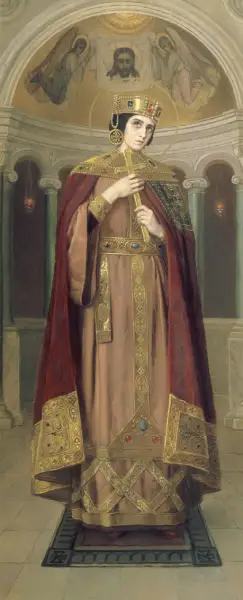
Alexandra's legacy is her scene: the crowned woman kneeling to the prisoner, and the soldier telling her that blood is a sufficient font. From that image the church has drawn, for seventeen centuries, the doctrine that martyrdom completes what sacrament has not begun, and the assurance that no rank is too high for the gospel and none too bound to the persecutor to escape its call. She is a patron, by implication, of converts whose families are hostile, and of all who come to faith through the witness of someone braver than themselves. The spread of her feast across the Byzantine, Roman, and Coptic calendars testifies to the reach of the George cycle, of which she is the indispensable complement: without the empress in the stands, the story of the soldier under torture would lack its proof that the spectators were being converted even as the executioners were working. Whether history can verify her or not, the figure of Alexandra has done its work in the Christian imagination.
Timeline
- 314
Goes to the arena while George is tortured, bows before him and openly professes her Christian faith
§ Life
- 314
Denounced as a Christian, imprisoned at Nicomedia on her husband's orders and sentenced to death
§ Life
- 21 Apr 314
Beheaded at Nicomedia with her servant Codratus after resting by the place of George's execution
§ Life
In Their Own Words
Do not fear, for your blood will baptize you.
What! Even thou hast fallen under their spell!
The Record
- Patron of
- Converts from paganism·Empresses (traditional)
- Symbols
- Crown (her attribute in iconography)·Palm of martyrdom
- Canonization
- Pre-congregation; cult in Eastern Orthodox, Catholic, and Oriental Orthodox traditions
Prayer
Profile text adapted from the Wikipedia article, licensed CC BY-SA 4.0.
Pray with this saint every day
Save St. Alexandra of Rome to your favorites, read the full profile, and get feast-day reminders in the Saints app.
Get the Saints AppFree on the App Store for iPhone and iPad