
1904-1918·Feast July 17 (with the Romanov passion-bearers)
St. Alexei Nikolaevich, Tsarevich of Russia
Passion-Bearer, Heir to the Russian Throne
Overview
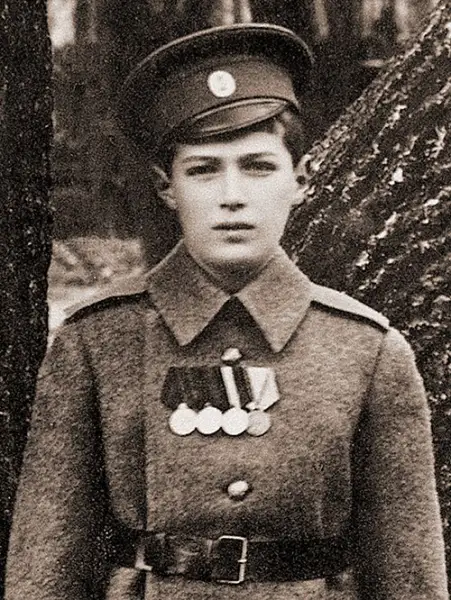
Alexei Nikolaevich Romanov, born on 12 August 1904 at Peterhof Palace, was the last tsesarevich of Russia, the only son and youngest child of Tsar Nicholas II and Tsarina Alexandra Feodorovna, grandson on his mother's side of Queen Victoria's daughter Alice. His birth after four daughters was greeted with nationwide rejoicing, gun salutes and church bells, but within weeks it was clear that he had inherited haemophilia through his mother's line, the disease that shadowed the whole family and led his desperate parents into dependence on the peasant faith healer Grigori Rasputin, whose closeness to the Empress weakened the monarchy. A lively, affectionate boy called Baby and Alyosha, he suffered repeated crises of bleeding that repeatedly brought him near death, and the hope of his recovery became entangled with the politics of the court. After the February Revolution of 1917 the family was sent into exile at Tobolsk in Siberia, and after the October Revolution their fate darkened. On 17 July 1918, with White Army soldiers approaching Yekaterinburg, the Ural Regional Soviet ordered the murder of Alexei, his parents, his sisters and four retainers in the Ipatiev House. He was thirteen. His remains, with those of one sister, were found in a secondary grave in 2007 and remain in state archives; the Russian Orthodox Church canonized the family as passion-bearers in 2000.
The Complete Life
The Longed-for Heir
Alexei was born on 12 August 1904 at Peterhof Palace, the youngest of five children and the only son of Emperor Nicholas II and Empress Alexandra Feodorovna. His ancestry joined the thrones of Europe: his father was the son of Alexander III and Princess Dagmar of Denmark, his mother the daughter of Louis IV of Hesse and Princess Alice of the United Kingdom, and so Queen Victoria was his great-grandmother. His birth was greeted with extraordinary joy as the first son after four daughters, the Empress exclaiming in disbelief when she woke, the Emperor writing in his diary of a great and unforgettable day, bells ringing all day in the capital and the city ablaze with flags. An amnesty was granted and scholarships founded. The title of tsesarevich and heir apparent was his from birth. Within weeks, however, the family learned what the rejoicing had hidden, that the boy had haemophilia, transmitted through his mother's line from Queen Victoria, the hereditary illness that would darken the last years of the Russian monarchy.
§ Early years
Sickness, Exile and Death
Alexei's childhood was punctuated by bleeding crises that repeatedly brought him to the edge of death, and the desperation of his parents, above all his mother, opened the court to the strange figure of Grigori Rasputin, the peasant faith healer whose prayers seemed to coincide with the boy's recoveries and whose influence over the Empress became a scandal that weakened the throne. The boy himself, known in the family as Baby and Alyosha, was lively, affectionate and willful, the favorite of parents and sisters alike. The February Revolution of 1917 ended the monarchy, and the family was sent to internal exile at Tobolsk in Siberia; after the October Revolution their position worsened, and in the spring of 1918 they were moved to the Ipatiev House at Yekaterinburg. As White Army forces drew near, the Ural Regional Soviet resolved to put the entire family to death together with four retainers, and on the night of 17 July 1918 Alexei, aged thirteen, was shot alongside his parents and sisters.
§ Introduction
Passion-Bearers
Rumors persisted for decades that the tsarevich had escaped, and multiple impostors claimed his identity, some famously; the truth emerged slowly. The main grave, holding his parents and three sisters and the retainers, was discovered in 1979 and formally interred in the Cathedral of Saint Peter and Paul on 17 July 1998, the eightieth anniversary. The second grave, containing Alexei and one sister, Maria or Anastasia, was found only in 2007, and their bones remain in Russian state archives. In 2000 the Russian Orthodox Church canonized the Romanov family as passion-bearers, saints who accept death in the manner of Christ's passion without being martyrs for the faith as such, and the tsarevich is commemorated with them on 17 July. His brief, sick, hunted life has made him, in popular devotion far beyond Russia, an image of innocent suffering under political violence, and pilgrimages to Yekaterinburg keep the memory of the family's last house.
§ Introduction
Timeline
- 12 Aug 1904
Born at Peterhof Palace, the only son and heir of Tsar Nicholas II and Tsarina Alexandra
§ Early years
- 3 Sep 1904
Christened in the chapel of Peterhof Palace with soldiers of the army and navy as honorary godfathers
§ Early years
- 8 Oct 1912
Received the last sacrament during the life-threatening hemorrhage at Spala
§ Rasputin
- 1915
Joined his father at Stavka army headquarters when Nicholas took supreme command in the war
§ Stavka
- 1916
Received the military rank of lance corporal, a distinction that delighted him
§ Stavka
- 1917
Arrested with the imperial family after the February Revolution and sent into exile at Tobolsk
§ Imprisonment of the imperial family
- Apr 1918
Left behind in Tobolsk, too ill to travel, when his parents and sister Maria were moved to Yekaterinburg
§ Imprisonment of the imperial family
- 17 Jul 1918
Murdered with his family by a Bolshevik firing squad in the cellar of the Ipatiev House
§ Death
- 1981
Canonized as a holy martyr by the Russian Orthodox Church Abroad
§ Canonization
- 17 Jul 1998
His parents and three sisters were interred in St. Peter and Paul Cathedral eighty years after the execution
§ Canonization
- 2000
Canonized as a passion bearer with his family by the Russian Orthodox Church
§ Canonization
- 23 Aug 2007
His partial burned remains were discovered in a secondary grave near Yekaterinburg
§ Discovery and identification of remains
- 30 Apr 2008
Russian forensic scientists announced DNA testing had identified the remains as his and Maria's
§ Discovery and identification of remains
- 2009
Genetic analysis published showing his hemophilia was hemophilia B, inherited through Queen Victoria's line
§ Hemophilia
The Record
- Patron of
- Children with illness (by popular devotion)·Hemophilia sufferers (by popular devotion)
- Symbols
- Sailor suit of the tsarevich·Crown and cross of the passion-bearers·Romanov double eagle
- Canonization
- Canonized as a passion-bearer in 2000 by the Russian Orthodox Church with the Romanov family
Prayer
Bibliography
Show 3 sources
- ↑ The title tsesarevich was introduced in the 1797 Pauline Laws as the title of the heir apparent of the Emperor of Russia. The older tsarevich was a title given to any son of a tsar, and historically also to sons of non-Russian rulers, e.g
- ↑ If Rasputin's daughter was right about the day that her father responded – 13 October – "the longstanding claim that Rasputin had somehow alleviated Alexei's condition is simply fictitious." [ 38 ]
- ↑ Alexei and the other Romanov saints are considered martyrs by the Russian Orthodox Church Outside of Russia
Profile text adapted from the Wikipedia article, licensed CC BY-SA 4.0.
Pray with this saint every day
Save St. Alexei Nikolaevich, Tsarevich of Russia to your favorites, read the full profile, and get feast-day reminders in the Saints app.
Get the Saints AppFree on the App Store for iPhone and iPad