
1856 – 1918·Feast July 17 (with the New Martyrs of Russia)
St. Alexei Trupp
Latvian Footman of the Imperial Household, Martyr with the Romanovs
Overview
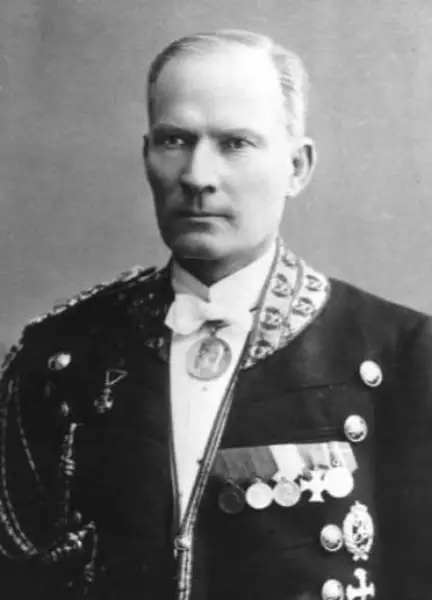
Aloizs Lauris Trūps, known in the imperial household as Alexei Yegorovich Trupp, was the Latvian head footman of the family of Tsar Nicholas II, born on 8 April 1856 at Kalnagals in the Vitebsk Governorate, now in Latvia's Madona Municipality, an ethnic Latgalian and, by his own faith, a Roman Catholic. He served the imperial family through the last decades of its existence and followed it into captivity after the Revolution of 1917. In the early hours of 17 July 1918, at the Ipatiev House in Yekaterinburg, he was murdered with the tsar, the tsarina, their four daughters, the tsarevich, and the three other members of the household who had chosen to remain, Dr. Eugene Botkin, Anna Demidova, and Ivan Kharitonov. The remains later identified include his, and he lies buried, with the family he served, in the martyrs' chapel of Saint Catherine within the Peter and Paul fortress cathedral at Saint Petersburg. In 1981 the Russian Orthodox Church Outside Russia canonized the imperial family as martyrs and included Trupp in their number, notwithstanding his Catholicism; the Moscow Patriarchate, canonizing the family as passion-bearers in 2000, did not include him.
The Complete Life
A Latgalian in the Imperial Service
Trupp was born Aloizs Lauris Trūps on 8 April 1856 at Kalnagals, in the Rezhitsky Uyezd of the Vitebsk Governorate, a Baltic province of the Russian Empire whose Latgalian Catholic population stood between the Lutheran Latvians of the north and the Orthodox Russians of the east; the district is now part of Latvia's Madona Municipality. His world was that of the rural Catholic peasantry of Latgale, poor, devout, and much drawn into Russian service; that he entered the imperial household and rose to be the head footman, the senior post of the male domestic staff, tells of a man trusted with the closest proximity to the family. He was, by confession, Roman Catholic, and remained so; the Orthodox Church that would one day number him among its saints received him as he was. Nothing survives of his interior life in the public record; what survives is the fact of his service, across the decades in which the imperial family's public existence narrowed to the private one he superintended.
§ Introduction
The Ipatiev House
When the Revolution took the imperial family first into house arrest at Tobolsk and then, in the spring of 1918, into the Ipatiev House at Yekaterinburg, the household was given its choice: to leave, or to remain. Trupp remained, with Dr. Botkin, the empress's maid Anna Demidova, and the cook Ivan Kharitonov, the four servants whose loyalty the family could not spare and who would not spare themselves. In the cellar of the house in the early hours of 17 July 1918, the whole party, the tsar and tsarina, their five children, and the four servants, was shot by the Ural Soviet's execution squad. Trupp was sixty-two. The bodies were taken to the Four Brothers minefield at Ganina Yama and there destroyed and buried; the scientific identification of the remains, completed in the 1990s with DNA evidence, established the fate of the party, and the recovered remains were interred in the Peter and Paul Cathedral in 1998, Trupp among them, in Saint Catherine's martyr chapel within the Peter and Paul fortress.
§ References
A Catholic among Orthodox Saints
Trupp's afterlife in the church's memory is unique in its ecumenical outline. The Russian Orthodox Church Outside Russia, the émigré jurisdiction that kept the memory of the murdered family at the center of its piety, canonized the Romanovs as martyrs in 1981 in New York, and in the same act numbered the servants with them, including Trupp, though he had lived and died a Roman Catholic; the ROCOR menology thus contains a Latvian Catholic footman among the new martyrs of Russia, kept with the family on their common day. The Moscow Patriarchate, when it glorified Nicholas and his family in 2000, chose the distinct title of passion-bearers, saints who suffer meekly rather than for the faith specifically, and did not extend the glorification to the servants. The two decisions, taken nineteen years apart, together outline the peculiar case: a man not martyred for his church, killed for his loyalty, and honored by a church not his own.
§ Introduction
Legacy
For Latvia, and for Latgale above all, Trupp has become a small but real national memory: a Catholic peasant's son from the Vitebsk province who served at the center of the empire and died at its violent end, and whom the church of the empire's rulers canonized. For students of the Romanov canonizations, he is the figure who exposes the theological joints of the case, the reason the Moscow Patriarchate chose passion-bearer over martyr, and the demonstration that the ROCOR act of 1981 was broader in its sympathies than strict martyr-theology required. For the ordinary reader his witness is simpler and not less: when the house fell, the servants were offered the door and took the cellar. The four who remained with the family have been given, by the piety of the Russian emigration and the patient work of the DNA laboratories, a place in the same grave and the same memory, and Trupp's name carries into the sanctorale the dignity of service kept to the end.
§ Introduction
Timeline
- 8 Apr 1856
Born Aloizs Lauris Trūps at Kalnagals in the Vitebsk Governorate, an ethnic Latgalian
§ Introduction
- 17 Jul 1918
Shot with the Romanovs and fellow servants in the cellar of the Ipatiev House, Yekaterinburg
§ Introduction
- 1981
Numbered among the martyrs canonized by the Russian Orthodox Church Outside Russia despite his Catholic faith
§ Introduction
- 2000
Moscow Patriarchate glorifies the imperial family as passion-bearers but leaves Trupp out
§ Introduction
The Record
- Patron of
- Household servants·Lay Catholics in Orthodox lands·The Latgalian people
- Symbols
- Livery of an imperial footman·Palm of martyrdom
- Canonization
- Canonized as a martyr by the Russian Orthodox Church Outside Russia in 1981 (a Roman Catholic; not canonized by the Moscow Patriarchate)
Prayer
Bibliography
Show 4 sources
- ↑ King, Greg; Wilson, Penny (12 September 2003). The Fate of the Romanovs . Wiley. pp. 65, 495, 496. ISBN 978-0-471-20768-9 .
- ↑ Coble, Michael D.; Loreille, Odile M.; Wadhams, Mark J.; Edson, Suni M.; Maynard, Kerry; Meyer, Carna E.; Niederstätter, Harald; Berger, Cordula; Berger, Burkhard; Falsetti, Anthony B.; Gill, Peter; Parson, Walther; Finelli, Louis N. (200
- ↑ "The slaughter of Russia's last tsar and his family 100 years on" . The National . 17 July 2018.
- ↑ King, Greg; Wilson, Penny (12 September 2003). The Fate of the Romanovs . Wiley. pp. 495, 496. ISBN 978-0-471-20768-9 .
Profile text adapted from the Wikipedia article, licensed CC BY-SA 4.0.
Pray with this saint every day
Save St. Alexei Trupp to your favorites, read the full profile, and get feast-day reminders in the Saints app.
Get the Saints AppFree on the App Store for iPhone and iPad