
c. 1296-1378·Feast February 12
St. Alexius, Metropolitan of Kiev
Metropolitan of Kiev and All Rus', Bishop and Statesman
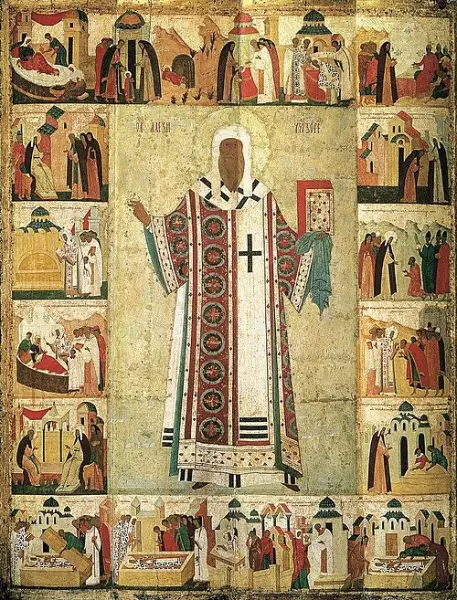
Overview
Alexius — born Eleutherius before 1296, son of the boyar Theodore Biakont, founder of the Pleshcheev family — was Metropolitan of Kiev and all Rus' from 1354 to 1378 and the effective ruler of Moscow during the minority of Dmitri Donskoi. Taking monastic vows at Moscow's Epiphany Monastery around 1313 and receiving the name Alexius, he joined the household of Metropolitan Theognostus in 1333, became the metropolitan's deputy at Vladimir in 1340, and was consecrated bishop of Vladimir in 1352. Chosen metropolitan at Constantinople in 1354, he governed the Russian church through the worst years of the Horde, twice served as regent of Moscow, and was spiritual tutor to the young Dmitri Donskoi, whose side he took against Tver, sending Sergius of Radonezh to suspend church services in the hostile city. In 1357 Khan Jani Beg summoned him to cure his mother Taidula Khatun of blindness; the cure was credited to him, and it was seen as an act that turned back a Tatar raid against Moscow. The Andronikov, Chudov, and Alekseyevsky monasteries were his foundations; he also promoted the canonization of Metropolitan Peter and died in 1378, leaving sermons and epistles.
The Complete Life
Early Life
Alexius was born Eleutherius before 1296 in Moscow, son of Theodore Biakont, a Chernigov boyar who had moved to Moscow and established the Pleshcheev boyar family; his mother was Mary. The Chernigov emigres were part of the northward drift of the Russian elite after the Mongol destruction of the old southern cities, and their sons served the rising principality of Moscow. At around seventeen, by a story recorded in his Life, the boy resolved on the monastic life — in one telling after a shoot of a tree he had grafted withered, read as a call away from the world's flowering — and he took his vows at Moscow's Epiphany Monastery around 1313, receiving in religion the name Alexius. In or about 1333 he entered the household of Metropolitan Theognostus, the Greek who headed the Russian church, becoming his deputy at Vladimir in 1340. The metropolitans had made Moscow their seat only in 1325, within living memory when Eleutherius was growing up; the boyar's son thus belonged to the first Moscow generation of the Russian church.
§ Biography
Vocation to the Primacy
In 1352 Alexius was consecrated bishop of Vladimir, the senior see of the north, and in 1354 he traveled to Constantinople, where the patriarch chose him to be Metropolitan of Kiev and all Rus', the head of the whole Russian church at a moment when the metropolia was contested by a rival candidate backed by Lithuania. The title still said Kiev, but the metropolitan had long resided in Moscow, and Alexius's allegiance to the Moscow princes was implicit in his office. By the will of Symeon the Proud he had already been appointed adviser to the grand prince's brothers Ivan and Andrew, and when Dmitri Donskoi and Vladimir the Bold came to power as children, Alexius served as their spiritual tutor and, in practice, as regent of the Moscow state — churchman and statesman in one person for the decisive decades of Moscow's rise. The patriarch's choice of a Moscow man over the candidate favored by the Lithuanian princes fixed the political alignment of the Russian church for the rest of the century.
§ Biography
Mission: Church and Horde
Alexius's public work ran on two fronts at once. Within the Russian lands he took the side of Dmitri Donskoi in the struggle against Tver and Nizhny Novgorod, going so far as to send Sergius of Radonezh to suspend services in the churches and monasteries of the rebellious city until the strife ended — the spiritual weapon of interdict deployed for Moscow's cause. Within the Horde, his mission was preservation: in 1357 Khan Jani Beg summoned him to cure his mother, Taidula Khatun, of blindness, and the metropolitan's success — reckoned a miracle in the chronicles — was understood to have turned aside a Tatar raid against Moscow. That healing, shown in later Russian painting, fixed his reputation both as a holy man and as the shield of the city; his embassies to Sarai on behalf of the church's freedoms continued through the unrest that followed Jani Beg's murder and the Horde's long civil war.
§ Biography
Monastic Foundations
Alongside his politics Alexius was a builder of monasteries, and in the 1360s he founded three houses that became permanent centers of Moscow's spiritual life: the Chudov Monastery in the Kremlin, built in thanksgiving for the healing of Taidula — whose name it also bore — and destined to be the residence of Moscow's hierarchs for centuries; the Andronikov Monastery on the Yauza, where he installed his disciple Andronik as first abbot, and where Andrei Rublev would live, paint, and be buried; and the Alekseyevsky convent. He promoted the canonization of Metropolitan Peter, his great predecessor, whose relics in the Kremlin's Dormition cathedral became the spiritual anchor of the Moscow metropolia. His own writings — sermons and epistles — show a bishop of practical holiness, concerned with the discipline of clergy and laity alike. Icons show him vested as a bishop with the patriarch's koukoulion, Gospel Book in hand, right hand raised in blessing — the image Moscow painted of its bishop-statesman.
§ Biography
Final Years
In his last years Alexius tried, fruitlessly, to convince Sergius of Radonezh to become his successor, the saint declining the burden; a second attempt, to install his own protege Mikhail-Mityaya, collapsed with the candidate's death in Constantinople, and the see was in dispute when Alexius died in Moscow on 12 February 1378. He had governed the Russian church for twenty-four years and the Moscow state through its most vulnerable regency, and he died with the work unfinished — the battle of Kulikovo, prepared in his years, was fought two years later under Sergius's blessing. He was buried in the Chudov Monastery he had founded, and his relics, uncovered in 1431, were found incorrupt. No other fourteenth-century hierarch administered a principality, and Moscow kept the memory of the man who had crozier and princely seal in one hand through a minority, teaching its ruler his letters of state as he taught him his prayers.
§ Biography
Canonization
Alexius was canonized by the Russian Orthodox Church in 1448, seventy years after his death, among the first of the Moscow hierarchs to be glorified. His relics were venerated in the Chudov Monastery until its destruction in 1929 by the Soviet authorities, after which they were transferred to the Epiphany Cathedral at Elokhovo, where they rest today. The church celebrates him on three feasts: his repose falls on 12 February; his relics were uncovered on 20 May; and on 5 October he appears in the Synaxis of the Hierarchs of Moscow, standing beside Peter, Jonah, Philip, and Job. Moscow numbers him among its patron saints. The three feasts the church keeps for him gather around one office: the hierarch who healed a khan's mother, raised the Kremlin's monastery, and steered a state through a regency, glorified by his own church while the Horde still ruled.
§ Biography
Legacy
Alexius's legacy is the Moscow he helped make. The regent of Dmitri Donskoi's minority preserved the principality through the Horde's convulsions and prepared the national revival that culminated at Kulikovo; his monasteries — Chudov above all, with Andronikov beside it — shaped the spiritual and artistic life of the capital for five hundred years, and through Andronikov he is an ancestor of Russian iconography itself. The 2012 film The Horde offered a highly fictionalized narrative of his healing of Taidula, a modern testament to the story's power. Russian church historians regard him as the model of the bishop-statesman: a man who kept the peace of the church under a foreign yoke and made the church the ark of the nation's identity. Few churchmen have governed a state; fewer still have left it a school of monasteries.
§ Biography
Timeline
- 1296
Born Eleutherius in Moscow, son of the boyar Theodore Biakont from Chernigov
§ Biography
- 1313
Took monastic vows at the Epiphany Monastery of Moscow, receiving the name Alexius
§ Biography
- 1333
Joined the household of Metropolitan Theognostus
§ Biography
- 1340
Appointed the metropolitan's deputy in Vladimir
§ Biography
- 1352
Consecrated as Bishop of Vladimir
§ Biography
- 1354
Chosen Metropolitan of Kiev and all Rus' after a visit to Constantinople
§ Biography
- 1357
Summoned by Khan Jani Beg to the Horde and healed Taydula Khatun of blindness, averting a raid on Moscow
§ Biography
- 1360
Founded the Andronikov, Chudov and Alekseyevsky monasteries during the 1360s
§ Biography
- 12 Feb 1378
Died in Moscow; the date of his repose is kept as his feast
§ Feast days
- 1448
Canonized by the Russian Orthodox Church and revered as a patron saint of Moscow
§ Biography
The Record
- Major works
- Sermons and epistles of the metropolitan
- Patron of
- Moscow
- Symbols
- Bishop's omophorion and patriarch's koukoulion·Gospel book, right hand raised in blessing
- Canonization
- Canonized by the Russian Orthodox Church in 1448
Prayer
Bibliography
Show 4 sources
- ↑ André Vauchez; Richard Barrie Dobson; Adrian Walford; Michael Lapidge (2000). Encyclopedia of the Middle Ages . Editions du Cerf. p. 39. ISBN 978-1-57958-282-1 . Retrieved October 20, 2010 .
- ↑ "АЛЕКСИЙ (БЯКОНТ) - Древо" . drevo-info.ru (in Russian) . Retrieved 2021-08-26 .
- ↑ Orthodox Church of America, Feasts and Saints
- ↑ Moscow International Portal Archived October 27, 2014, at the Wayback Machine
Profile text adapted from the Wikipedia article, licensed CC BY-SA 4.0.
Pray with this saint every day
Save St. Alexius, Metropolitan of Kiev to your favorites, read the full profile, and get feast-day reminders in the Saints app.
Get the Saints AppFree on the App Store for iPhone and iPad