
4th-5th century (legendary)·Feast July 17 (West); March 17 (East)
St. Alexius of Rome
Confessor, the Man of God
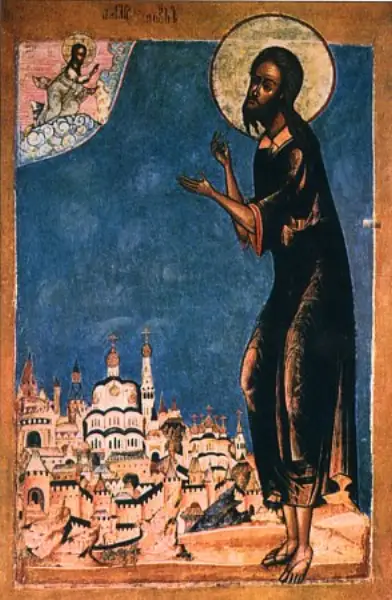
Overview
Alexius of Rome, the 'Man of God,' belongs to a legend told in Syriac and in Greek versions, that of a saint of the Christian East whose cult later took root at Rome. The Greek legend makes him the only son of Euphemianus, a wealthy Roman senator: married by arrangement, he left the bridal chamber to follow a life of poverty, and lived unrecognized as a beggar at Edessa in Syria — accepting alms even from servants sent from his own household to search for him — until a miraculous icon of the Mother of God singled him out. Fleeing that fame, he returned to Rome so altered in appearance that his own parents did not know him; they sheltered the unknown poor man, and for seventeen years he lived beneath their staircase, praying and teaching children the faith. Only after his death did a note on his body reveal who he had been. Behind the legend stands, most scholars agree, a real Edessene ascetic of the fifth century, remembered by Syriac tradition as a beggar saint revealed after death as a Roman by birth. Veneration reached Rome around the end of the tenth century; his feast, kept on 17 July in the West and 17 March in the East, was taken out of the General Roman Calendar in 1969 on account of the legendary character of the life.
The Complete Life
Two Versions of a Saint
The oldest strand of the Alexius tradition is Syriac, and it knows nothing of Rome's aristocracy. Under Bishop Rabbula of Edessa (412-435), it says, there lived in the city a beggar who shared his alms with others still poorer, and when he died he was found to have been a native of Rome. That is the whole of the historical kernel that most scholars allow: a real Edessene ascetic of the fifth century, a holy beggar whose hidden origin was revealed by death. The Greek legend that later swept the Christian world built on this foundation a romance of imperial scale: Alexius, only son of the senator Euphemianus, betrothed by his parents' arrangement, who left the wedding feast — or its eve — for the life of a pilgrim, and was found out at Edessa not by men but by an icon of the Mother of God that pointed him out as the Man of God.
The Flight and the Return
The Greek version then accomplishes its most famous turn. Fleeing the notoriety the miracle brought him at Edessa, Alexius set sail — and the ship carried him to Rome, the city of his birth. So changed was he by years of beggary that his own father and mother did not recognize the poor man at their gate; but as Christians they took him in. For seventeen years he lived as a dependent under his parents' roof, in a cubbyhole beneath the staircase, praying through the nights and, the legend adds, teaching catechism to the children of the house. The scene is one of the great images of hagiography: the heir eating the bread of charity from hands that had once rocked him, both parties unknown to each other, both known to God.
The Writing Found on His Body
The revelation came only at the end. When the beggar died, a paper was found on his body — by some accounts clutched in his hand — declaring who he was and describing the penance he had kept ever since his wedding day, all for love of God. The household, so the legend runs, was devastated; the city was consoled. The detail of the written revelation is what fixed the story in the Christian imagination: an identity voluntarily renounced for a lifetime, disclosed in a document that reads like a last will in reverse — not the distribution of a fortune but the confession of a poverty deliberately chosen and perfectly kept.
Cult and Calendar
Alexius was unknown in the West before the end of the tenth century; his name first appears in Latin liturgical books around that time. The cult took root through the Aventine: in 972 Pope Benedict VII gave the near-abandoned church of St Boniface to Sergius of Damascus, an exiled Greek metropolitan, who built a monastery beside it for Greek and Latin monks and added Alexius to the church's title — Santi Bonifacio e Alessio, which it still bears. Sergius and his monks are credited with bringing the veneration to Rome; the church was believed to stand on the site of the family house. The East keeps him on 17 March, the West on 17 July. In 1969 the revisers removed his feast from the General Roman Calendar, citing the legendary character of the life — though the Roman Martyrology retains his entry and local celebration remains possible. The Alexian Brothers, the nursing order, take their name from him.
Legacy
Few legendary saints have been so durable. The Vie de saint Alexis, an Old French poem of the mid-eleventh century in 125 five-line stanzas, stands among the foundation monuments of French literature — one of the earliest poems in any Romance language to use the ten-syllable line that became the decasyllable of the chansons de geste. Byzantine hymnody, Ethiopian and Syriac churches, and the iconography of the ladder-stair spread the story across the whole Christian world. Its power is not historical but thematic: the saint as incognito, holiness perfected precisely by remaining unknown, and the family that practices charity to a stranger who is its own flesh. Even the Church that removed his feast has never stopped telling the story.
Timeline
- 401
Died at Rome in the fifth century, by tradition after a hidden life of penance beneath his family's stairs
§ Introduction
- 412
Syriac legend sets a beggarly 'Man of God' at Edessa under Bishop Rabbula, found after death to be a Roman
§ Syriac version
- 972
Pope Benedict VII hands the Aventine church of St Boniface to Sergius of Damascus, who adds Alexius as titular saint
§ Veneration
- 1000
Only from about the close of the tenth century does his name start appearing in Western liturgical books
§ Veneration
- 1050
The Old French poem la Vie de saint Alexis is composed in the early or mid-eleventh century
§ French version
- 1398
Emperor Manuel II Palaiologos donates the saint's skull to the monastery of Agia Lavra near Kalavryta
§ Relics
- 1969
His feast is dropped from the General Roman Calendar owing to the legendary character of his written life
§ Veneration
The Record
- Patron of
- Alexians·Beggars·Belt makers·Nurses·Pilgrims·Travelers
- Symbols
- Ladder (the stair beneath which he lived)·Pilgrim's staff·Letter revealing his identity
- Canonization
- Pre-congregation; feast removed from the General Roman Calendar in 1969
Prayer
Profile text adapted from the Wikipedia article, licensed CC BY-SA 4.0.
Pray with this saint every day
Save St. Alexius of Rome to your favorites, read the full profile, and get feast-day reminders in the Saints app.
Get the Saints AppFree on the App Store for iPhone and iPad