
930-1050·Feast April 12 (with the first abbots of Cava)
St. Alferius
Abbot and Founder of the Cava Congregation
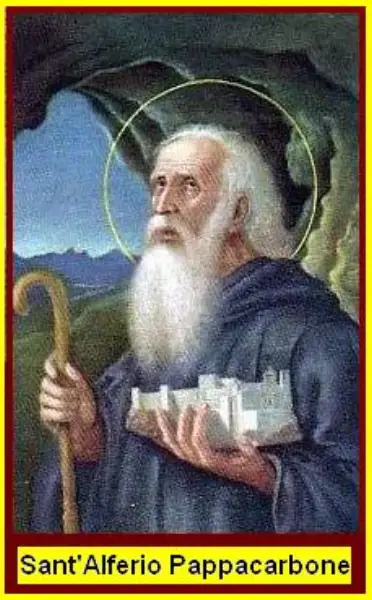
Overview
Alferius, born in 930 at Salerno to the noble Pappacarbona family, was an Italian abbot and the founder of the Benedictine abbey of La Trinità della Cava. He spent many years serving Guaimar, prince of Salerno, and in 1002 was chosen to lead a delegation from his city to King Robert II of France. The journey brought a grave illness upon him, and he convalesced at the monastery of San Michele della Chiusa, where he met Odilo of Cluny and promised to become a monk should he regain his health. He kept the vow, spending time at Cluny itself before returning to Salerno. Around 1011, longing for solitude, he retired to a grotto on the slopes of Monte Finestra southwest of Cava, giving his days to contemplation and prayer. His reputation for holiness drew a nucleus of hermit monks to his side, and there he brought into being the monastery of La Trinità della Cava, living under the Benedictine rule, which became one of the great monastic centers of southern Italy. He governed it until his death in 1050, at a reputed age of 120 years. He was canonized with the first four abbots of Cava by Pope Leo XIII on 21 December 1893.
The Complete Life
Early Life
Alferius was born in 930 at Salerno, the Lombard principality's capital on the Tyrrhenian coast, into the noble Pappacarbona family. His was the world of the tenth-century south: a princely court with Byzantine and Muslim neighbors, a church rebuilding after the darkest decades of the era, and an aristocracy whose sons moved between arms, administration and the cloister. Alferius took the courtly road, serving for many years Prince Guaimar of Salerno in capacities that evidently included diplomacy, for in 1002 he was chosen to head his city's delegation to King Robert II of France, a mission of real weight, sent to treat with the Capetian king across the Alps. The traditional chronology makes him already past seventy at that date, and his death in 1050 past 120, figures the sober historian must report with reserve; what the numbers preserve is the tradition's sense of a life stretching across the whole transition of the south from the age of disorder to the age of reform.
§ Life
Vocation
The vow that changed his life was made in illness. Traveling north on the embassy, Alferius fell so gravely ill that he was left to convalesce at the monastery of San Michele della Chiusa, the great pilgrimage abbey above the Alps in the valley of Susa. There he met Odilo, the abbot of Cluny, the most influential churchman of the age, and the encounter, joined to his danger of death, brought him to promise God the monastic habit if he recovered. He did, and he kept the promise with a thoroughness his court had not expected: he went to Cluny itself and lived as a monk under Odilo, at the very fountainhead of the reform then remaking the monastic world. When he returned to Salerno, it was as a man changed; the prince had lost his diplomat, and after a time Alferius withdrew altogether, seeking at Monte Finestra, southwest of Cava, a grotto in which to live for God alone. The hermits of the Latin tradition had always begun in exactly this way, and Cava's history began in the same pattern.
§ Life
Foundation of Cava
The hermit did not stay alone. Around 1011 a nucleus of hermit monks, drawn by his reputation for saintliness, gathered to Alferius at his grotto, and out of that company arose the abbey of La Trinità della Cava — the Holy Trinity of Cava — living under the rule of St. Benedict. The site, in the gorge below Monte Finestra, grew into one of the great abbeys of the Mezzogiorno: endowed by the princes of Salerno, linked by its Cluniac pedigree to the reform movement of the age, and served by a dynasty of holy abbots. Alferius governed the house as its first abbot until his death in 1050, when he was succeeded by Leo I, the second of the four canonized abbots, followed by Peter of Pappacarbone and Constabilis. The continuity of sanctity across the first four abbots, founders in succession, gave Cava its peculiar spiritual signature and its later title to canonization en bloc.
§ Life
Canonization
The formal recognition of Alferius' sanctity came in a single act that honored the whole foundation: on 21 December 1893 Pope Leo XIII canonized the first four abbots of Cava together, Alferius, Leo I, Peter of Pappacarbone and Constabilis, confirming the cult that the abbey and the church of southern Italy had kept for eight centuries. The collective canonization was a considered statement: the church was declaring not merely four holy men but a holy institution, whose founding generation had been given, as it were, corporately. The relics of the four are honored at the Badia di Cava, the abbey that still functions in its valley above Cava de' Tirreni, and their joint feast binds the community's memory to its origins. For Leo XIII, whose reign saw many confirmations of ancient Italian cults, the abbots of Cava were an emblem of the Benedictine contribution to the civilization of the south.
§ Veneration
Legacy
Alferius' legacy is the abbey he founded, which for nine hundred years has continued on its site and today houses a living monastic community, a famous library of medieval manuscripts, and the memory of the whole Cluniac reform in the south. La Trinità della Cava became the mother house of a congregation of dependencies across southern Italy and one of the great landowners and cultural centers of the Mezzogiorno; its archive is a principal source for the medieval history of the kingdom. The pattern of Alferius' life, courtier, pilgrim, Cluniac, hermit, founder, became the model of the reforming abbot in the eleventh century, and the tradition of holy abbots he began, four canonized in succession, gave the Benedictine order one of its most luminous dynasties. Pilgrims still visit his grotto above the abbey, the quiet beginning from which all the rest grew.
§ Life
Timeline
- 930
Born at Salerno into the noble Pappacarbona family
§ Introduction
- 1002
Heads Salerno's delegation to King Robert II of France, falls ill, and vows to become a monk while convalescing at San Michele della Chiusa
§ Life
- 1011
Founds the Benedictine monastery of La Trinità della Cava
§ Life
- 1020
Withdraws to live in contemplation at the foot of Monte Finestra southwest of Cava, drawing hermit disciples to him
§ Life
- 12 Apr 1050
Dies aged a reputed 119 or 120
§ Introduction
- 21 Dec 1893
Pope Leo XIII confirms his cult with that of the first four abbots of Cava
§ Veneration
The Record
- Patron of
- The Badia di Cava·Monastic founders of southern Italy
- Symbols
- Hermit's grotto·Benedictine habit
- Canonization
- Canonized 21 December 1893 by Pope Leo XIII, with the first four abbots of Cava
Prayer
Bibliography
Show 5 sources
- ↑ Holweck, Frederick George. A Biographical Dictionary of the Saints , B. Herder, 1924, p. 50
- ↑ "Alferius", The Cyclopedia of Biblical, Theological, and Ecclesiastical Literature . (James Strong and John McClintock, eds.); Harper and Brothers; NY; 1880 This article incorporates text from this source, which is in the public domain .
- ↑ Oldfield, Paul. Sanctity and Pilgrimage in Medieval Southern Italy, 1000–1200 Cambridge University Press, 2014. p. 85 ISBN 9781139915793
- ↑ Monks of Ramsgate. "Alferius". Book of Saints , 1921. CatholicSaints.Info. 27 May 2012 This article incorporates text from this source, which is in the public domain .
- ↑ San Constabile (Costabile)
Profile text adapted from the Wikipedia article, licensed CC BY-SA 4.0.
Pray with this saint every day
Save St. Alferius to your favorites, read the full profile, and get feast-day reminders in the Saints app.
Get the Saints AppFree on the App Store for iPhone and iPad