
1598-1628·Feast November 15
St. Alfonso Rodríguez Olmedo
Jesuit Priest, Missionary, and Martyr
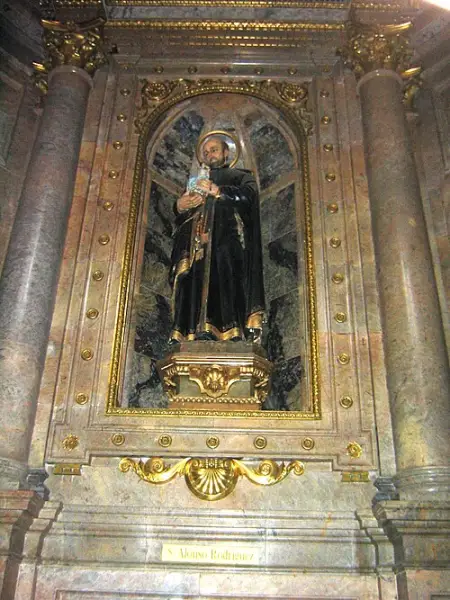
Overview
Alfonso Rodríguez Olmedo was born at Zamora in Spain on 10 March 1598 and made his Jesuit novitiate at Villagarcía de Campos near Valladolid before sailing from Lisbon with the expedition of Father Juan de Viana for the South American missions. In 1626 his superiors sent him to the Guaycuru missions facing Asunción across the Paraguay river, where he was the first of the missionaries to master the local tongue, preaching among the people and working to secure decent living conditions for them. Two years later he moved on to the Guaraní missions of the Paraná and then Itaipú, and was appointed to accompany Roque González de Santa Cruz in founding Todos los Santos de Caaró on the river's east bank. The chieftain Ñezú of Igní, a sorcerer set against the project, ordered the missionaries killed. On 15 November 1628, as the people gathered in the plaza to watch a bell installed, González was struck down in the confusion; Rodríguez, hearing the noise, came out of the church and was himself beaten to death with a stone mallet called an itaizá, and the two bodies were dragged into the church and burned together with its paintings and images. Juan de Castillo met the same fate two days later. A Jesuit classmate of all three, Juan Eusebio Nieremberg, wrote their lives in 1644.
The Complete Life
Early Life
Alfonso Rodríguez Olmedo was born in the city of Zamora, in the Crown of Castile, on 10 March 1598, the son of a Spain still swelling with missionary enterprise a generation after the Jesuits first sailed for the Americas. Of his family and childhood the surviving record says little; what it does record is the turn his life took as a young man, when he sought admission to the Society of Jesus. He was thirty when he died, and he made his novitiate at Villagarcía de Campos near Valladolid, one of the order's houses in Castile, where the formation of those years — prayer, study, discipline and obedience — prepared him for work his superiors already had in view. It was clear early that he was destined not for a Spanish pulpit but for the reductions of South America, and before his studies were complete he had been assigned to the Paraguay missions.
Conversion and Vocation
Rodríguez's vocation was of the straightforward kind: a Castilian youth who entered the Society and never looked back. The decisive step was the acceptance of the missions. Sailing from Lisbon with an expedition that Father Juan de Viana led, he crossed the Atlantic and pushed inland to the Jesuit province of Paraguay, then the most remote and most ambitious of the order's undertakings. The journey itself, months of ocean and river and forest, was a kind of second novitiate, and it ended in a country where the Gospel had to be learned again in Guarani before it could be preached. His willingness to go where the order needed him, and to stay there until death, is the whole of what can be said about his inner road; the sources preserve deeds rather than doubts. What they do not record is any hesitation, and the little that survives suggests a man entirely given to the work in hand.
Mission and Ministry
In 1626 Rodríguez was sent to the Guaycuru missions, which stood opposite Asunción on the far bank of the Paraguay River. The Guaycuru were a warlike people whose language no missionary had yet mastered, and Rodríguez became the first to learn it, a fact his biographers treat as his particular glory. His work there was twofold: to preach the faith, and to secure for the indigenous people conditions of life that were decent by any measure — protection from enslavement and from the brutalities of the colonial labour system. Two years later he was transferred to the older Guaraní missions on the Paraná, and then to Itaipú, learning a second mission country. His superiors then appointed him to accompany the experienced Roque González y de Santa Cruz the founding of a new town, Todos los Santos de Caaró, on the Uruguay's eastern bank — the founding of a reduction being as much an act of civil organisation as of evangelisation.
Trial and Final Years
The new settlement at Caaró had enemies. But Ñezú — sorcerer and chieftain at Igní — set himself against the project and gave orders for the missionaries' deaths. On 15 November 1628, while the community was gathered in the plaza for the installation of the church bell, armed men appeared suddenly in the confusion. Roque González was struck on the head where he stood; hearing the noise, Rodríguez came out of the church and was beaten to death with a stone mallet the Guaraní called an itaizá. The bodies of both men were dragged into the church and burned together with the paintings and sacred images. A few days later, on 17 November, their companion Juan de Castillo was assassinated in the same cause at another mission. The three Jesuits had worked side by side for months; their deaths, within days of each other and in the same cause, made them one cause from the beginning.
Canonization
News of the three martyrs reached Rome slowly, and their cause slower still. Rodríguez was beatified by Pius XI on 28 January 1934, together with Roque González and Juan de Castillo, his companions in the Guaraní missions. More than fifty years later, on 16 May 1988, Pope John Paul II canonised the three in Asunción, Paraguay — the first canonisation ceremony held in the Americas outside Rome's usual practice in that region, and a deliberate honouring of the Guaraní church they had served. For Paraguay, Argentina and Brazil the three are the founding martyrs of the reductions. Juan Eusebio Nieremberg, who had been a classmate of all three in Spain, wrote their biographies as early as 1644, preserving the earliest narrative of their deaths and of the missions that produced them. His cult is kept with those of his companions, whose shared feast honours the founding generation of the Paraguay reductions.
Timeline
- 10 Mar 1598
Born at Zamora in the Crown of Castile
§ Life
- 1626
Sent to the Guaycuru missions across the Paraguay River from Asunción; first missionary to learn the local language
§ Life
- 1628
Transferred to the Guaraní missions at Paraná and Itaipú, then named to help Roque González found Todos los Santos de Caaró
§ Life
- 15 Nov 1628
Beaten to death with a stone mallet at Todos los Santos de Caaró during an attack ordered by the chieftain Ñezú
§ Life
- 1644
Juan Eusebio Nieremberg, a classmate of the three martyrs, writes their biographies
§ Life
- 28 Jan 1934
Beatified by Pope Pius XI together with Roque González and Juan de Castillo
§ Veneration
- 16 May 1988
Canonized by Pope John Paul II at Asunción, Paraguay, with his two companion martyrs
§ Veneration
The Record
- Symbols
- Jesuit cassock·The stone mallet (itaizá) of his martyrdom·Mission bell
- Canonization
- Beatified at Rome by Pius XI, 28 January 1934; canonized by Pope John Paul II on 16 May 1988 at Asunción, Paraguay, with Roque González and Juan de Castillo
Prayer
Bibliography
Show 2 sources
Profile text adapted from the Wikipedia article, licensed CC BY-SA 4.0.
Pray with this saint every day
Save St. Alfonso Rodríguez Olmedo to your favorites, read the full profile, and get feast-day reminders in the Saints app.
Get the Saints AppFree on the App Store for iPhone and iPad