
c. 1220-1250·Feast June 15
St. Alice of Schaerbeek
Cistercian Lay Sister, Victim of Leprosy
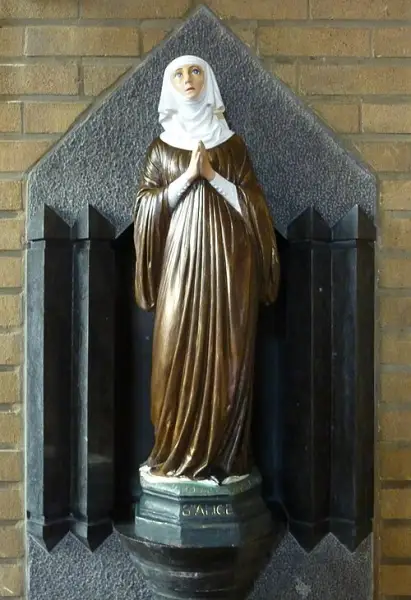
Overview
Alice of Schaerbeek — also Adelaide or Aleydis, and known as Alice the Leper — was a Cistercian lay sister of La Cambre Abbey near Brussels, venerated as patroness of the blind and the paralyzed. Born at Schaerbeek around 1220, a sickly little girl, she was sent away at seven years old to board and receive her schooling at La Cambre — the Camera Sanctae Mariae, the Chamber of Our Lady — where she remained the rest of her life. Pretty, endearing, and quick-minded, and filled with love of God, she went on to become one of the abbey's lay sisters. Around 1240, when she was about twenty, she caught leprosy and was forced to live shut off in a small hut. Her illness brought her terrible pain, and this anguish she offered up for sinners and for the souls being purified in purgatory; in the end paralysis and blindness overtook her. Her chief consolation lay in receiving the Eucharist, yet she was forbidden the chalice, since it was feared she might contaminate its contents; the Lord, it is said, came to her in a vision and assured her that He was present in the consecrated bread and in the wine alike. She died in 1250, aged about thirty. Her life is known from a Latin biography composed between about 1260 and 1275, probably by an anonymous chaplain of La Cambre, though Martinus Cawley proposed Arnulf II of Ghistelles, abbot of Villers, as author. Thomas Merton described the vita as a practical, concise treatise on Cistercian asceticism.
The Complete Life
A Child of La Cambre
Alice was born at Schaerbeek, the village now a district of Brussels, then in the Duchy of Brabant, about 1220. She was a sickly little girl, and when she was seven her parents placed her to board and be schooled at the Cistercian abbey of La Cambre — the Camera Sanctae Mariae, the Chamber of Our Lady — at the edge of the Sonian forest, whose name survives today in the Bois de la Cambre. The Brabant of Alice's childhood was the heartland of the new women's religious movement of the thirteenth century: within a few miles stood the houses and haunted the memories of the beguines of Brussels, of Lutgard of Aywières, of Ida of Nivelles, of Christina the Astonishing — a landscape in which women's sanctity was a visible local fact. Alice never left. She grew up pretty, lovable, and intelligent, with a deep love for God, and in due course became a lay sister of the abbey, the rank of the women who did the house's work rather than its chanting.
The Hut
At about twenty, around 1240, Alice contracted leprosy, and the community did what the thirteenth century did: she was shut away in a hut of her own. The leper's hut was both sentence and cell — expulsion from the common life, and a rule of solitude harder than any cloister, since the solitary was cut off not by choice but by fear. The vita records that Alice transformed the sentence into an offering: her illness inflicted cruel anguish on her, anguish she offered up for sinners and for the souls undergoing purification in purgatory. As it progressed she became paralyzed and blind, so that the enclosure contracted to a bed. The one exemption the sources dwell on was the Eucharist: she was forbidden the chalice, since it was feared she might contaminate its contents; the Lord, it is said, came to her in a vision and assured her that He was present in the consecrated bread and in the wine alike — the whole Christ in the half she could receive.
A Treatise of Cistercian Asceticism
The spirituality the vita teaches is that of suffering made apostolic. Alice's pain was not described as merely endured; it was assigned work — for sinners, for the dead in purgatory — in the economy of the Cistercian theology of vicarious suffering that the order's vitae of women elaborated across the thirteenth century. Thomas Merton, writing in 1954, judged the Life of Alice to be a practical, concise treatise on Cistercian ascetic practice, one of the texts in which the tradition's teaching on humility, patience, and the imitation of Christ's passion is worked out in an actual biography rather than a treatise. Modern scholarship has placed the vita in the Holy Women of Liège corpus of thirteenth-century Latin biographies, alongside Marie of Oignies, Christina the Astonishing, and the Idas — the literary flowering of the beguine and Cistercian women's movement, in which Alice, enclosed from childhood, is the monastic representative. Her paralysis and blindness, which the vita narrates without embellishment, gave the treatise its authority: this was a life, not a hypothetical case.
Death and Cult
Alice died in 1250, aged about thirty, having spent her last decade in the hut, paralyzed and blind. Her biography was composed between roughly 1260 and 1275, within living memory, by an author the scholars have not certainly named — traditionally an anonymous chaplain of La Cambre, with Martinus Cawley proposing Arnulf II of Ghistelles, abbot of Villers 1270-1276. Five manuscripts survive, four in Latin and one in Middle Dutch, including copies bound with the lives of Christina the Astonishing and Ida of Nivelles and the digitized Vienna codex with its constellation of Cistercian women's vitae. The critical text was printed in the Acta Sanctorum in 1688 and translated into English by Cawley in 2000. The five surviving manuscripts — four Latin and one Middle Dutch — bind her memory with the other holy women of the Brabantine and Liégeois corpus. The vita's date range, 1260 to 1275, places it within the memory of the sisters who had known her, which is the strongest guarantee of its outline.
Cultus Confirmed
Alice's cult was local and late-formalized, as the Brabant saints' cults usually were. On 1 July 1702, Pope Clement XI by decree gave the monks of the Congregation of St. Bernard Fuliensis the faculty to celebrate her cultus; Rome's confirmation of Alice's cult came in 1907 from Pope Pius X. She was never famous — Chrysogone Waddell, reflecting on his own entrance into the Cistercian life in the 1950s, observed that even in devout Cistercian communities of that era she was hardly known at all — and yet her vita kept a readership, and the modern studies of Cistercian women, of medieval leprosy, and of the theology of redemptive suffering have all found her. Her feast is 15 June, and the church of Sainte-Alice in her native Schaerbeek keeps her name in the Brussels streets. The critical text printed in the Acta Sanctorum in 1688 and Cawley's English version of 2000 carried the vita to the modern readers who found her again.
Timeline
- 1220
Born at Schaerbeek near Brussels, in the Duchy of Brabant, a frail child
§ Life
- 1227
Leaves home as a seven-year-old child to live and study at Cistercian La Cambre Abbey, remaining there for life
§ Life
- 1240
Contracts leprosy at about twenty years of age and is isolated in a small hut
§ Life
- 11 Jun 1250
Dies at La Cambre Abbey at about thirty, after paralysis and blindness, offering her sufferings for sinners
§ Life
- 1260
A Latin biography of Alice is composed, probably by a chaplain of La Cambre Abbey
§ Life
- 1 Jul 1702
Pope Clement XI grants the Congregation of St. Bernard Fuliensi the faculty to celebrate her cultus
§ Life
- 1907
Pope Pius X approves devotion to Alice as a saint
§ Life
The Record
- Patron of
- The blind·The paralyzed·Leprosy patients and the isolated sick
- Symbols
- Cistercian lay sister's habit·The Eucharistic host
- Canonization
- Cultus confirmed in 1907 by Pope Pius X (devotion approved); earlier faculty granted to the Fuliensis monks by Clement XI in 1702
Prayer
Profile text adapted from the Wikipedia article, licensed CC BY-SA 4.0.
Pray with this saint every day
Save St. Alice of Schaerbeek to your favorites, read the full profile, and get feast-day reminders in the Saints app.
Get the Saints AppFree on the App Store for iPhone and iPad