
died c. 800·Feast March 28
St. Alkelda
Anglo-Saxon Princess and Martyr of Middleham
Overview
Alkelda — her name also appears as Alcelda or Alchhild — was a princess in Anglo-Saxon England about whom nearly everything is uncertain, down to whether she ever lived. Tradition makes her a princess, probably a nun and perhaps the abbess of a Middleham monastery in Yorkshire; during the Danish raids of around 800, pagan Viking women are said to have strangled her. She is the patron of the church at Giggleswick and of St Alkelda's at Middleham, which has a holy well, and of no other churches. No documentary reference to her appears until the late Middle Ages, and scholars have surmised that her name is a corruption of the Old English haligkelda, holy spring — though this is contested, and one theory would make her name Icelandic, from Ölkelda, her reputation carried to Yorkshire by Vikings. Her feast is 28 March. In 1389 the crown licensed Middleham's lord to keep a weekly market along with an annual fair on her feast day.
The Complete Life
The Legend
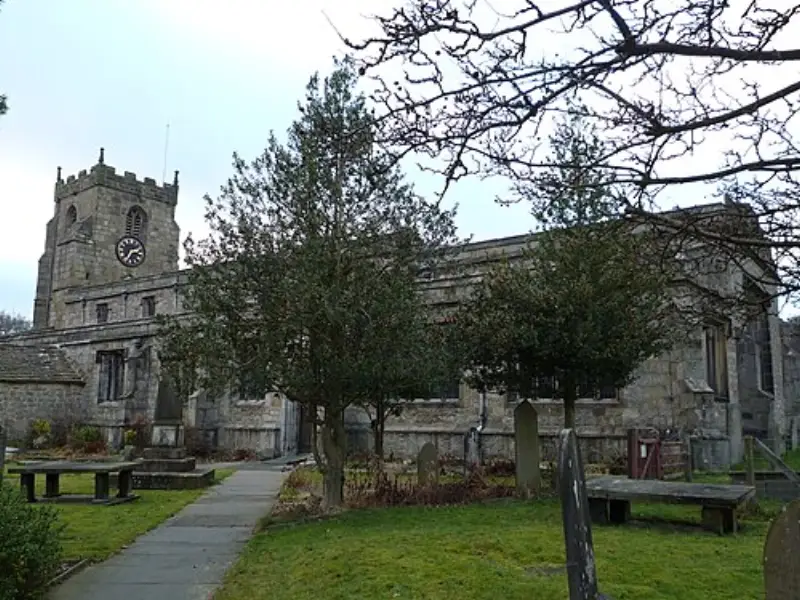
The received story of Alkelda is brief: a princess of Anglo-Saxon England, probably a nun, possibly the abbess of a religious house at Middleham in Wensleydale, she was murdered during the Danish raids of about 800 — strangled, the legend specifies, by pagan Viking women, perhaps because she was herself a noblewoman who refused apostasy or marriage. The detail of female executioners is unusual and may preserve a genuine memory of a raid in which women of the settlement were killed. Nothing else survives: no genealogy, no house record, no early calendar entry. John Blair's handlist of Anglo-Saxon saints classes her among the doubtful. The cult attaches to exactly two churches, St Alkelda's in Giggleswick and the church of Saints Mary and Alkelda at Middleham, and the Middleham church possesses the holy well that gives, or takes, her name.
Holy Wells and Names
With no documentary reference before the late Middle Ages, the origin of Alkelda has been debated for centuries. The simplest theory is linguistic: her Old English name would be Haelcelde, 'healing spring', and the Yorkshire Dales are famous for springs, several of them very near her two churches, so that a well called haligkelda — holy spring — could have been personified into a saint. Against this it has been argued that well-saints usually keep their well's name only; Alkelda's legend is too specific for that. An alternative suggestion derives the name from the Icelandic Olkelda, meaning ale-well or holy well in Old Norse, and would make her an Icelandic woman whose reputation travelled with the Vikings to Yorkshire, a strange origin for a victim of Viking women, but consistent with the mixed world of the ninth-century Dales. No theory commands assent.
Cult
Whatever her origin, Alkelda's cult was real enough in medieval Wensleydale. In 1389 the crown licensed Middleham's lord to keep a weekly market along with an annual fair on the feast of St Alkelda, 28 March — commercial proof of a festival, and of the crowds it drew. The church at Middleham, rebuilt in the fifteenth century by Richard of Gloucester's family, was dedicated to Saints Mary and Alkelda and kept her well; Giggleswick's church, picturesquely set below the Nab, shares the dedication alone. Her day continued to be kept locally after the Reformation, as such northern cults tended to be. The Roman Martyrology does not carry her, and her standing is that of a local pre-congregation saint of the Church of England's inheritance as much as Rome's.
Legacy
Alkelda's modern legacy is the landscape itself. St Alkelda's Way, a self-guided pilgrimage of thirty-three miles, links Giggleswick with Middleham by way of the Yorkshire Dales National Park, and passes the remains of Coverham Abbey — a route promoted by the British Pilgrimage Trust that has given the dubious saint a new congregation of walkers. Her well at Middleham and her two churches anchor the identity of their towns, and her story is retold in every local history of the Dales. She illustrates a whole class of medieval devotion: the instinct to give a name and a story to the holy in the landscape. This profile is marked thin_source, and reports honestly that her existence is questioned; whether princess, abbess, well-goddess or Icelandic memory, she has been prayed to at Middleham for over a thousand years.
Timeline
- 28 Mar 800
According to legend, strangled by pagan Viking women in a Danish raid on Middleham; her feast keeps this date
§ Introduction
- 1389
Middleham's lord obtains a royal licence for a weekly market and an annual fair kept on her feast
§ Alternative origins
The Record
- Patron of
- Middleham and Giggleswick, Yorkshire·Holy wells
- Symbols
- Royal robes·Cord or veil (emblem of her strangling)·Holy spring
- Canonization
- Pre-congregation; local cult at Middleham and Giggleswick
Prayer
Profile text adapted from the Wikipedia article, licensed CC BY-SA 4.0.
Pray with this saint every day
Save St. Alkelda to your favorites, read the full profile, and get feast-day reminders in the Saints app.
Get the Saints AppFree on the App Store for iPhone and iPad