
c. 770 – c. 800·Feast March 19 (March 20 in the Diocese of Nottingham)
St. Alkmund of Derby
Prince of Northumbria, Martyred King
Overview
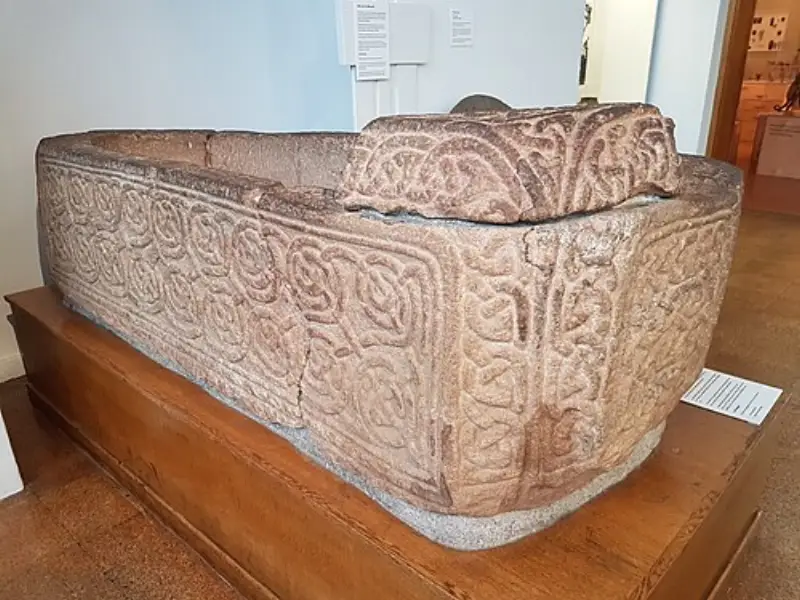
Alkmund of Derby, also of Lilleshall, his name variously spelled Ealhmund, Alhmund, Alcmund, or Alchmund, was born about 770, a son of Alhred of Northumbria, and was caught from childhood in the dynastic struggles that made and unmade Northumbrian kings. He passed over twenty years of exile among the Picts before coming back with an army to claim his inheritance; as king he acquired a reputation for charity to the poor and the orphaned. He was killed about the year 800, and King Eardwulf of Northumbria was held responsible for his death; whatever the exact circumstances, Northumbrians and Mercians alike received Alkmund's death as a martyr's and honoured him as a saint. His first burial was in Shropshire; later his remains were translated to Northworthy, modern Derby, out of reach of Viking raids; miracles were reported at his tomb, and in the early tenth century Æthelflæd, Lady of the Mercians, had his remains translated to Shrewsbury. When the Shrewsbury church passed to Lilleshall Abbey around 1145, his body returned to Derby, where the sarcophagus was recovered from the demolished St Alkmund's Church in 1968 and now rests in the Derby Museum and Art Gallery. Six English churches are dedicated to him.
The Complete Life
A Prince of Northumbria
Alkmund was born about 770 into the most turbulent royal house in Anglo-Saxon England. His father, Alhred, had himself taken and lost the Northumbrian throne, and the kingdom's politics in these decades ran by deposition, exile, and return; the genealogies of its kings read like a casualty list. When Alkmund's family fell, the prince, still a child, went into exile among the Picts, the people of northern Britain with whom the Northumbrian royal line had old ties of marriage and refuge, and there he grew up and waited. The wait lasted more than twenty years, the whole of his young manhood spent in a foreign court with a borrowed future. When at last the throne of his fathers stood open, he returned with an army, the standard method of the Northumbrian succession, and reigned as king in the closing years of the eighth century. The tradition remembers the reign not for its wars but for its charity: the king acquired a reputation for being generous to the poor and to orphans, the classic virtues of a Christian ruler in an age that judged kings by their almsgiving.
§ References
Death and Translation
Alkmund was killed about the year 800, and his death, in the manner of the Northumbrian succession, was political: King Eardwulf, who benefited by it, was held responsible, and the holding was durable. What turned a dynastic murder into a martyrdom was the people's judgment; whatever the exact circumstances, the tradition states plainly, Alkmund's death was accepted as a martyrdom and he was honoured as a saint, and a cult grew at his tomb. He was buried first in Shropshire, at a site whose church became Lilleshall's; the body was moved, against the Viking raids of the ninth century, to Northworthy, the place the Danes called Derby, and buried in the minster beside the Derwent. Signs and wonders were reported at the grave. In the early tenth century Æthelflæd, Lady of the Mercians, the daughter of Alfred who rebuilt the English towns, translated the remains to Shrewsbury as part of her policy of gathering relics into defended centers; and when the Shrewsbury church passed into the hands of Lilleshall Abbey around 1145, the body went back to Derby, completing a circuit of the Midlands that traced the movements of the Danish wars.
§ History
The Sarcophagus and the Churches
The material memory of Alkmund is unusually rich for a saint of his obscurity. When St Alkmund's Church in Derby was demolished in 1968, the excavation revealed traces of several earlier churches stretching back to the ninth century, the succession of buildings raised over the tomb, and among the finds was a stone sarcophagus, believed to be the saint's, now displayed in the Derby Museum and Art Gallery with the carved cross-shaft from the same site. Six English churches are dedicated to him, at Derby itself, where a new St Alkmund's replaced the old, at Duffield in Derbyshire, at Shrewsbury and Whitchurch in Shropshire, at Aymestrey in Herefordshire, and at Blyborough in Lincolnshire, a map of the medieval cult. His feast is 19 March, kept in the Diocese of Nottingham as a commemoration on the 20th, since the solemnity of Saint Joseph claims the 19th; the arrangement is a fair emblem of his whole history, a royal martyr of the eighth century accommodated, without resentment, into the church's later calendar.
§ History
Timeline
- 770
Born around this year, a son of Alhred of Northumbria, caught up in the kingdom's dynastic struggles
§ Introduction
- 800
Killed after returning from more than twenty years of exile among the Picts; King Eardwulf is held responsible
§ History
- 800
His death is regarded as a martyrdom and he is honoured as a saint; he is first buried in Shropshire
§ History
- 900
His remains are moved to Shrewsbury in the early tenth century, likely at the instigation of Æthelflæd of Mercia
§ History
- 1145
When St Alkmund's, Shrewsbury passes to Lilleshall Abbey, his body is translated back to Derby
§ History
- 1968
Demolition of St Alkmund's Church, Derby reveals earlier churches and the stone sarcophagus now in Derby Museum
§ History
The Record
- Patron of
- Derby, England·Orphans and the poor
- Symbols
- Royal robes and crown·Sarcophagus·Sword
- Canonization
- Pre-congregation (ancient cult; death regarded as martyrdom)
Prayer
Bibliography
Show 8 sources
- ↑ "St Alkmund: Patron Saint of Derby", BBC - Faith, September 4, 2014
- ↑ "Ealhmund of Derby, son of Alhred", Saints in Scottish Place-Names
- ↑ Signage at Derby Museum notes that he was recorded in the 9th century as being a saint buried in the Minster beside the Derwent at a place called Northworthy – whose Viking name is Derby .
- ↑ The museum's exhibit label says "Part of 9th-century Anglo Saxon stone cross which once stood at St. Alkmund's church, Derby. This stone was found when St Alkmund's church was rebuilt in 1844. The cross was originally about 4 metres tall.
- ↑ Meijns, Brigitte (2010). "The Policy on Relic Translations of Baldwin II of Flanders (879–918), Edward of Wessex (899–924), and Æthelflæd of Mercia (d.924): A Key to Anglo-Flemish Relations". In Rollason, David; Leyser, Conrad; Williams,
- 1 2 Saint Alkmund, His Life, Murder and Cults , Derek & Marion Taulbut, 1998
- ↑ Sarah Allard, Nicola Rippon (2003). Goodey's Derby (Paintings and Drawing in the Collection of Derby Museum & Art Gallery) p.134 . Breedon Books Publishing Co Ltd. ISBN 978-1-85983-379-7 .
- ↑ "Nottingham Diocesan Ordo 2023-2024" (PDF) . Diocese of Nottingham . 30 May 2024.
Profile text adapted from the Wikipedia article, licensed CC BY-SA 4.0.
Pray with this saint every day
Save St. Alkmund of Derby to your favorites, read the full profile, and get feast-day reminders in the Saints app.
Get the Saints AppFree on the App Store for iPhone and iPad