
1568-1591·Feast June 21
St. Aloysius Gonzaga
Jesuit Seminarian and Patron of Youth
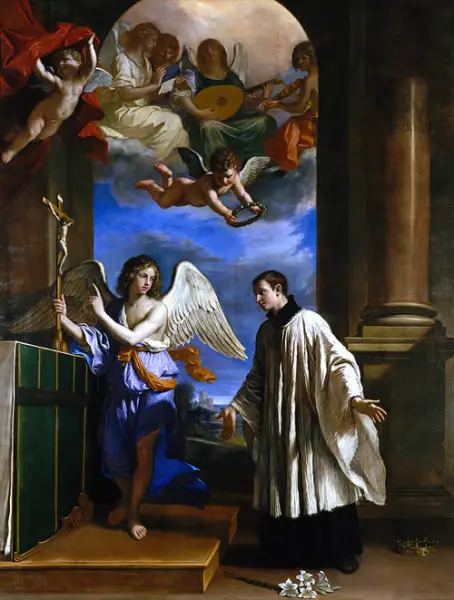
Overview
Luigi Gonzaga, known in religion as Aloysius, was born on 9 March 1568, eldest son of the Marquess of Castiglione delle Stiviere and heir to a cadet branch of the great Gonzaga house. His father drilled him for a soldier's life from the age of four, marching him through military camps, while the boy's piety grew in the opposite direction. Sent to the Medici court in Florence at eight, he suffered kidney disease that lingered for life and used his convalescence to read the lives of the saints. A book on the Jesuit missions in India fixed his vocation, and in 1580 Cardinal Charles Borromeo gave him his First Communion. Four years of family resistance — his father furious, relatives offering to arrange him a bishopric — ended when he renounced his inheritance, and on 25 November 1585 he entered the Society of Jesus in Rome. As a novice he was told to soften his severe penances and be more sociable. When plague struck Rome in 1591 he begged alms and carried the dying from the streets to the Jesuit hospital, washing and feeding them while conquering, as he admitted to Robert Bellarmine, his physical revulsion. Forbidden the hospital yet persistent, he was infected while serving at another house, took to bed on 3 March, and died at twenty-three just before midnight on 21 June 1591.
The Complete Life
Early Life
Luigi Gonzaga — Aloysius, in the Latin form — entered the world on 9 March 1568 in the castle his family held at Castiglione delle Stiviere, between Brescia and Mantua in Italy's north, the oldest son of the Marquess of Castiglione and an heir to a minor, cadet branch of the great Gonzaga house. His father, a soldier through and through, drilled him for a soldier's life from the age of four, taking him on review of the troops and marching him through military camps; the boy's piety grew in exactly the opposite direction. Sent to the Medici court in Florence at eight, he suffered kidney disease that lingered for life, and used his convalescence to read the lives of the saints. A book on the Jesuit missions in India fixed his vocation while he was still a boy; in 1580 Cardinal Charles Borromeo, visiting the marchese's family, gave him his First Communion.
§ Early life
The Renunciation
Four years of family resistance followed the boy's declared intention to become a Jesuit: his father was furious, relatives offered to arrange him a bishopric — a career more splendid and less total — and the negotiations went on until the father yielded. Aloysius renounced his inheritance in favor of his younger brother, and on 25 November 1585 he entered the Society of Jesus in Rome, the heir of a marquisate become a novice. He professed vows of chastity, poverty and obedience in 1587. As a novice and scholastic he was a problem to his directors: his penances were so severe — scourging, fasting, and a lifelong refusal to look anyone in the face, in his effort against temptation — that he was told to soften them, eat better, and be more sociable. He said of himself that he was a piece of twisted iron, and had entered religion to be twisted straight.
§ Religious life
The Plague and His Death
When plague struck Rome in 1591, the Jesuits opened a hospital for the infectious, and Aloysius volunteered: he begged alms for the patients and carried the dying from the streets to the hospital, washing and feeding them. He admitted to Robert Bellarmine, his confessor, that he had to conquer horror and nausea in the work, and there is no reason to doubt him — the plague hospital was his particular battle. He caught the disease in March 1591 and lingered for months, the illness aggravating his old kidney trouble. He died on 21 June 1591, the Octave of Corpus Christi, aged twenty-three, having predicted the day. Bellarmine testified to his holiness at the cause.
§ Religious life
Canonization
Beatification came to Aloysius from Pope Paul V on 19 October 1605 — a mere fourteen years past his death — and Pope Benedict XIII canonized him on 31 December 1726, together with the Jesuit novice Stanislaus Kostka — the two young Jesuits paired in the Church's memory. In 1729 he was declared patron of youth and students; later patronages have included the blind, and in our own time AIDS patients and their caregivers. His feast is 21 June.
§ Veneration
Legacy
Aloysius Gonzaga became, within a generation of his death, the model of the young saint: the pure youth renouncing a throne for poverty and dying in an epidemic — an icon reproduced in every Catholic school and college for three centuries. His cult drove the ideal of youthful chastity; his renunciation drove the trope of the noble novice. Modern readers find the severity of his penances troubling, and his biographers now emphasize what his plague work shows: that the twisted iron was straightened by service of the dying rather than by the scourge. In academic and Jesuit contexts he remains the patron of students, and the death of 1591 — the young scholastic killed by the disease he caught nursing — has kept his meaning current.
§ Introduction
Timeline
- 9 Mar 1568
Born at the family castle in Castiglione delle Stiviere, eldest son of Ferrante Gonzaga
§ Introduction
- 1576
Sent aged eight to serve and study at the Medici court in Florence with his brother Rodolfo
§ Early life
- Nov 1579
Sent with his brother to the court of the Duke of Mantua, whose frivolous lifestyle shocks him
§ Early life
- 22 Jul 1580
Receives his First Communion from Cardinal Charles Borromeo at Castiglione
§ Early life
- Mar 1582
Arrives in Madrid, where he and Rodolfo become pages to the young Infante Diego
§ Early life
- Jul 1584
The family returns to Italy, where relatives fail to dissuade him from joining the Jesuits
§ Early life
- Nov 1585
Gives up his rights of inheritance, confirmed by the emperor, and moves to Rome
§ Religious life
- 25 Nov 1585
Accepted into the Society of Jesus in Rome after an audience with Pope Sixtus V
§ Religious life
- 25 Nov 1587
Professes lifelong vows of chastity, poverty and obedience as a Jesuit novice in Rome
§ Religious life
- 1588
Receives minor orders in February and March and begins studying theology for ordination
§ Religious life
- 1589
Summoned to Mantua to reconcile his brother Rodolfo with the ruling duke
§ Religious life
- May 1590
Returns to Rome; later that year he reportedly has a vision foretelling his death within a year
§ Religious life
- 3 Mar 1591
Volunteering in the Jesuit plague hospital in Rome, he becomes infected and is bedridden
§ Religious life
- 21 Jun 1591
Dies in Rome on the Octave of Corpus Christi, aged twenty-three, with Bellarmine giving the last rites
§ Religious life
- 4 Apr 1600
Mary Magdalene de' Pazzi claims a vision of him radiant in glory as a hidden martyr
§ Veneration
- 19 Oct 1605
Beatified in Rome by Pope Paul V, only fourteen years after his death
§ Veneration
- 31 Dec 1726
Canonized in Rome by Pope Benedict XIII, together with the Jesuit novice Stanislaus Kostka
§ Veneration
- 1729
Declared patron saint of youth and students by Benedict XIII, with all schools placed under his patronage
§ Patronage
- 1926
Pius XI proclaims him patron of Christian youth throughout the world
§ Patronage
In Their Own Words
What God does is all well done: if He takes away from us what He had previously given us, He does it to secure it in an inviolable place.
Charity consists, as St. Paul says, in «rejoicing with those who are in joy and weeping with those who are in weeping».
The separation will not be long. We shall see ourselves again in heaven and together united with the author of our salvation we shall enjoy immortal joys, praising him with all the capacity of the soul and singing his graces without end.
He takes away from us what he had previously given us only to place it in a safer and more inviolable place and to adorn us with those goods that we ourselves would choose.
The Record
- Patron of
- Youth and students·All Christian youth (named by Pius XI, 1926)·Plague victims and epidemics·AIDS patients and their caregivers·Valmontone, Italy
- Symbols
- Lily (innocence)·Cross (piety and sacrifice)·Skull (early death)·Rosary (devotion to Our Lady)·Young man in a black cassock and surplice
- Canonization
- Beatified by Pope Paul V on 19 October 1605; canonized by Pope Benedict XIII on 31 December 1726, with the Jesuit novice Stanislaus Kostka
Prayer
Bibliography
Show 12 sources
- 1 2 3 "Who is Aloysius Gonzaga?" . Gonzaga University. Archived from the original on 5 January 2013 . Retrieved 24 December 2012 .
- 1 2 Martin, James, S.J. (20 June 2011). "The Life of Times of St. Aloysius Gonzaga" . America . Retrieved 27 May 2015 . {{ cite journal }} : CS1 maint: multiple names: authors list ( link )
- ↑ Sisters of Notre Dame of Chardon, Ohio (2004). Saints and Feast Days . Loyola Press. ISBN 978-0-8294-1505-6 .
- 1 2 3 O'Conor, John Francis Xavier (1907). St. Aloysius Gonzaga. The Catholic Encyclopedia. Vol. 1 . New York: Robert Appleton Company.
- ↑ Coulson, John. "The Saints: A Concise Biographical Dictionary" . Catholic Information Network . Retrieved 5 March 2025 .
- 1 2 Henderson, Silas (2017). Saint Aloysius Gonzaga, S.J.: With an Undivided Heart . San Francisco: Ignatius Press. ISBN 978-1586179380 .
- 1 2 3 "Finding God Amid Disease: The Story of St. Aloysius Gonzaga", Gonzaga University
- ↑ "Saint Aloysius Gonzaga", Franciscan Media
- ↑ Cepari, Virgil, S.J. (1891). Life of Saint Aloysius Gonzaga . New York: Benziger Brothers. p. 232. {{ cite book }} : CS1 maint: multiple names: authors list ( link )
- ↑ Craughwell, Thomas J. "Patron Saints for Modern Challenges" . St. Anthony Messenger . American Catholic . Retrieved 24 December 2012 .
- ↑ "Aloysius Gonzaga" . Gonzaga College, Dublin. Archived from the original on 5 April 2013 . Retrieved 24 December 2012 .
- ↑ Catholic.org Basilicas in Italy
Profile text adapted from the Wikipedia article, licensed CC BY-SA 4.0.
Pray with this saint every day
Save St. Aloysius Gonzaga to your favorites, read the full profile, and get feast-day reminders in the Saints app.
Get the Saints AppFree on the App Store for iPhone and iPad