
1696-1787·Feast August 1
St. Alphonsus Liguori
Bishop, Moral Theologian, Confessor, Doctor of the Church
Overview
Alphonsus Maria de Liguori, founder of the Redemptorists, was born on 27 September 1696 at Marianella near Naples, the first of seven children born to the naval officer Giuseppe Liguori and Anna Cavalieri. Steered toward legal studies because myopia and asthma ruled out a military career, he was awarded a doctorate in both civil and canon law at only sixteen, and built a flourishing practice as an advocate; at twenty-seven, after losing the first case of his eight years of practice through another's deception, he abandoned the profession, remarking that lawyers lead an unhappy life and risk dying an unhappy death. Ordained in 1726, he worked among the neglected lazzaroni of Naples and the rural poor, and in November 1732, at Scala, he founded the Congregation of the Most Holy Redeemer to preach missions in the countryside. Consecrated bishop of Sant'Agata de' Goti in 1762, he resigned in 1775 after years of illness and conflict, and died at Pagani on 1 August 1787. He wrote copiously: nine editions of his Moral Theology appeared during his own lifetime, and The Glories of Mary, together with The Way of the Cross — devotions still used in parishes in Lent — rank among his most familiar works. He was canonized in 1839 and declared a Doctor of the Church in 1871; he is the patron of confessors, moralists, and lawyers, and is invoked by sufferers of arthritis.
The Complete Life
Early Life
Alphonsus was born on 27 September 1696 at Marianella, near Naples, and was baptised two days later with a string of names that filled the register. His father Giuseppe was a captain of the royal galleys, his mother Anna Maria Caterina Cavalieri a gentle and devout woman; the family was noble but the branch had grown poor. He learned to ride and fence but was a poor shot because of weak eyesight, and myopia and chronic asthma together precluded the military career for which a noble son was destined, so his father directed him to the law. Tutored at home and then at the University of Naples, he graduated doctor of civil and canon law in 1713 at sixteen, so small, he later recalled, that he was nearly buried in his doctor's gown while the spectators laughed. At eighteen he entered the confraternity of Our Lady of Mercy and began to work with the sick at the hospital for incurables, an experience that marked him for life. As a lawyer he was brilliantly successful for eight years; in 1723, when a notary's false document lost him a case he had in fact won, he left the court, remarking later that the lawyer's calling is beset with difficulties and dangers, that advocates live unhappily and risk an unhappy death. He entered the seminary, and was ordained priest on 21 December 1726.
Vocation
Alphonsus' vocation took shape among the poor. As a young priest of the Neapolitan missions he preached in the streets to the lazzaroni, the beggars and labourers whom the churches had effectively lost, gathering the children of the alleys and teaching them catechism. In 1730, while giving missions in the provinces, he saw at Scala, in the hills above Amalfi, the condition of the mountain peasants, poor, ignorant, and shepherdless, and the experience decided his life. In November 1732, at Scala, he founded the Redemptorists, formally the Congregation of the Most Holy Redeemer, a body of priests and brothers vowed to follow the example of Christ the Redeemer by preaching missions and retreats to the most abandoned, especially in the rural districts. The early years were bitter: the first companions left, the archbishop of Naples tried to seize the house, and Alphonsus endured a dark night of spirit that nearly destroyed him; but the congregation survived, obtained the approval of Benedict XIV in 1749, and spread. His rule joined apostolic labour with community prayer and the simple life. His vocation was thus twofold: to be a missionary, and to make missionaries.
Mission
Alphonsus' mission as founder filled the middle of his life, and his mission as bishop its end. From 1732 to 1762 he led the Redemptorists in the itinerant preaching of parish missions across the kingdom of Naples, sermons and instructions that brought whole towns to confession, in a style adapted to the simplest hearers; he told his missionaries to speak so that the most unlettered person present could understand. He simultaneously built up the congregation, founding houses at Nocera, Illiceto, and elsewhere, and defending its rule in Rome. In 1762, reluctant and in poor health, he accepted election as bishop of Sant'Agata de' Goti, a small and needy diocese, where he was consecrated on 20 June; for thirteen years he was the model of the reforming bishop, visiting the whole diocese many times, correcting an ignorant and negligent clergy, restoring the seminary, rooting out abuses, and writing for his people and priests. His final years were crucified ones: the regalist governments of Naples and Sicily intrigued against his congregation, and in 1775, old and almost blind, he was deceived into signing a modification of the rule that Rome then rejected, a humiliation accepted in silence. He resigned the see and died at Pagani on 1 August 1787, worn out at ninety.
Spirituality
The spirituality of Alphonsus is a spirituality of the love of the incarnate God, and its engine is prayer. His insistence that perseverance in prayer is the ordinary condition of perseverance in grace, and that no one who truly prays is lost, states with characteristic force the doctrine of his Great Means of Prayer. His ascetical works, Preparation for Death, The Great Means, The Love of Jesus Christ, Uniformity with God's Will, and The Way of the Cross, were written in the vernacular for ordinary people, and their immediate and lasting success, continuing to this day in Lenten stations services, made him the most-read devotional author of the modern church. His Marian teaching, concentrated in The Glories of Mary, grew out of his missions' sermons on the Salve Regina and gives the theological foundation for the popular Marian devotion of the last three centuries. In moral theology he reacted against the rigorism that drove penitents from confession, and against the laxism condemned by the church, finding the safer path in equiprobabilism; his Theologia Moralis, published in nine editions in his lifetime, shaped seminary education into the twentieth century. The whole is governed by his practical principle: the salvation of souls is the supreme law.
Final Years
The last twelve years of Alphonsus were an extended passion. In 1775 he resigned the diocese and retired to Nocera and then Pagani, among his own religious, crippled with rheumatism, able to celebrate Mass only with difficulty, his head bent so low that it seemed to rest upon his chest, and troubled by scruples and interior desolation that the tradition compares to the dark night of the mystics. The civil governments, pursuing the subjection of the religious orders, excluded his congregation from the kingdom; the division of the institute and the tampered act of 1780, signed in his confusion and repudiated by Rome, left him without authority over his own sons. He bore it all with the words that the will of God be done, and kept, through the worst, his charity and his humour. He continued to write when his eyes permitted, correcting and blessing. He died at Pagani on 1 August 1787, at ninety, and his death was immediately regarded as that of a saint. The Redemptorists, restored in Naples after his death, carried his rule and his doctrine through the world.
Legacy
Alphonsus is the most influential moral theologian of the modern church and one of its most beloved devotional writers. Beatified in 1816, canonized in 1839, declared Doctor of the Church in 1871, he gave the church the moral tradition that bore the title of equiprobabilism and held the field in seminaries until the Second Vatican Council; the ills of casuistry were often charged against his school, but the school's intention, the accessibility of confession, was his own. He is the patron of confessors, moral theologians, lawyers, and the arthritic, and of vocations. The Redemptorists, from the poor houses of the Two Sicilies, spread over the world, counting among their sons Clement Hofbauer, the second founder, and Gerard Majella; the Redemptoristines continue the line of Sister Maria Celeste through whom Alphonsus received his rule. His Way of the Cross and his Glories of Mary are still in print in every language the church uses, and his feast on August 1 marks the day of his death. The boy buried in his doctor's gown became the lawyer of the poor and the doctor of mercy.
Timeline
- 27 Sep 1696
Born at Marianella near Naples, eldest of the seven children of Giuseppe Liguori and Anna Cavalieri
§ Early years
- 1723
Resolves to leave the legal profession at 27 after losing the first case in eight years of practice
§ Early years
- 1723
Offers himself as a novice to the Oratory of St Philip Neri, intending to become a priest
§ Early years
- 21 Dec 1726
Ordained a priest at the age of 30, beginning work among the homeless and marginalised youth of Naples
§ Calling to the Priesthood
- 1729
Leaves the family home and takes up residence at the Chinese Institute in Naples, starting missionary work inland
§ Early years
- 1731
While ministering to earthquake victims at Foggia, reports a vision of the Virgin as a young girl of 13 or 14
§ Early years
- 1732
Composes the Italian carol Tu scendi dalle stelle while staying at the Convent of the Consolation in Deliceto
§ Congregation of the Most Holy Redeemer
- 9 Nov 1732
Founds the Congregation of the Most Holy Redeemer, the Redemptorists, to preach missions among the poor
§ Congregation of the Most Holy Redeemer
- 20 Jun 1762
Consecrated Bishop of Sant'Agata de' Goti, having been appointed on 14 June
§ Bishop of Sant' Agata de Goti and final years
- 26 Jun 1775
Resignation as bishop is accepted by Pope Pius VI, by then deaf, blind and gravely infirm
§ Bishop of Sant' Agata de Goti and final years
- 1 Aug 1787
Dies at Pagani after living there with the Redemptorist community
§ Bishop of Sant' Agata de Goti and final years
- 15 Sep 1816
Beatified by Pope Pius VII
§ Veneration and legacy
- 22 Jul 1831
A papal decree permits confessors to follow any of his moral opinions without weighing the reasons behind them
§ Veneration and legacy
- 26 May 1839
Canonized by Pope Gregory XVI
§ Veneration and legacy
- 1871
Honoured with the title of Doctor of the Church by Pius IX
§ Introduction
In Their Own Words
My Jesus, I love Thee with my whole heart, and I desire to be always united with Thee. Since I cannot now receive Thee sacramentally, I receive Thee spiritually. Come, then, into my heart; I embrace Thee, and unite myself wholly to Thee, and I beg Thee not to permit me to be ever separated from Thee.
Prayer must be humble: God resists the proud, but gives grace to the humble. Here St. James tells us that God does not listen to the prayers of the proud, but resists them; while, on the other hand, he is always ready to hear the prayers of the humble.
Let us examine in what true wisdom consists, and we shall see, in the first point, that sinners are truly foolish, and, in the second, that the saints are truly wise.
“But one thing is necessary,” (Luke 10:42), and it is not beauty, not health, not talent. It is the salvation of our immortal souls.
At death all our hope of salvation will come from the testimony of our conscience as to whether or not we are dying resigned to God’s will.
The Record
- Major works
- Theologia Moralis (nine editions in his lifetime)·The Glories of Mary·The Way of the Cross (stations devotions)·The Practice of the Love of Jesus Christ·Preparation for Death; The Great Means of Prayer; Visits to the Blessed Sacrament·Uniformity with God's Will
- Patron of
- Confessors·Moral theologians·Lawyers·Arthritis sufferers·Vocations·Pagani and Naples
- Symbols
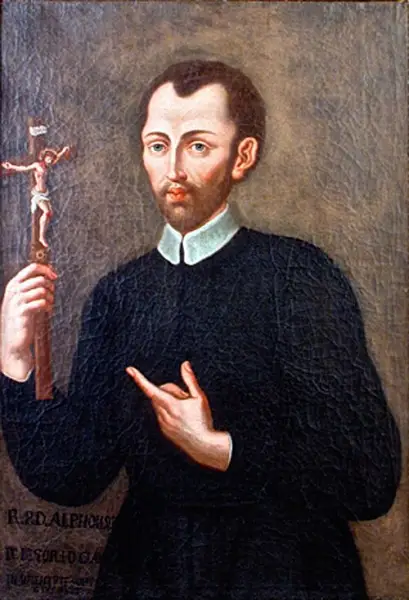
- Bishop's vestments·Crucifix·The pen of a moralist
- Canonization
- Beatified 15 September 1816 by Pope Pius VII; canonized 26 May 1839 by Pope Gregory XVI; declared Doctor of the Church in 1871 by Pope Pius IX
Prayer
Profile text adapted from the Wikipedia article, licensed CC BY-SA 4.0.
Pray with this saint every day
Save St. Alphonsus Liguori to your favorites, read the full profile, and get feast-day reminders in the Saints app.
Get the Saints AppFree on the App Store for iPhone and iPad