
1532-1617·Feast October 31
St. Alphonsus Rodriguez
Jesuit Lay Brother
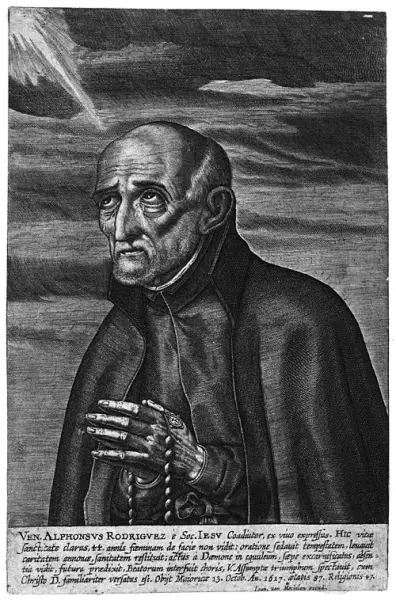
Overview
Born at Segovia on 25 July 1532 to a wool merchant's household, Alphonsus Rodriguez met the first Jesuits as a boy when Peter Faber stayed with the family and prepared him for his First Communion. Sent at twelve to the new Jesuit college at Alcalá, he left after two years to help his widowed mother run the business. He married at twenty-six and fathered three children; by thirty-one his wife and two of the children were dead. Stripped of nearly everyone he loved, he gave himself to prayer and penance, and when his last child died he set his heart on religious life. Turned away at first for want of education, he tried to make up the deficit at Barcelona at thirty-nine and broke his health with austerities before the Society of Jesus at last received him into its lay brotherhood on 31 January 1571. Posted to the college on Mallorca, he kept the door for forty-six years, imagining each ring of the bell to be God asking admittance, and the porter's lodge became a busy parlor of counsel for students and townspeople. There he steadied the young Peter Claver, who asked from him the missions of South America. Tormented by scruples yet credited with visions, he died on 31 October 1617, leaving spiritual notes his superiors had commanded him to write.
The Complete Life
Early Life
Alphonsus Rodriguez was born on 25 July 1532 at Segovia in Spain, the son of a wool merchant whose trade gave the family a comfortable place among the townspeople. The first Jesuits passed through Spain in his childhood, and one of the most famous of them touched his life directly: Peter Faber, on a preaching visit to Segovia, stayed with the Rodriguez family and prepared the boy for his First Communion. At twelve Alphonsus was sent to Alcala, to the Jesuits' new college there, an opening toward the learned career his family could now afford him. His father's death two years later ended all that. Alphonsus left the college to help his mother run the business, and for the next quarter century he lived the life of a Segovia tradesman, a life interrupted by one bereavement after another.
§ Life and work
Conversion and Vocation
At twenty-six he married Maria Suarez, and the couple had three children. By the time he was thirty-one his wife was dead and two of the children with her. Rodriguez's interior life turned decisively in these years: he began a discipline of prayer and mortification, withdrawing from the world's business while remaining in it, and on the death of his third and last child his thoughts settled on entering religion. The obstacle was his lack of education, the unfinished schooling of his boyhood, and the Society of Jesus, an order of the learned, hesitated. He tried to make up the deficiency by attending the classes of the Barcelona college at thirty-nine, but his health, undermined by his austerities, gave way, and the studies failed. At forty, on 31 January 1571, he was at last admitted to the Society as a lay brother, the provincial reportedly remarking that if Alphonsus lacked the qualifications for brother or for priest, then he could be received in order to become a saint.
§ Life and work
Mission and Ministry
After his novitiate, spent at Valencia or Gandia in the years before Spain had a separate novitiate for lay brothers, Rodriguez was assigned in 1573 to the Jesuit college at Palma on the island of Mallorca, and there he remained, by his own acceptance, for the rest of his life. His office was the humblest in the house: porter, doorkeeper of the college, the man who answered the bell, received visitors, sorted alms, and managed the traffic of a busy school. He held the door for more than forty years and made of it a ministry. The advice he gave at the gate, and the letters he wrote, circulated widely; his position gave him a view of every human need that came to the college, and he developed a gift for spiritual direction exercised in fragments at the doorstep. Among those he guided was a young student named Peter Claver, whom he urged toward the missions; Claver went to the West Indies and became the apostle of the slaves of Cartagena, a work set in motion at the door of Palma.
§ Life and work
Spirituality and Teaching
Rodriguez's spirituality was that of the sanctification of ordinary duty, worked out in a religious life without office or study. He is remembered for the maxim that he did not need to become a St Paul or a St Francis, only Alphonsus, and for a methodical exactness in small things, treating each knock at the door as an obedience and each visitor as sent by God. His mortifications, severe in his early widowhood, matured into a gentler discipline of presence and prayer, and his counsels, preserved by those who received them, show a practical wisdom in the cast of the great Spanish masters of the period. The notes of his prayer and the record of his direction, gathered after his death, were used in the cause for his canonization, and through them the porter of Mallorca became a teacher of the interior life to readers who never saw his door.
§ Introduction
Trial and Final Years
Rodriguez's last years combined bodily decay with an interior life that his contemporaries found remarkable. His duties at the door were eventually lightened, and he suffered a long final illness, borne, as witnesses testified in the process, with patience and even joy. He died at Palma on 31 October 1617, at eighty-five, having spent forty-four years in the Society, all of them on the same island. His funeral was an occasion of public veneration in Palma, the townspeople and the students of the college claiming the dead porter as their own, and the early biographical accounts report favors and cures at his tomb, the beginning of the reputation that carried his cause forward.
§ Introduction
Canonization
Rodriguez was beatified by Pope Leo XII on 5 June 1825, his cause advanced by the testimony collected at Palma and by the persistent devotion of the Jesuit colleges. He was canonized by Pope Leo XIII on 15 January 1888, in the same ceremony that canonized the young Jesuit scholastic John Berchmans, an occasion the order took as a deliberate pairing: the sanctity of study and the sanctity of the door, offered to the church in one rite. His remains are honored at the Jesuit college in Palma, his shrine for four centuries.
§ Introduction
Legacy
Alphonsus Rodriguez is the church's principal witness that a life of sanctity can be built entirely on humble work faithfully repeated. He is invoked as a model for lay brothers and for all whose work is service without advancement, and his story is standard in Jesuit formation as the counterweight to ambition: the province that hesitated to admit him produced in him one of its canonized men. His influence on Peter Claver gave his porter's life a historical reach far beyond Mallorca, since the slave mission of Cartagena traces its origin in part to his encouragement. For the church at large he stands with the Martha tradition of the spiritual life, and the door of the college of Palma has become, in religious literature, one of the fixed emblems of ordinary duty transfigured.
§ Life and work
Timeline
- 25 Jul 1532
Born at Segovia, son of a wool merchant
§ Life and work
- 1544
Sent at twelve to the new Jesuit college at Alcalá
§ Life and work
- 1558
Marries María Suarez at about twenty-six; they have three children
§ Life and work
- 1563
His wife and two of his children have died by this time, turning his thoughts to religious life
§ Life and work
- 31 Jan 1571
Enters the Jesuits at forty, received as a lay brother after years of frustrating delays
§ Life and work
- Jul 1571
After six months of probation he is sent to the new college on Mallorca, where he serves as porter
§ Life and work
- 1585
Makes his perpetual vows at the age of fifty-four
§ Life and work
- 31 Oct 1617
Dies at Palma de Mallorca, aged eighty-five, after forty-six years as doorkeeper
§ Introduction
- 1626
Declared venerable
§ Veneration
- 1633
The island's governing council acclaims him a special patron of Mallorca and its people
§ Veneration
- 1760
Pope Clement XIII decrees that his virtues were proved to a heroic degree
§ Veneration
- 5 Jun 1825
Beatified by Pope Leo XII after the Jesuit suppression had long delayed the cause
§ Veneration
- 15 Jan 1888
Canonized by Pope Leo XIII
§ Veneration
In Their Own Words
Each time the bell rang, he looked at the door and envisioned that it was God who was standing outside seeking admittance.
The Record
- Major works
- Obras Espirituales (Spiritual Works; published notes of his domestic exhortations, Barcelona 1885)
- Canonization
- Declared Venerable in 1626; beatified by Pope Leo XII on 5 June 1825; canonized by Pope Leo XIII on 15 January 1888
Prayer
Bibliography
Show 1 sources
- ↑ Note that Pope Francis refers to Rodriguez as a priest in this text, but other sources refer to him as a lay brother.
Profile text adapted from the Wikipedia article, licensed CC BY-SA 4.0.
Pray with this saint every day
Save St. Alphonsus Rodriguez to your favorites, read the full profile, and get feast-day reminders in the Saints app.
Get the Saints AppFree on the App Store for iPhone and iPad