
c. 800-874·Feast August 15
St. Altfrid
Bishop of Hildesheim, Founder of Essen Abbey
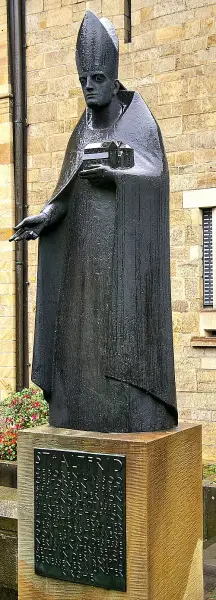
Overview
Altfrid, also called Altfrid of Hildesheim, was a leading figure of ninth-century Germany: a Benedictine monk, bishop of Hildesheim from 851, founder of Essen Abbey, and a close adviser to the East Frankish king Louis the German. First mentioned as bishop at a Mainz council on 3 October 852, he probably died, rich in days as the Hildesheim Chronicle says, on 15 August 874, giving a birth year around 800. He seems to have belonged to the Saxon nobility, owning land in the Harz foreland and at Essen, and possibly connected with the Liudolfings, though that family had no influence at Essen until after his death. A monk of Corvey before his election in succession to Ebbo, he repeated all his predecessor's consecrations and ordinations to secure their validity, and rebuilt Hildesheim cathedral, consecrating it in 872. His chief monument is the abbey of Essen, founded on his own property, whose first abbess was his kinswoman Gerswith.
The Complete Life
A Saxon Noble in the Carolingian Church
No contemporary biography of Altfrid exists — a silence that obliges the historian to work from documents — and his first certain appearance is on 3 October 852, at a council in Mainz, where he signs as bishop of Hildesheim. The rest of the reconstruction rests on circumstantial evidence of solid quality. The Hildesheim Chronicle records that he died in 874 'rich in days,' implying a birth around 800. He owned land in the Harz foreland and in central Essen, property of a kind most plausibly inherited from family, which points to the Saxon nobility — and perhaps to a connection with the Liudolfing dynasty, though that family had no hand in his foundation at Essen until he was dead. Altfrid, it seems, was a monk of Corvey, the great Saxon daughter of Corbie, before 851: the abbey whose abbot would later stand at his cathedral's consecration, and whose network underlies his whole career.
An Awkward Succession
The see of Hildesheim came to Altfrid in 851 through the death of Ebbo on 20 March of that year — and in the succession lay a trap. Ebbo, several times installed and removed as archbishop of Reims, left open to question whether everything he had done in Hildesheim stood canonically. Altfrid answered by repeating, in an unusual step, all of his predecessor's consecrations and ordinations, so that no one ordained under Ebbo need fear invalidity — an act at once pastoral and juridical, showing the practical intelligence that marks his whole episcopate. He was a bishop of the second Saxon generation: the mission church planted by Charlemagne's force was becoming an indigenous church of Saxon noblemen-bishops, building in stone and endowing from their own property.
Builder and Founder
Altfrid's missions were stones and women. In 852 he laid the cornerstone of a new cathedral at Hildesheim — a three-aisled cruciform church with crossing and transept, among the early examples of the type north of the Alps — and its consecration followed on 1 November 872, before four bishops and the abbot of Corvey. Around the same years he managed relics like a program: the bodies of Cosmas and Damian brought from Rome between 845 and 847 (before his episcopate, for the communities he was already founding), Saint Hadrian procured from Rome for Count Ricdag's nunnery at Lamspringe, and in 864 the translation of Saint Marsus from Auxerre to Saxony, most likely to Corvey — an occasion for which his sermon survives, a rare piece of ninth-century episcopal oratory. His characteristic work, however, was the foundation of houses for women: even before his consecration he had been active in establishing female religious communities, and on his own property at Essen, on the Hellweg, he built the Stift Essen — its first abbess his kinswoman Gerswith, often called his sister though the evidence is indirect — with a chapel of St. Quentin for the settlement and the Stiftskirche for the canonesses. He also founded Liesborn Abbey and a house for men at Osterwieck, and a monastery of unknown site on his Harz land.
The Diplomat of a Dividing Empire
Altfrid's other office was political. A close confidant of Louis the German from at least 860, he played an influential role in the power struggles of the disintegrating Frankish empire: at Koblenz in 860 for the meeting of Louis and Charles the Bald in St. Castor's basilica; at Asselt in 862, at Compiègne and Savonnières, at Pitres in 864, at the synod of Thousey in 865, at Metz in 867 and the synod of Worms in 868. The itinerary of a bishop in those years was diplomacy conducted at walking pace. His decisive contribution was the Treaty of Meerssen of 9 August 870, which divided Lotharingia between West and East Francia — the settlement that determined which half of the middle kingdom, and ultimately of Europe, each of his foundations would belong to. His spirituality of office, if the phrase is allowed, was the Carolingian ideal entire: reform of the church through good building, good relics, good canonesses, and good treaties.
Death and Tomb
Altfrid died on 15 August 874 — the feast of the Assumption, as Abbot Altbert of Lobbes records — though the place of his death is unknown. He was buried, as he had wished, not in his cathedral at Hildesheim but in the church he had built for the canonesses at Essen. Miracles were reported at his tomb around the year 1000, and a healing spring near the church was ascribed to his intercession; after a thirteenth-century fire a Gothic sarcophagus was set over his remains, and the east crypt of Essen Cathedral — his crypt — holds it still. The veneration lapsed when the abbey was secularized in 1803, revived during the Kulturkampf, and in 1965, after the founding of the diocese of Essen in 1958, its first bishop obtained Rome's confirmation of Altfrid's feast as an official church festival.
Cult
Altfrid is a pre-congregation saint whose cult has had a modern official afterlife — the rare combination of medieval tomb and twentieth-century confirmation. Essen keeps his feast on 16 August (displaced from the Assumption), and the diocese that bears the city's name honors him as its founder. Hildesheim remembers him as cathedral-builder; the Liudolfings, who had no part in his foundation, adopted his abbey afterward and made it one of the great houses of the empire — Gundulf's plan growing into the Essen whose golden Madonna and seven-branch candlestick remain among the supreme objects of Ottonian art, treasured in the museum beside his crypt.
Legacy
Altfrid's legacy is measured in what still stands. Hildesheim cathedral, rebuilt on his plan's succession, is a UNESCO world heritage church; Essen, from his Stift, became a diocese in 1958 that took his tomb for its mother church; and the treasures his house accumulated — the golden Madonna among the earliest fully sculptural images of the Virgin in the West — descend from the foundation he endowed from his own inheritance. As a statesman he belongs to the small company of bishops who managed the partition of an empire competently; as a churchman he represents the ninth century at its best, a monastic bishop who turned family land into institutions that outlasted his family's own prominence by a thousand years.
Timeline
- 800
Year of birth assumed around this date from the Hildesheim Chronicle's report that he died rich in days
§ Life
- 845
Acquires the relics of Saints Cosmas and Damian in Rome, before his consecration as bishop
§ Life
- 851
Made bishop of Hildesheim after Ebbo's death that March, repeating all his predecessor's ordinations
§ Life
- 852
Lays the cornerstone of a new three-aisled cruciform cathedral at Hildesheim
§ Life
- 3 Oct 852
First mentioned, taking part in a council at Mainz as bishop of Hildesheim
§ Life
- 860
Present at Koblenz when Louis the German and Charles the Bald agree a peace treaty
§ Diplomat
- 864
Translates the relics of Saint Marsus from Auxerre to Saxony, most likely to Corvey Abbey
§ Life
- 868
Attends the Synod of Worms after years of travel through the Frankish courts
§ Diplomat
- 1 Nov 872
Consecrates the completed Hildesheim cathedral before four bishops and the Abbot of Corvey
§ Life
- 15 Aug 874
Dies on the feast of the Assumption and is buried, per his wishes, in the church of Essen Abbey
§ Death and after
- 1000
Miracles reported at his tomb in Essen greatly increase his veneration
§ Death and after
- 1965
Rome confirms the celebration of his feast day as an official festival for the new Bishopric of Essen
§ Death and after
The Record
- Major works
- Sermon on the arrival of the relics of Saint Marsus (surviving)
- Patron of
- Essen·Diocese of Essen
- Symbols
- Bishop's vestments·Church model (of Essen and Hildesheim cathedral)
- Canonization
- Pre-congregation; cult confirmed in the Catholic Church
Prayer
Profile text adapted from the Wikipedia article, licensed CC BY-SA 4.0.
Pray with this saint every day
Save St. Altfrid to your favorites, read the full profile, and get feast-day reminders in the Saints app.
Get the Saints AppFree on the App Store for iPhone and iPad