
died c. 760·Feast February 9
St. Alto of Altomünster
Irish Hermit and Benedictine Abbot in Bavaria
Overview
Alto, O.S.B., who died around 760, was a Benedictine abbot of the Irish or Scottish wandering monasticism that carried the faith across the continent in the eighth century. He is thought to have reached Bavaria as a pilgrim monk, having earlier led the life of a hermit in the country around Munich and Augsburg alike, and he is the eponymous founder of Altomünster Abbey, around which the market town of Altomünster grew. The documentation of his life is thin but not empty: the Diocese of Freising preserves a document, datable to about 763, whose signature — Alto reclausus, Alto the hermit — is judged to be his own, and a grant by King Pepin the Short gave him the wooded land on which the monastery was built. and Saint Boniface, by the tradition, came to bless the new church around the year 750. A Vita of Alto was written about 1062 by Otloh of St. Emmeram. The Catholic Church honors him among the saints, with his feast on 9 February; he is a patron of the Diocese of Freising, and the Abbey of Altomünster, which for centuries after his death housed a community of Brigittine nuns, remained his shrine. A Gospel lectionary made for the abbey bears a metal cover of 1489 depicting one of his miracles.
The Complete Life
A Wanderer from the Isles
Alto belongs to the great diaspora of the insular monks, the Irish and Scottish pilgrims for Christ who, from the sixth century onward, crossed to the continent in their boats and walked until they found the solitude they had vowed. The tradition holds that Alto arrived in the region of Bavaria as just such a wandering monk, living first as a hermit in the stretch of country between Munich and Augsburg, twin centers of early Bavarian Christianity. Of his life before the crossing nothing is recorded: whether he was Irish or Scots, of what house, taught by whom, the sources do not say, and the Vita that Otloh of St. Emmeram wrote about 1062, three centuries after the facts, supplies the outlines with the conventional colors of the hermit-saint. What the documentary record does vouchsafe is one of the rarest things in the hagiography of the period, a signature: a document of the Diocese of Freising, dating perhaps to 763, carries the subscription Alto reclausus, Alto the enclosed one, the hermit, and it is considered authentic, a pen-stroke from the saint's own hand.
§ Life
The Hermitage becomes a Monastery
The transformation of Alto's hermitage into Altomünster, the monastery on the Alto, is the substance of his mission. King Pepin the Short's donation supplied the hermit with wooded ground on which to build, the royal grant that turned a recluse's cell into an institution; and and Saint Boniface, the apostle of Germany, whose organization of the Bavarian church was the work of those same decades, is said to have arrived to bless the church around the year 750, linking the little foundation to the great reforming hierarchy of the age. Around the monastery the market town of Altomünster grew, one of those Bavarian settlements whose name still announces its origin in a saint's enclosure. The house that Alto founded had a long and varied afterlife, passing in the fifteenth century to the Brigittine nuns, who kept it until the secularizations and beyond, and it remained throughout the shrine of its founder, whose feast the region kept on 9 February.
§ Life
Legacy
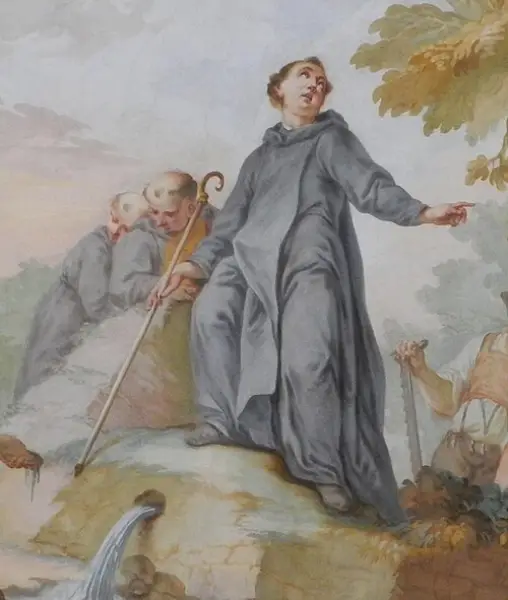
Alto's legacy is bound up with the abbey and the town that bear his name, in the district between Munich and Augsburg where he had lived as a stranger. The Diocese of Freising, whose archives preserved his signature and whose patron he is, kept his cult as part of the fabric of Bavarian Christianity, and the pilgrim trail called the St-Alto-way still runs in the forest that keeps his name. The iconography that grew around him centers on the Alto Spring, the water he was said to have struck from the ground, painted by Josef Mages in the abbey church in the eighteenth century; the Gospel lectionary made for the abbey, with its metal cover of 1489 showing one of his miracles, records the community's pride in its founder. He stands in the church's memory for the countless anonymous Irish and Scottish monks who planted hermitages in the German forests: the one whose name survived because his monastery did.
§ Life
Timeline
- 750
Saint Boniface is said to come and dedicate the church of Alto's monastery about this year
§ Life
- 760
Dies around this year at Altomünster Abbey, whose founder tradition holds him to be
§ Introduction
- 763
The Diocese of Freising holds a document, perhaps of this date, signed Alto reclausus, Alto the hermit
§ Life
- 1062
Otloh of St. Emmeram writes a Vita of Alto's life about this time
§ Life
- 1489
A metal cover showing one of Alto's miracles is added to the abbey's Gospel lectionary
§ Life
The Record
- Patron of
- The Diocese of Freising·Bavaria·Hermits
- Symbols
- Hermit's cell·Spring struck from the rock (the Alto Spring)·Monastic habit
- Canonization
- Pre-congregation (ancient cult; patron of the Diocese of Freising)
Prayer
Bibliography
Show 4 sources
- 1 2 " "St-Alto-way", Markt Altomünster" . Archived from the original on 2016-08-15 . Retrieved 2016-07-14 .
- ↑ "Sant' Altone Abate" . Santi e beati (in Italian).
- ↑ Thurston, Herbert. "St. Alto." The Catholic Encyclopedia Vol. 1. New York: Robert Appleton Company, 1907. 30 May 2016
- ↑ "Gospels for the Year" . World Digital Library . Retrieved 2014-06-03 .
Profile text adapted from the Wikipedia article, licensed CC BY-SA 4.0.
Pray with this saint every day
Save St. Alto of Altomünster to your favorites, read the full profile, and get feast-day reminders in the Saints app.
Get the Saints AppFree on the App Store for iPhone and iPad