
reputedly 522-640·Feast November 26
St. Alypius the Stylite
Stylite and Monastic Founder
Overview
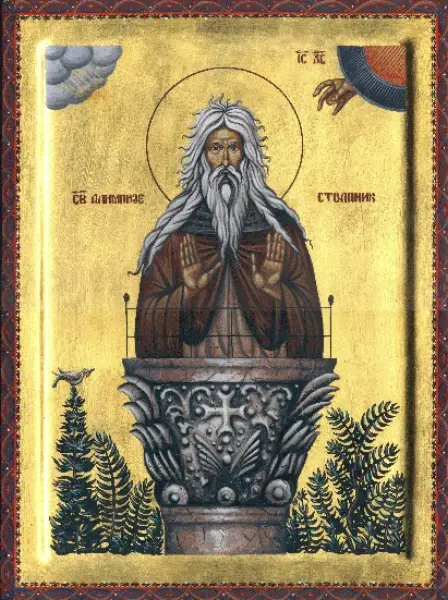
Alypius the Stylite was a seventh-century ascetic of Paphlagonia, one of the most famous of the pillar saints. Born reputedly in 522 at Hadrianopolis, he was raised by a widowed mother so pious that she gave her livelihood to the poor, became a deaconess, and lived ascetically herself. Yearning for the hermit's life, he was held back by his bishop, Theodore; instead he raised a church dedicated to the martyr Euphemia where a crumbling pagan temple stood, and next to it he set up a pillar, on which he lived for most of his adult life. In time two monasteries rose beside the pillar, one housing monks and the other nuns, and Alypius acted as spiritual guide to both communities, a starets whose counsel was widely sought. Once he had stood upright for fifty-three years and his feet could no longer bear him, he refused to descend but remained on the pillar, lying on his side, for the fourteen years that were left of his life. He died in 640, said to have reached the age of 118, and is invoked as an intercessor for the infertile.
The Complete Life
Early Life
Alypius was born in the city of Hadrianopolis in Paphlagonia, in north-central Asia Minor. His mother was left a widow while still young and proved deeply devout: she placed her son with Bishop Theodore for his education, handed her whole livelihood to the poor, and took the diaconate herself, living ascetically — a household, in other words, already shaped by the church's radical teaching before the child made his own choice. The boy longed to take up a hermit's life, but Bishop Theodore, who clearly prized him, refused permission; the delay proved providential, since Alypius's vocation turned out to be not flight from the world but a lifelong, visible stand above it, at the service of the crowds who came. Hadrianopolis, his birth town, is today Eskipazar in Turkey's Karabük province — a town now known to most of the faithful only through him.
§ Life
Vocation to the Pillar
The stylite vocation was born a century earlier in Symeon the Stylite of Aleppo, and Alypius became its greatest Paphlagonian heir. His first work was constructive: on the ground of a ruined pagan temple he put up a church honoring the great martyr Euphemia — the old sanctity of the place replaced, the new prayer planted where the old gods had been abandoned. Beside the church he erected his pillar and ascended it, and there he remained for the majority of his adult life. The pillar was not a retreat from people but a pulpit and a lighthouse: visible from far across the valley, unapproachable yet public, it made a life of constant prayer into a standing sermon. Herbert Thurston judged the whole pillar movement in one sentence: in an age of corruption and social decadence, he wrote, nothing impressed the need of penance on Eastern Christians as these standing ascetics did.
§ Life
Two Monasteries
Around the pillar a pair of monasteries took shape — one housing monks, the other nuns — and Alypius acted as the spiritual guide of both, so that a single praying man stood at the head of a double community. While he lived he was a starets in great demand, guiding others in the Christian spiritual life, consulted from the surrounding towns and from further away, and the Life that survives presents his counsel as practical, patient, and unafraid of detail. The arrangement he headed — church, pillar, monks, nuns — was the complete stylite institution as it functioned at its best: not a circus of endurance but a parish centered on prayer, where the ascetic's body bore witness to what the whole community professed. The tradition ranks him with Symeon the Elder and Daniel the Stylite among the three great pillar ascetics of the Byzantine tradition.
§ Introduction
Fifty-Three Years Standing
The number the tradition preserves is staggering: Alypius stood upright for fifty-three years, and when his feet at last failed him he did not climb down from his pillar; he simply lay upon it, on his side, and passed the fourteen years still remaining to him in that posture. The detail is hagiography's way of saying what the life cost — that the man who taught balance to others ended crucified on his own choice — and it made him, for Byzantine readers, the very image of perseverance. His patronage of fertility and of young children belongs to the same logic from the other side: the man who never fathered children became, by prayer, a father to the childless, and mothers invoked him at the pillar and after his death. The claimed age of 118 at his death is hagiography's own arithmetic, preserved because the wonder of the figure suited the wonder of the life.
§ Veneration
Veneration
Alypius belongs to the pre-congregation saints of Byzantium. He is venerated in the Eastern Orthodox Church, the Eastern Catholic Churches, and the Roman Catholic Church, with his feast on 26 November. The Menologion of Basil II, the great eleventh-century illuminated calendar of Byzantine sanctity, preserves an image of him among the saints of November, and the iconography is fixed: a monk in habit atop his pillar, hands raised in the orans of unceasing prayer. His cult continued under the Ottomans in local Paphlagonian memory and passed into the Slavic calendars with Byzantine monasticism. His relics were laid to rest in the church of St Euphemia that he himself had raised, and his head is preserved at the monastery of Koutloumousiou on Mount Athos; churches on the Julian calendar keep his 26 November on 9 December. The Menologion image and the Athos head-relic mark the two poles of his cult: image and body, calendar and place.
§ Veneration
Legacy
Alypius is the second name of the stylite movement, after Symeon himself, and his form of the life — pillar beside a church, double monastery around the pillar, spiritual direction from above — became the pattern wherever the movement spread, from the Taurus to the Balkans. For the modern reader he is both difficult and compelling: a man whose asceticism is alien to our comforts, whose constancy — sixty-seven years on a pillar — is not. He remains an intercessor invoked for fertility and for children, a patronage that spans the distance between the desert and the nursery, and a reminder that the Church's memory honors the body's witness as well as the mind's. The Prologue from Ochrid of St Nikolaj Velimirovic gives him a full life, and the Orthodox synaxaria keep his icon — the monk in orans atop his pillar — before the faithful to this day.
§ Introduction
Timeline
- 522
Born at Hadrianopolis in Paphlagonia, reputedly in this year
§ Introduction
- 640
Dies at Hadrianopolis at the claimed age of 118, after some fifty-three years standing and fourteen lying on his pillar
§ Life
The Record
- Patron of
- Fertility in women and young children
- Symbols
- Monastic habit, standing atop a pillar in orans
- Canonization
- Pre-congregation; ancient Byzantine cult
Prayer
Bibliography
Show 3 sources
- 1 2 3 "Venerable Alypius the Stylite of Adrianopolis", Orthodox Church in America
- 1 2 Thurston, Herbert. "Stylites (Pillar Saints)." The Catholic Encyclopedia Vol. 14. New York: Robert Appleton Company, 1912. 3 August 2018
- ↑ "Saint Alipios the Stylite" Archived 2007-10-10 at the Wayback Machine Saint Barbara Greek Orthodox Church
Profile text adapted from the Wikipedia article, licensed CC BY-SA 4.0.
Pray with this saint every day
Save St. Alypius the Stylite to your favorites, read the full profile, and get feast-day reminders in the Saints app.
Get the Saints AppFree on the App Store for iPhone and iPad