
7th century·Feast July 10
St. Amalberga of Maubeuge
Widow, Benedictine Nun of Maubeuge
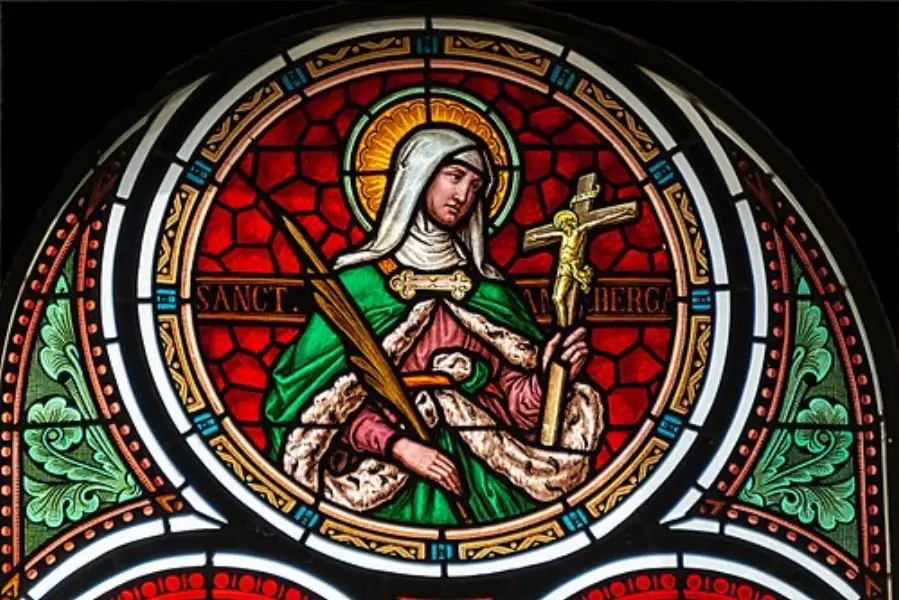
Overview
Amalberga of Maubeuge — also Amalia, or Amelia of Lobbes or Binche — was a Merovingian widow and nun of the seventh century, remembered in the Brabantine tradition as the mother of five saints. Born in Brabant, the daughter of Saint Geremarus and said to be a niece of Pepin of Landen, she was wed unwillingly to a great lord called Thierry, and bore him a daughter, the future Saint Pharailda of Ghent. After Thierry died, Pepin is said to have married her again, to Count Witger, presented in her biography as duke of Lorraine; by him she became mother of Saints Pharaildis, Emebert, Reineldis, Ermelindis, and Gudula — the last the future patroness of Brussels. Sometime after Gudula's birth Witger retired to become a Benedictine monk at Lobbes, and Amalberga joined the Benedictine nuns of Maubeuge, where she lived out her widowhood. Her biography, the Vita sancti Amalbergae viduae, was probably written by Abbot Hugo of Lobbes between 1033 and 1048, and modern scholarship judges it largely legendary: its genealogy was copied from an eleventh-century passion of Saint Catherine, and its duke Witger is a fictional double of the tenth-century Wigeric of Lotharingia. Her feast is kept on 10 July; the removal of her relics from Lobbes to Binche during the fifteenth century is commemorated in June. She is invoked for arm pain, bruises, and fever, and is portrayed holding an open book with a crown on her head.
The Complete Life
A Daughter of Brabant
Amalberga was born in Brabant in the seventh century, into the Frankish aristocracy of the Meuse country. The legendary vita makes her the daughter of Saint Geremarus — the hermit-founder of Fly, on the Oise — and a niece of Pepin of Landen, the mayor of the palace who, with his wife Itta and daughter Gertrude of Nivelles, stands at the head of the Carolingian line. The family as constructed by the vita is almost impossibly sainted: a father, a husband, five children, and a constellation of in-laws all canonized. Modern scholarship has pulled the genealogy apart gently but firmly; the Vita sancti Amalbergae viduae is probably the work of Abbot Hugo of Lobbes, written between 1033 and 1048, some four centuries after the events, and its genealogy was copied from an eleventh-century Passio sancti Katharinae, while its duke Witger is a literary double of the tenth-century count Wigeric of Lotharingia. Behind the fabrication, most historians allow, stands a real widow and nun of Maubeuge whose memory the Brabantine houses embroidered.
Marriages Arranged and a Household of Saints
The vita's narrative of Amalberga's marriages is a study in aristocratic women's lack of choice: given unwillingly in marriage to a great lord called Thierry, bearing him a daughter, the future Saint Pharailda of Ghent; and then, on Thierry's death, remarried by Pepin to Count Witger, presented as duke of Lorraine. By Witger she is said to have borne the four saints who anchor the Brabantine tradition: Emebert, counted bishop of Cambrai; Reineldis, martyred at Saintes; Ermelindis of Meldert; and Gudula, the virgin of Moorsel who became patroness of Brussels. Whatever the history beneath the legend, the tradition itself had consequences: for a thousand years the Low Countries have read their Christian origins as a family affair, a household of saints spread across the abbeys and cities of Brabant, and Amalberga has been honored as its mother. The vita's arrangement of her two marriages and five sainted children reads less as biography than as a charter of the Brabantine churches' claims to a common holy ancestry.
Maubeuge
Sometime after the birth of Gudula, the youngest, the vita says, Witger decided to become a Benedictine at Lobbes, the great abbey on the Sambre, and Amalberga joined the Benedictine nuns of Maubeuge — the double monastery founded a generation earlier by the Waldara and Aldegonde circle of Hainaut. Husband and wife thus ended their lives in parallel cloisters, a not uncommon Merovingian arrangement for couples whose children were raised. Amalberga's own death belongs to the unwritten part of her story; the liturgical memory settled on the removal of her relics, carried from Lobbes to Binche during the 1400s, kept on 10 June in one tradition, with a second translation feast on 2 July and her main commemoration on 10 July. Binche, with its noble convent, became her major shrine. Lobbes and Maubeuge, the paired houses of her widowhood, were the two great monasteries of the Sambre valley, and her cult belonged to both.
Mother of the Brabantine Saints
Amalberga's legacy is the thing her legend was built to serve: the conviction that the Christianization of Brabant ran through one extended holy family — Amalberga, Witger, Gudula, Reineldis, Ermelindis, Emebert, Pharailda, and their kin — whose cults are spread from Ghent to Brussels to Hainaut. Critical scholarship since Van Droogenbroeck's work on the Lobbes hagiographers has shown how the eleventh-century vitae manufactured and cross-referenced this family, but the devotion the manufacture served has outlived the critique. She must not be confused, the calendars warn, with Amalberga of Temse, the virgin of Ghent and Munsterbilzen who died in 772 and shares her feast day. Amalberga of Maubeuge is invoked for arm pain, bruises, and fever, and portrayed holding an open book, crowned — the iconography of a woman whose sanctity was remembered as both learned and royal. The feast days of her commemorations — 10 July, with translation feasts in June — were fixed by the liturgical practice of Hainaut rather than by any central decree.
Timeline
- 600
Born in Brabant in the seventh century, daughter of Geremarus and said niece of Pepin of Landen
§ Legend
- 690
Dies around 690 after entering the Benedictine nuns of Maubeuge
§ Introduction
- 1033
Her vita is probably written by Abbot Hugo of Lobbes between 1033 and 1048
§ History
- 1400
Relics translated from Lobbes to Binche in the fifteenth century, commemorated on 10 June
§ Legend
The Record
- Patron of
- Arm pain, bruises, and fever·Binche, Belgium·Mothers of families
- Symbols
- Open book and a crown on her head·Widow's veil
- Canonization
- Pre-congregation (ancient cult; relics translated from Lobbes to Binche in the 15th century)
Prayer
Profile text adapted from the Wikipedia article, licensed CC BY-SA 4.0.
Pray with this saint every day
Save St. Amalberga of Maubeuge to your favorites, read the full profile, and get feast-day reminders in the Saints app.
Get the Saints AppFree on the App Store for iPhone and iPad