
741-772·Feast July 10
St. Amalberga of Temse
Virgin, Abbess of the Scheldt
Overview
Amalberga of Temse, also called Amalia or Amelia, was a Frankish consecrated virgin of the eighth century, probably a Frankish subject from the Ardennes. Raised by Saint Landrada, foundress of Munsterbilsen Abbey, she took the habit there and either became Landrada's successor as abbess or led a community of nuns on estates of her own. She is remembered chiefly for her refusal of Charlemagne's offer of marriage, a legend that grew around the historical memory of a noblewoman who would not be taken from her vow. The story credits her with miracles of escape: her arm, broken when the king grasped it, was healed, and a sturgeon appeared to carry her safely across the Scheldt. She died on 10 July 772 at Bilsen, and her relics were later translated to St Peter's at Ghent, her major shrine. Never officially canonized, she is honoured as a saint by both the Catholic Church and the Eastern Orthodox Church, invoked for fevers, intestinal disease, and pains of the arms and shoulders.
The Complete Life
Early Life
Amalberga was born around 741, probably in the Ardennes, then part of Francia and now divided among Belgium, Luxembourg and France; some accounts make her family Frisian. Whatever her blood, her formation was Frankish and monastic: she was raised by Saint Landrada, the foundress of Munsterbilsen Abbey in Limburg, one of the first communities of women in the Low Countries. Under Landrada she received the habit and the rule, and as a young woman she was consecrated a virgin — the ancient order of women living under vow in the world or in community, older than most of the formal orders. The sources allow her to have been either Landrada's successor as abbess at Bilsen or the head of a smaller community on her own inherited lands; both options mark her as a woman of property and standing, which is precisely what made her, in legend, worth a king's attention.
Charlemagne's Suit
The centre of her legend is the proposal of marriage from Charlemagne — before or in the earliest years of his reign — and her refusal. In the full medieval telling, the young king persisted, grasped her arm and broke it, and divine punishment struck him down until he relented; her arm was healed whole, and the future emperor, chastened, became her protector instead. Historicity is beyond recovery: the tale belongs to a family of legends in which Carolingian power is rebuked by consecrated women, echoing the real politics of an age when royal marriage was an instrument and female inheritance a temptation. What the story preserves is the Church's claim that a vow made to God outranks a crown's convenience. Baring-Gould printed the tale in full, and Butler's Lives keeps her feast on its merits: a virgin whom even an emperor could not compel.
Miracles and the Scheldt
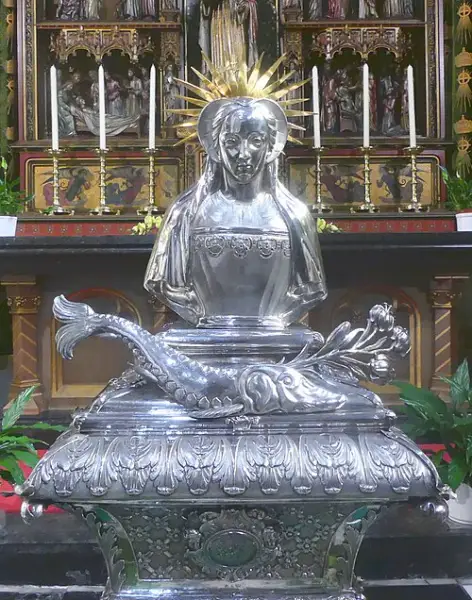
Around Amalberga's escapes gather the water miracles that fixed her iconography. Pursued, she reached the Scheldt with no boat, and a great sturgeon — the giant fish of Flemish rivers — appeared and bore her across on its back; later legend adds that fish multiplied for her community, provisions arriving with the tide. The sturgeon became her emblem in art and her shrine at Ghent shows her with the fish, a badge of the river peoples of the Scheldt who invoked her. The wells and rivers of her homeland carried her cult along the waterways from Bilsen toward Ghent and Temse, the town on the Scheldt whose name is linked with hers. Her patronage of the body's ills — fevers, intestinal complaints, and especially pains of arms and shoulders — flows directly from the legend: the arm Charlemagne broke and God healed became the pledge that she cares for broken bodies still.
Death and Translation
Amalberga died on 10 July 772, still young, at Bilsen, and was buried in the community she had served. Her relics did not stay: in 1073 they were solemnly translated to St Peter's Abbey at Ghent, as Philip Grierson's classic study of the translation showed, giving her a major shrine in the growing commercial city. At Ghent her cult prospered beside those of the city's other patrons, and her feast kept its summer date. Munsterbilsen and Temse both retained their share of her memory, the latter binding her name permanently to the river she had crossed. The division of her honours between Bilsen, Ghent and Temse is typical of Carolingian saints, whose bodies were distributed as their fame grew. At Ghent she kept her summer feast beside the city's greater patrons, and her sturgeon swam into local art; at Bilsen the community of Landrada remembered its own foundress and her pupil; at Temse the river town kept her name in its very identity, so that the Scheldt itself became part of her cult through the ages. In this division of relics and honours among the three places, her memory survived where written records of her life did not.
Legacy
Amalberga belongs to that first rank of Low Countries virgins — with Landrada, Reinildis and the other maidens of the Meuse and Scheldt — whose legends dress the frontier between Frankish power and consecrated womanhood. She was never officially canonized; her sanctity rests on immemorial cult, accepted by Rome and, remarkably, shared by the Eastern Orthodox Church, which honours this western virgin in its own calendar. Medical historians have recently claimed her, with Ursula and others, among the patron saints of trauma and orthopaedic surgery, on the strength of the broken arm. In Flanders her name still walks the river: a yearly procession near Pentecost honours her at Temse, and the sturgeon on the town's memory bears the virgin across the Scheldt once more.
Timeline
- 741
Born, probably in the Ardennes of Francia
§ Introduction
- 10 Jul 772
Dies at Bilsen at the age of thirty-one
§ Life
- 10 Jul 772
Laid to rest in the Temse church she had founded, under the invocation of Our Lady
§ Life
- 870
Relics translated to Saint Peter's Abbey at Ghent
§ Life
- 1578
Relics at Ghent dispersed by the Calvinists
§ Life
The Record
- Patron of
- Temse, Belgium·Against fevers, intestinal disease, and arm and shoulder pains
- Symbols
- Sturgeon·Broken arm healed·Veil of a consecrated virgin
- Canonization
- Pre-congregation; venerated in the Catholic Church and Eastern Orthodox Church
Prayer
Profile text adapted from the Wikipedia article, licensed CC BY-SA 4.0.
Pray with this saint every day
Save St. Amalberga of Temse to your favorites, read the full profile, and get feast-day reminders in the Saints app.
Get the Saints AppFree on the App Store for iPhone and iPad