
1872-1900·Feast July 9
St. Amandina of Schakkebroek
Franciscan Missionary and Martyr
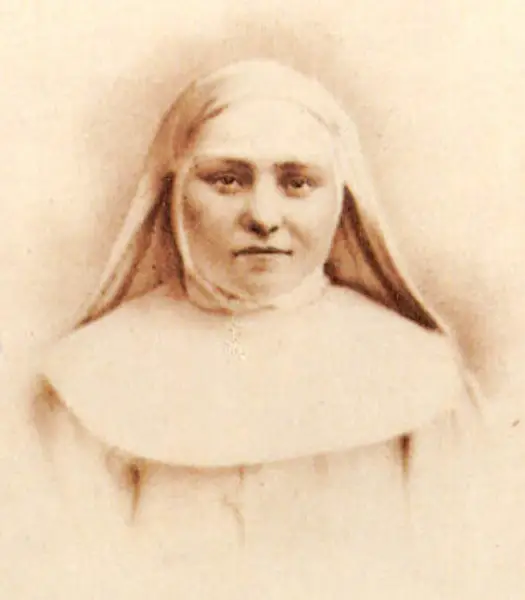
Overview
Pauline Jeuris was born on 28 December 1872 at Schakkebroek in Belgian Limburg, the seventh of nine children of Cornelius Jeuris and Agnes Thijs. Her mother died in 1879 giving birth to her youngest sibling, and the girl was boarded out with neighbours and with the Van Schoonbeek family while she attended the Ursuline primary school in Herk-de-Stad. From 1886 she worked alongside her sisters among the Sisters of Love in Sint-Truiden, and in 1892 she went to Hasselt to keep house for her widowed sister Anna. Drawn to the missions, she entered the Franciscan Missionaries of Mary and took the name Marie Amandina. She was first sent to Marseilles to nurse the sick, and then to Taiyuan in China, where she served in the mission hospital. Her good humor and ready laughter endeared her to the Chinese, who nicknamed her the laughing foreigner. When the Boxer edict of 1 July 1900 was issued, ordering missionaries expelled and Christians forced to apostatize on pain of death, she faced it with Franciscan joy. She and six companions were put to death at Taiyuan on 9 July 1900, singing the Te Deum as they died.
The Complete Life
Early Life
Pauline Jeuris — in religion Amandina of Schakkebroek — was born on 28 December 1872 at Schakkebroek in Belgian Limburg, the seventh of nine children born to Cornelius Jeuris and to his wife Agnes Thijs. Her mother died in childbirth with the last of them, on 27 October 1879, leaving Pauline, not yet seven, to be brought up in other people's houses. A neighbour woman kept her until she was fifteen, and the Van Schoonbeek family for the two years after that; through those years she attended the Ursuline primary school at Herk-de-Stad. Two of her elder sisters had already gone into religious life or work at Sint-Truiden, and from 1886 Pauline herself served with the Sisters of Love congregation there, which also let her continue her studies. On 2 August 1892 she moved to Hasselt to keep house for her sister Anna, widowed, ill, and left with four small children. The pattern of her girlhood — service, sickness, and household labor taken up without complaint — was already the pattern of her life.
§ Education
Conversion and Vocation
Keeping house for a widowed sister might have been the whole of Pauline's story. Instead the death that scattered her family seems to have turned her thoughts to the missions. She entered the Franciscan Missionaries of Mary, a young institute founded for exactly that work, and took the religious name Marie Amandina — Amandina of Schakkebroek, after her native village. The Institute sent her first to Marseilles, where she nursed the sick, completing her formation in a hospital ward rather than a classroom; the assignment confirmed both her skill and her temperament. From there she was sent to China. Nothing in the record suggests hesitation on her part: a Limburg farm girl who had lost her mother at seven and raised other people's children from her teens had already given away most of what a life can hold. The congregation's charism, formed by its foundress Mary of the Passion, was precisely this combination of Franciscan poverty and practical service, and it sent its sisters singly or in small groups wherever the work was hardest.
§ Religious life
Mission and Ministry
Amandina's assignment was Taiyuan, the capital of Shanxi in northern China, where the Franciscan Missionaries of Mary served the mission hospital founded by Bishop Gregorio Grassi. Her work was nursing — the sick, the injured, and the orphans who crowded the mission compound — and her manner of doing it became her signature. Her good humor and ready laughter disarmed Chinese patients who had never seen a foreign woman, let alone one who joked with them; they came to call her the laughing foreigner, and the affection in the nickname was genuine. It was a small achievement with large consequences: a hospital succeeds only if people are willing to enter it. In a province where foreign missionaries were already suspected of everything from kidnapping to sorcery, a sister who could make a frightened family laugh had done half the evangelization before any catechism was opened. She learned enough of the local language to nurse by ear, and her wards included the abandoned children whom the mission took in when no one else would.
§ External links
Spirituality and Teaching
Amandina's spirituality was Franciscan in the plain sense: joy taken as a discipline, and suffering accepted without drama. The one saying of hers that the record preserves captures both. When news came that a persecution was approaching, she said that her prayer was not that the martyrs should be saved but that they should be strengthened. The sentence is often quoted because it reverses what most people would pray for, and because it was spoken by a young nurse with no illusions about what the Boxer edict meant. Her last hours bore out the words. Contemporary accounts of the executions at Taiyuan describe the seven Franciscan sisters going to their deaths singing the Te Deum, the Church's great hymn of thanksgiving — a choice that turned an execution into an act of worship and that witnesses, including hostile ones, found harder to forget than the violence itself. Gratitude under those circumstances is a theological position, not a mood, and it was the position she had chosen before the soldiers came.
§ Religious life
Trial and Final Years
By 1900 Shanxi was sliding into the Boxer Rebellion, and the province's governor, Yuxian, was among the movement's most zealous patrons. The edict of 1 July 1900 declared, in substance, that good relations with the European missionaries and their Christians were at an end: the foreigners were to be expelled at once and the Chinese Christians forced to apostatize on penalty of death. At Taiyuan the mission compound was seized. Amandina and her companions were not given a trial in any meaningful sense; they were offered the usual alternative — renounce the faith and live — and refused it. On 9 July 1900, before a crowd assembled for the purpose, seven sisters of the Franciscan Missionaries of Mary were put to death together with bishops, priests, and seminarians of the Taiyuan mission. Amandina was twenty-seven. The other victims of the same day included Bishops Gregorio Grassi and Francesco Fogolla, Franciscan friars, seminarians of the mission, and lay employees of the compound, making Taiyuan the single worst massacre of the Boxer persecution.
§ Religious life
Canonization
The martyrs of Taiyuan were among the first of the Boxer victims to be honored: the seven sisters were beatified by Pope Pius XII in 1946, in the group of the Martyrs of Shanxi. More than half a century later, on 1 October 2000, Pope John Paul II canonized Amandina in Rome together with the other Taiyuan martyrs as part of the 120 Martyrs of China, the company of Augustine Zhao Rong and companions killed between 1648 and 1930. Her feast is kept with that group on 9 July. For the Franciscan Missionaries of Mary she is one of the congregation's founding generation of witnesses, and her Belgian homeland keeps her among the handful of its modern missionary saints. The ceremony in Saint Peter's Square on that October morning was the occasion on which the Church set the whole Chinese martyrology, Catholic and lay as well as missionary, before the world. For the Franciscan Missionaries of Mary the canonization crowned a century in which the congregation had lost sisters to violence in China, and it confirmed the seven of Taiyuan as the community's most illustrious dead.
§ External links
Legacy
Amandina's afterlife has been most vivid in the places that knew her shortest. In Belgian Limburg her memory is kept by an Amandina museum at her native Schakkebroek, whose Chinese Chapel preserves a painting of the sister at her mission post in Taiyuan; pilgrims there encounter a young nurse in a habit rather than an icon of suffering. In China the hospital she served is long gone, but the Taiyuan martyrdoms of July 1900 remain among the best-documented episodes of the Boxer persecution, and the seven singing sisters are the episode's human center. Her one recorded sentence — a prayer not for rescue but for strength — has outlived every account of her circumstances, and is the reason she is invoked by those facing persecution rather than merely remembered as one of its victims. Belgium, which had largely forgotten its missionary exports, rediscovered her in 2000; the fiftieth anniversary of her death had already been marked locally in 1950.
§ Introduction
Timeline
- 28 Dec 1872
Born Pauline Jeuris at Schakkebroek, Herk-de-Stad, Belgium, seventh child of Cornelius Jeuris and Agnes Thijs.
§ Introduction
- 27 Oct 1879
Her mother, Agnes Thijs, died giving birth to a ninth child; Pauline was seven years old.
§ Background
- 1886
Entered service with the Sisters of Love in Sint-Truiden, where she was also able to continue studying.
§ Education
- 2 Aug 1892
Moved to Hasselt to help keep house for her sister Anna, widowed and ill with four children.
§ Education
- 1 Jul 1900
An edict amid the Boxer Rebellion ordered missionaries repatriated and the faithful to apostatize on pain of death.
§ Religious life
- 9 Jul 1900
Martyred at Taiyuan with six companion sisters, dying as they sang the Te Deum.
§ Religious life
- 24 Nov 1946
Beatified by Pope Pius XII together with her fellow martyrs.
§ Introduction
- 1 Oct 2000
Canonized by Pope John Paul II among the Martyr Saints of China.
§ Introduction
In Their Own Words
I pray God, not to save the martyrs, but to fortify them.
The Record
- Symbols
- Franciscan Missionaries of Mary habit·Known in Taiyuan as 'the laughing foreigner'
- Canonization
- Beatified 24 November 1946 by Pope Pius XII; canonized 1 October 2000 by Pope John Paul II among the 120 Martyr Saints of China
Prayer
Bibliography
Show 2 sources
Profile text adapted from the Wikipedia article, licensed CC BY-SA 4.0.
Pray with this saint every day
Save St. Amandina of Schakkebroek to your favorites, read the full profile, and get feast-day reminders in the Saints app.
Get the Saints AppFree on the App Store for iPhone and iPad