
c. 584 – 679·Feast February 6 (formerly February 1 and October 26)
St. Amandus
Bishop and Missionary Apostle of Flanders
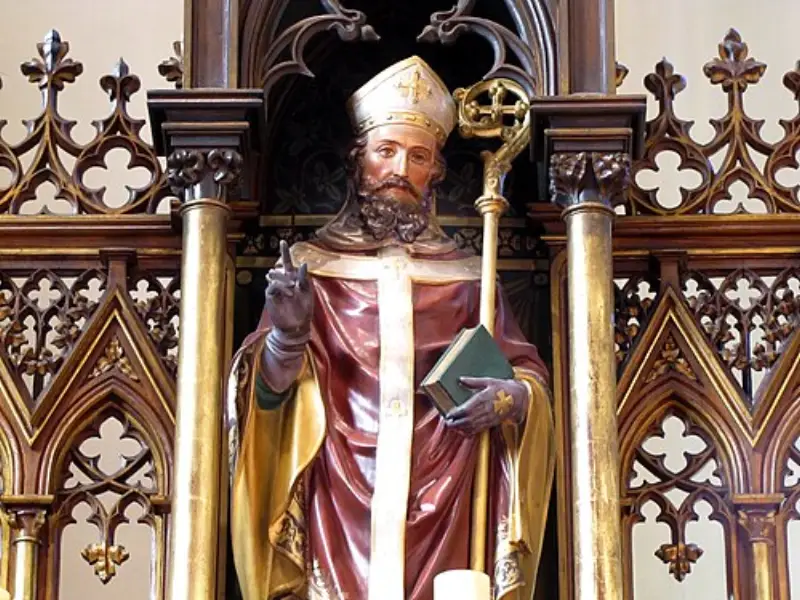
Overview
Amandus, commonly Saint Amand, born of noble family in Lower Poitou about 584, was a bishop of Tongeren-Maastricht and the principal Catholic missionary of Flanders, honored in France and Belgium as its apostle. Against his family's wishes he became a monk at twenty on the Île d'Yeu, his father threatening disinheritance, then passed fifteen years near Bourges as a pupil of Bishop Austregisilus, living in a cell on bread and water. Consecrated in 628 as a missionary bishop of the Merovingian kingdom, with no fixed diocese attached, he evangelized Ghent at Clotaire II's request and then all Flanders, suffering persecution and hardship until a miracle, the restoration to life of a hanged criminal, turned the people to conversion. He founded the monastery of Elnon, where he later died; angered Dagobert I by demanding the reform of the king's life and was expelled to Gascony; founded two monasteries at Ghent in 633, one on the estate of Saint Bavo; attempted an unsuccessful mission among the Slavs of the Danube; served as bishop of Maastricht from 647 to 650, resigning the see to Remaclus to resume mission; helped Saints Itta and Gertrude found Nivelles; preached again among the Basques at seventy; and died at Elnon Abbey, later Saint-Amand-les-Eaux, at about ninety. He is the patron of brewers, winemakers, merchants, innkeepers, and bartenders.
The Complete Life
Early Life
Amandus was born about 584 in Lower Poitou, in Neustria, the western Frankish kingdom, of a noble family with the means and the intention to secure his future in the world. His own inclination ran otherwise: at twenty he entered the monastery on the Île d'Yeu, an island off the Vendée coast, against the explicit wishes of his family, and his father went so far as to threaten to disinherit him if he did not come home. The young monk held his course, and then moved to deepen it: he went to Bourges and placed himself under Bishop Austregisilus, one of the respected bishops of the age, and there, in the outer solitude of an episcopal city, he lived in a cell for fifteen years on bread and water. The story of Amandus's first forty years is thus a story of renunciation in installments, family, then comfort, then society itself, and it ended, as such stories often did in the Merovingian church, not in a hermit's death but in a commission: the man who had turned his back on the world was to be sent back into it.
§ Life
Missionary Bishop without a See
In 628 Amandus received consecration as a missionary bishop of the Frankish kingdom, and the office was deliberately left without a fixed see: the church needed a bishop free to go where the gospel had not reached. At the request of Clotaire II he evangelized Ghent, then extended his work to all Flanders, a country of pagan Franks and Frisians where his first success was small: he was persecuted and the work cost him dearly. The turn came, the Vita says, with a miracle: he brought back to life a hanged criminal, and the attitude of the people changed, and many were converted. He founded the monastery of Elnon, later Saint-Amand, and served as its abbot for four years. The pattern of his career was now set: foundation, conflict, expulsion, return. He advised Adalbard of Ostrevent on founding Marchiennes Abbey; he angered Dagobert I by pressing the king to reform his own way of living, and in spite of the intervention of Acarius was expelled from the kingdom, going to Gascony; when Dagobert asked him back to tutor the heir to the throne, he declined.
§ Life
Foundations and Missions
Amandus's middle and old age are an atlas of Merovingian Europe. In 633 he founded two monasteries at Ghent, one at Blandinberg and one on the estate given by Saint Bavo, the nobleman whose conversion began the second great monastic city of Flanders. Tournai received an abbey from him in 639. His next mission field lay far to the east, in the Danube valley among its Slavic peoples, in the Slovakia of today — an effort that came to nothing, and on which he traveled to Rome to report to the pope. From 647 to 650 he served as bishop of Maastricht, the see of Tongeren-Maastricht whose stubborn pagan hinterland was his own country of long labor; the pope counseled him on disobedient clerics and briefed him on the Monothelite controversy then troubling the East, and charged him with convening church councils in Neustria and Austrasia so that Rome's decrees would be put into effect, the bishops entrusting the transmission of the acts to him. He resigned the see to Saint Remaclus to resume the missionary life. He helped Saints Itta and Gertrude establish the great monastery of Nivelles, and at seventy, when the Basque country's inhabitants asked that he come back to the folk he had preached to in vain thirty years before, he went.
§ Life
Final Years
The last years were spent in foundation as in everything else: with the help of King Dagobert he established several more monasteries in present-day Belgium before withdrawing to Elnon, the house he had built and governed, where he died at about ninety, in the year 679. The length of the life is itself the summary: Amandus was active in the Frankish church for well over half a century, outliving most of his collaborators, from Clotaire and Dagobert to Amand's own disciples, and dying in the abbey that carried his name, which became Saint-Amand-les-Eaux and kept his tomb. His body remained there through the Middle Ages as one of the pilgrimages of the frontier lands, and the Walters Art Museum preserves the enamel shrine made for his relics. The Vita Sancti Amandi, written within a generation by Beaudemond and expanded later by Philippe, abbot of Aumône, is the source of nearly everything recounted above, one of the better Merovingian lives.
§ Life
Cult
Amandus's sanctity was public property long before any process could have certified it: he was venerated as a saint in Flanders and Picardy from his death, and the cult spread with the monastic network he had founded, carried by his disciples and by the houses that claimed him as father. The Eastern Orthodox Church likewise honors him, keeping his memory with the western date. His feast is 6 February, with February 1 and October 26 appearing in the older calendars, including the fifteenth-century calendar of the Diocese of Liège. In England at least one private chapel, at East Hendred in Oxfordshire, is dedicated to him, a trace of the wider medieval diffusion. The attributes of his iconography, a chair, a church, and a flag, are the emblems of a bishop, a founder, and a missionary standard-bearer, which is precisely what the tradition held him to be: the principal evangelist of Belgium.
§ Introduction
Legacy
No saint of the early Middleiards did more to plant Christianity in the Low Countries. The faith of Flanders, which would produce the medieval cloth towns' great churches, the Beguines, and Thomas à Kempis's world upstream, owed its first systematic preaching to Amandus; the monasteries he founded, Elnon, Ghent's St. Bavo, Nivelles by his counsel, Marchiennes by his advice, became the institutional skeleton of the church in the north. His popular patronage has proved the most durable of all: as the patron of all who produce beer, brewers, maltsters, innkeepers, and bartenders, and of the vine growers and merchants as well, he presides over the convivial trades of the very lands he evangelized, a folk memory of the missionary's own hospitality. He is honored also as a patron of the Boy Scouts, a modern extension of the wandering ideal his whole life embodied. Belgium has kept his name in its towns and its churches, and historians from Krusch to de Moreau have kept the facts.
§ Life
Timeline
- 584
Born of noble family in Lower Poitou
§ Introduction
- 604
Becomes a monk at twenty on the Île d'Yeu, against his family's wishes
§ Life
- 610
Enters Bourges as a pupil of Bishop Austregisilus, living fifteen years in a cell on bread and water
§ Life
- 628
Made a missionary bishop without a fixed diocese; at Clotaire II's request begins preaching to the pagans of Ghent
§ Life
- 630
Returns to the Merovingian kingdom, before his later expulsion by Dagobert I and exile in Gascony
§ Life
- 633
Founds two monasteries at Ghent, one at Blandinberg and one named for St. Bavo
§ Life
- 639
Builds an abbey near Tournai
§ Life
- 647
Begins a brief tenure as Bishop of Maastricht
§ Life
- 650
Resigns the see of Maastricht to St. Remaclus to take up missionary work again
§ Life
- 679
Dies at Elnon Abbey (Saint-Amand-les-Eaux) at about ninety
§ Life
The Record
- Patron of
- Brewers and beer makers·Winemakers and vine growers·Merchants·Innkeepers·Bartenders·Boy Scouts·Flanders and Belgium
- Symbols
- Chair, church, and flag·Bishop's vestments·Serpent (from the manuscripts)
- Canonization
- Pre-congregation (ancient cult, venerated in the Catholic and Eastern Orthodox churches)
Prayer
Bibliography
Show 12 sources
- ↑ "Shrine of Saint Amandus", The Walters Art Museum
- ↑ February 19 / February 6. https://www.holytrinityorthodox.com/htc/orthodox-calendar/
- ↑ Calendar of Saints in the Diocese of Liège (15th c.).
- 1 2 "Vita S. Amandi [ manuscript ] " . lib.ugent.be . Retrieved 2020-08-24 .
- ↑ Kreiner, Jamie. The Social Life of Hagiography in the Merovingian Kingdom , Cambridge University Press, 2014, p. 207 ISBN 9781107050655
- 1 2 3 Campbell, Thomas (1907). "St. Amandus", The Catholic Encyclopedia . Vol. 1. New York: Robert Appleton Company.
- ↑ "Saint Humbert", Nominis
- ↑ St. Humbert - Saints & Angels - Catholic Online
- ↑ Monks of Ramsgate. “Humbert of Marolles”. Book of Saints , 1921. CatholicSaints.Info. 5 September 2013 This article incorporates text from this source, which is in the public domain .
- 1 2 "Saint Amandus Recues a Man From Judicial Vengeance", Vengeance in Medieval Europe: A Reader , (Daniel Lord Smail, Kelly Gibson, eds.), University of Toronto Press, 2009, p. 115 ISBN 9781442601260
- ↑ " "Saint Amandus", Treasures of Heaven , Columbia University" . Archived from the original on 2016-03-06 . Retrieved 2015-12-26 .
- 1 2 Fell, Charles and Challoner, Richard. "St. Amandus, Bishop", The Lives of Saints: Collected from Authentick Records of Church History , T. Osborne, 1750, p. 143 This article incorporates text from this source, which is in the public dom
Profile text adapted from the Wikipedia article, licensed CC BY-SA 4.0.
Pray with this saint every day
Save St. Amandus to your favorites, read the full profile, and get feast-day reminders in the Saints app.
Get the Saints AppFree on the App Store for iPhone and iPad