
1226-1292·Feast May 8
St. Amato Ronconi
Lay Franciscan and Founder of Hospices
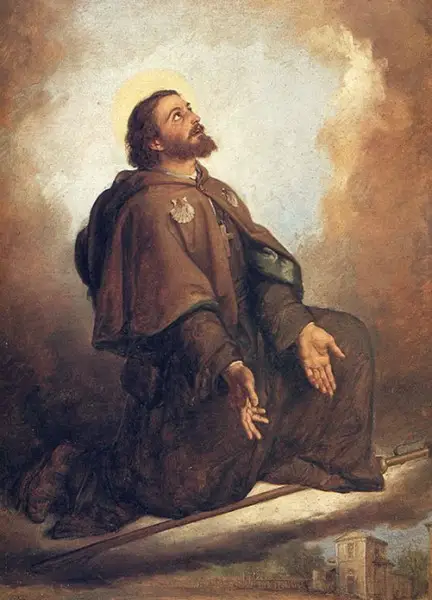
Overview
Amato Ronconi, born in 1226 at Saludecio near Rimini, was an Italian Catholic layman who embraced life as a professed member of the Secular Franciscan Order and ranked among the great hospital founders of the Romagna. Orphaned in childhood and raised in the house of his older brother Giacomo, he was the landless younger son of a noble family and worked as a farmhand. Declining the marriage his sister-in-law Lansberga pressed on him, he turned the small house and land his brother gave him, which stood on the pilgrim road from Rimini to Rome, into a hospice for pilgrims, giving away his possessions to the poor, working the fields to support the work, and living for a time as a hermit. Slandered by Lansberga, he was cleared after investigation. He built chapels and shelters along the roads, several of which survive, including a hospital in Rimini still in service. He walked four times to Santiago de Compostela and visited the shrines of Rimini and San Marino. Warned of his death, he gave his last possessions to the Benedictines of San Giuliano and died on 8 May 1292, acclaimed a saint by his townsmen in his lifetime.
The Complete Life
Early Life
Amato was born in 1226 at Saludecio, a hill town of the Romagna in the Papal States behind Rimini, into a noble and wealthy household that his own life would strip to nothing. His parents died in his childhood, and he was raised in the home of his elder brother Giacomo, with at least one sister, Chiara. Being the landowner's younger son, he could expect no fortune of his own, and he worked as a farmhand, an aristocrat's son at the plow. His sister-in-law Lansberga, wishing to marry him to her own younger sister and keep the estate in the family, urged him persistently toward marriage; Amato, however, had already resolved to serve the Lord in the hermit's life, and by that refusal made himself unwelcome. To preserve family harmony, Giacomo granted his brother a house with a small parcel of land as his inheritance, and there, with his sister, he settled to work the soil. The house stood on the road from Rimini to Rome, the pilgrim road, and its position chose his life's work for him.
§ Life
Vocation
The house on the pilgrim road became a hospice. Amato opened it to the pilgrims making their way to Rome, fed them from the land he worked himself, and gave up all his possessions to the poor of the district, retaining only what fed the guests. Lansberga's anger turned to slander: knowing the affection between brother and sister, she spread the rumor that Amato and Chiara lived in incest, a charge investigated and proven false, an episode the sources record with the plainness of a real town's memory. Vindicated, Amato joined the Secular Franciscan Order, the tertiary life that let a layman live the Franciscan ideal in the world, and adopted for a period the life of a hermit before emerging to build. His vocation joined the two great currents of thirteenth-century Italian piety, the Franciscan love of poverty and the older tradition of xenodochia, the hospices for pilgrims and the sick, and he pursued it as a layman, without orders, without a community, on his own land and with his own hands.
§ Life
Mission
The mission was construction and welcome. From his base at Saludecio, Amato built chapels and shelters for pilgrims along the roads of the Romagna, and several of those places still exist, among them a hospital in Rimini that continues to serve, one of the small miracles of institutional continuity in the history of charity; the original hospice at Saludecio is today the Casa di Riposo Pia Beato Amato Ronconi, a retirement home keeping his name and his work in one. His own pilgrimages extended the pattern: he walked to the tomb of Gaudentius at Rimini, to the cave of Marinus on Monte Titano above San Marino, and four times, across the Alps and the whole length of France, to the tomb of James at Santiago de Compostela, journeys of months each, on which several miracles were reported. The roads he built for others he also walked himself, and the Franciscan habit made the point that the hospice and the pilgrimage were one devotion: the world as a road, and the Christian as its servant.
§ Life
Final Years
Attempting a fifth journey to Compostela, Amato was stopped, the tradition says, by an angel who told him his death was near and that he must return home. He turned back and stopped at the Benedictine convent of San Giuliano at Rimini, where on 10 January 1292 he gave the community the remainder of his possessions, disposing of the last of what he had held. He died at Saludecio on 8 May 1292, aged about sixty-seven, already recognized by his townsmen as a saint, the contemporary record noting that the residents hailed him as such in his lifetime. His first resting place was destroyed by fire, and in May 1330 his remains were translated to the church of San Biagio at Saludecio, where they rest beneath the altar and where his cult has been centered ever since.
§ Life
Canonization
Ronconi's path to the altar ran across eight centuries. The popular cult was old and continuous, and its formal confirmation allowed Pope Pius VI to beatify him on 17 April 1776. In 1997 the parish of San Biagio at Saludecio and the Pia Unione del Beato Amato revived the process of canonization, gathering the evidence of his life, his works and his continuing intercession, and the cause advanced under St. John Paul II before its completion under his successors: Pope Francis canonized Amato Ronconi in Saint Peter's Square on 23 November 2014. The canonization of a thirteenth-century lay tertiary, a farmhand and hospice-keeper, was read as a deliberate word about the laity, about poverty, and about the works of mercy, and Saludecio celebrated its son with the festivals of a town that had waited seven hundred years.
§ Canonisation
Legacy
Amato Ronconi's legacy is institutional and exemplary at once. Institutionally, the works he founded have never closed: the hospital at Rimini and the Casa di Riposo at Saludecio carry his hospice work into the twenty-first century under his name, and the chapels he built stand along roads that pilgrims walk again. Exemplarily, he is the church's model of the lay founder, the man without orders or community who built a ministry of welcome out of a farmhand's wages and a small inheritance, against family opposition and public slander. His canonization placed him before the whole church as an answer to the question of what a lay person's holiness looks like: the Secular Franciscan rule lived without softening, and the corporal work of sheltering pilgrims done until death. The people of the Romagna, who kept his memory through every change of state, saw in 2014 the confirmation of what they had said since 1292.
§ Life
Timeline
- 1226
Born at Saludecio near Rimini into a noble household; orphaned in childhood and raised by his older brother Giacomo
§ Introduction
- 10 Jan 1292
An angel warns him of approaching death, so he abandons a fifth Compostela pilgrimage and gives his remaining goods to the convent of San Giuliano in Rimini
§ Life
- 8 May 1292
Dies at Saludecio, aged about sixty-seven, revered as a saint in his own lifetime
§ Introduction
- May 1330
After his first burial place is destroyed by fire, his remains are translated to the church of San Biagio in Saludecio
§ Life
- 17 Apr 1776
Pope Pius VI beatifies him in Rome upon confirmation of his enduring local cultus
§ Canonisation
- 1997
The parish of San Biagio and La Pia Unione del Beato Amato revive the cause for his canonization
§ Canonisation
- 23 Nov 2014
Pope Francis canonizes him in Saint Peter's Square alongside five other blesseds
§ Canonisation
The Record
- Patron of
- Saludecio·Pilgrims and hospice workers
- Symbols
- Franciscan habit·Pilgrim's staff
- Canonization
- Beatified 17 April 1776 by Pope Pius VI (confirmation of cult); canonized 23 November 2014 by Pope Francis
Prayer
Bibliography
Show 8 sources
- 1 2 "Amato Ronconi", Congregrazione delle Cause dei Santi
- 1 2 3 "Blessed Amatus Ronconi" . Retrieved 3 December 2014 .
- 1 2 "Saint Amatus Ronconi" . Saints SQPN. 2014 . Retrieved 3 December 2014 .
- 1 2 3 "8 maggio 1292 - Muore a Rimini il santo Amato Ronconi da Saludecio" [ 8 May 1292 – The saint Amato Ronconi da Saludecio dies in Rimini ] . Chiamami Città (in Italian). 7 May 2023 . Retrieved 11 January 2024 .
- 1 2 "Saint Amato Ronconi" . Santi e Beati . Retrieved 30 May 2016 .
- ↑ "Pope Francis to Preside Mass of Canonization on Feast of Christ the King", Salt + Light Media, November 19, 2014
- 1 2 Odden, Per Einar. "Den hellige Amatus Ronconi (~1225-1292)", Den katolske kirke, June 17, 2006
- ↑ Rite of canonization of blesseds: Giovanni Antonio Farina, Kuriakose Elias Chavare of the holy family, Ludovico of Casoria, Nicola of Longobardi, Euphrasia Eluvathingal of the sacred heart, Amato Ronconi
Profile text adapted from the Wikipedia article, licensed CC BY-SA 4.0.
Pray with this saint every day
Save St. Amato Ronconi to your favorites, read the full profile, and get feast-day reminders in the Saints app.
Get the Saints AppFree on the App Store for iPhone and iPad