
died 418·Feast May 1
St. Amator of Auxerre
Bishop of Auxerre
Overview
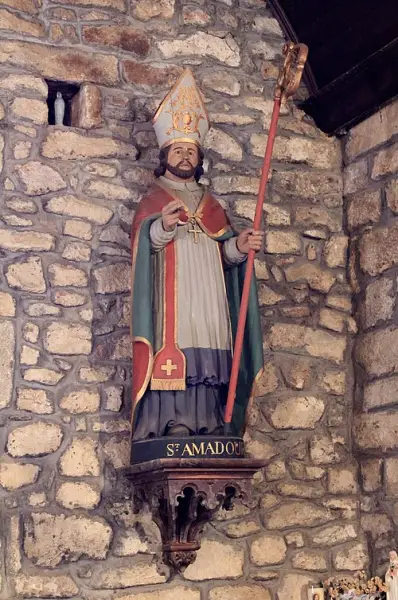
Amator — in French, Amadour or Amatre — occupied the see of Auxerre from 388 to his death on 1 May 418; the Catholic Church venerates him as a saint and keeps his feast on 1 May. His family was wealthy Auxerre upper class; he studied theology under Valerian, the city's bishop, yet to satisfy his parents he took as wife a holy woman from Langres whom locals venerate as Saint Martha. When the newlyweds came to church for their nuptial blessing, Bishop Valerian — in error, or as some believe through a special act of Providence — recited over them not the marriage prayer but the office of consecration to God's service; husband and wife resolved to live as brother and sister, Martha entered the religious life as a nun, and the clerical tonsure was given to Amator. Succeeding Eladius as bishop in 388, he governed the see thirty years, built two churches, converted the remaining pagans of his diocese, and introduced the relics of Saint Cyricus into France, propagating that saint's cult. His most famous act involved Germanus, a duke who had hung hunting trophies on a tree formerly the site of pagan worship; remonstrance failing, Amator ordered the tree felled and the trophies burned, and then — dreading the duke's fury and sensing his own death at hand — gave Germanus the tonsure despite his objections, declared that he would one day succeed him, and ordained him a deacon. On Amator's death Germanus was unanimously elected bishop, and Germanus himself wrote a biography of Amator. He is depicted in art as a bishop with an axe and a tree.
The Complete Life
Early Life and Marriage
Amator was of a wealthy, upper-class family of Auxerre, and studied theology under Valerian, the bishop of the city. To gratify his parents he wed a holy Langres woman whom the local faithful honor as Saint Martha. The wedding acquired its famous twist in church: as the couple knelt for their nuptial blessing, Bishop Valerian — in error, or, as some hold, through a special act of Providence — recited over them, in place of the marriage prayer, the office consecrating them to God's service. Once married, the two resolved by mutual consent to share their lives as brother and sister. Martha in time took the veil as a nun while Amator accepted the clerical tonsure: the marriage meant to anchor him in the world turned out to be the very door through which both spouses departed it.
§ Amator of Auxerre
Episcopate
Amator succeeded Eladius as bishop of Auxerre in 388 and governed the see for the next thirty years. His episcopate was a program of Christianization: he built two churches, converted the remaining pagans of his diocese, and introduced the relics of Saint Cyricus into France, propagating that child-martyr's cult across Gaul. It was the classic work of the late fourth-century Gallic bishop — buildings, preaching, and relics — carried out from one of the oldest sees of the province. Tradition credits him with a reputation for working wonders, in life no less than after death.
§ Amator of Auxerre
Germanus and Succession
The best-known story from Amator's last years concerns Germanus, a resident of Auxerre who numbered among the six dukes to whom the emperor had entrusted the administration of the Gallic provinces. The bishop took offense when Germanus hung his hunting trophies upon a tree which, ages before, had served as a place of pagan worship. Amator's protests went unheeded; so one day, while the duke was away, he had the tree felled and its trophies consumed by fire. The duke wanted him dead; dreading this fury, Amator escaped and petitioned the prefect Julius for leave to bestow the tonsure upon Germanus. Permission secured, and sensing that his own life was nearing its end, he came back; upon the duke's arrival at the church Amator had the doors shut, imposed the tonsure on the reluctant Germanus, bade him conduct himself as the man destined to occupy his see, and raised him to the diaconate. Within a short time Amator was dead, and Germanus — the future apostle of Britain — was unanimously chosen to succeed him.
§ Amator of Auxerre
Veneration
Amator is a pre-congregation saint, commemorated on 1 May, the day of his death in 418. He was buried in the church he had built in honor of the martyr Saint Symphorian, which later bore his own name. His biography was written by his successor, Germanus of Auxerre — a nearly contemporary life — while a medieval life by a certain Stephen is considered a work of fiction. He is occasionally mixed up with a legendary hermit whose feast falls on 20 August, and a tradition at Autun claims him as that city's first bishop in 250, among the seven bishops dispatched to evangelize Gaul under Decius — a claim lacking any historical basis.
§ Amator of Auxerre
Legacy
Amator's legacy is above all Germanus: the bishop whose act of holy audacity gave the church of Britain its apostle. His tree-cutting at Auxerre also left a mark on art — the bishop with the axe — and on the Christian imagination as an emblem of the felling of pagan worship. Rocamadour's commune is reputed to take its name from him: to Amator's name was fastened the legend of the hermit Saint Amadour — figured as Zacchaeus of Jericho and the spouse of Veronica — and the crypt of Saint-Amadour there, together with a Black Madonna credited to the hermit's own carving, turned the cliff sanctuary into one of the medieval age's great pilgrimage centers. Historically, J. B. Bury even proposed that it was Amator who gave Saint Patrick the diaconate at Auxerre.
§ Amator and Rocamadour
Timeline
- 250
A tradition of Autun makes him that city's first bishop, dating his occupancy to the persecution era of Decius
§ Iconography
- 388
Succeeds Eladius as Bishop of Auxerre, beginning a thirty-year rule of the see
§ Amator of Auxerre
- 1 May 418
Dies on 1 May and is buried in the church of Saint Symphorian that he had built
§ Amator of Auxerre
The Record
- Patron of
- Rocamadour (by tradition)
- Symbols
- Bishop's vestments·Axe and tree
- Canonization
- Pre-congregation
Prayer
Bibliography
Show 9 sources
- ↑ (in Greek) Ὁ Ἅγιος Ἀγαπητὸς Ἐπίσκοπος Ὡξέρρης . 1 Μαΐου. ΜΕΓΑΣ ΣΥΝΑΞΑΡΙΣΤΗΣ.
- ↑ The Cyclopedia of Biblical, Theological, and Ecclesiastical Literature , (James Strong and John McClintock, ed.) Harper and Brothers; NY; 1880 This article incorporates text from this source, which is in the public domain .
- 1 2 Butler, Alban. “Saint Amator, Bishop of Auxerre, Confessor”. Lives of the Fathers, Martyrs, and Principal Saints , 1866. CatholicSaints.Info. 4 May 2013
- ↑ MacErlean, Andrew. "St. Germain." The Catholic Encyclopedia. Vol. 6. New York: Robert Appleton Company, 1909. 26 Jan. 2013
- ↑ Bury, J.B., "Sources of the Early Patrician Documents", The English Historical Review , (Mandell Creighton et al, eds.), Longman., July 1904, p. 499
- ↑ Hosie, Bronwen. "The solution to the ‘Two St Patricks’ theory", The History Press, March 16, 2018
- ↑ Hughes, Kathleen. "The church in Irish society, 400-800", A New History of Ireland: Prehistoric and early Ireland , (Daibhi O Croinin, ed.) Oxford University Press, 1976, ISBN 9780198217374 , p. 302
- ↑ Monks of Ramsgate. “Amator”. Book of Saints , 1921. CatholicSaints.Info. 30 May 2012
- ↑ Clugnet, Léon. "Rocamadour." The Catholic Encyclopedia. Vol. 13. New York: Robert Appleton Company, 1912. 27 Apr. 2013
Profile text adapted from the Wikipedia article, licensed CC BY-SA 4.0.
Pray with this saint every day
Save St. Amator of Auxerre to your favorites, read the full profile, and get feast-day reminders in the Saints app.
Get the Saints AppFree on the App Store for iPhone and iPad