
c. 560-627·Feast September 13
St. Amatus
Abbot of Remiremont, Hermit of the Columbanian Tradition
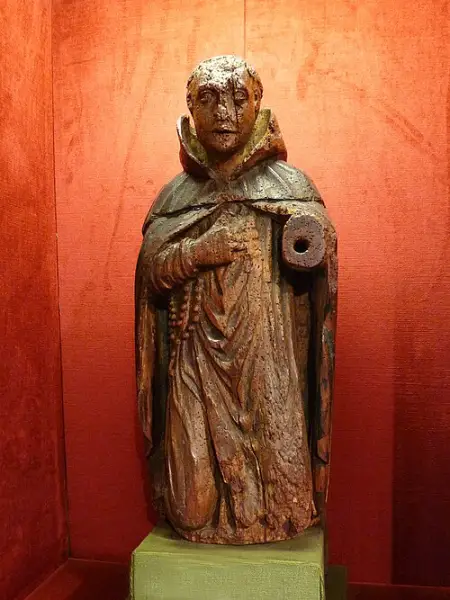
Overview
Amatus — also known as Amatus of Grenoble, Amatus of Remiremont or Saint Amé — was a Frankish monk and hermit in the Columbanian tradition, living from about 560 to 627. Born to a noble family at Grenoble, he entered the Abbey of St. Maurice at Agaunum around 581 and at the age of thirty withdrew to a hermitage, where his reputation for penance and prayer, and the grace of miracle-working attributed to him, drew the attention of Eustace of Luxeuil, who persuaded him to join the community founded by St. Columbanus. On a missionary journey to the court at Metz he converted St. Romaric, a former count palatine of King Theodebert II, and together the two men founded the double monastery of Remiremont on land that had belonged to Romaric. Amatus became its first abbot and established there the Laus perennis, the Perpetual Praise, an unbroken succession of psalmody maintained day and night by the monks and nuns of the house. He died in 627 and was buried, at his own request, just outside the church door; Pope Leo IX canonized him on 3 December 1049, and his memorial is kept on September 13.
The Complete Life
Early Life
Amatus was born around 560 into a noble Grenoble family, in the Frankish kingdom a generation after the death of Clovis. His childhood belongs to the world of Gallo-Roman aristocracy in the Alps, a class that was rapidly providing the Frankish church with its monks, its bishops, and its founders. Around 581, while still young, he entered the Abbey of St. Maurice at Agaunum, the great Burgundian house established over the relics of the Theban Legion, where the practice of permanent psalmody had been made the foundation of monastic life. There he was formed in a tradition of liturgical prayer that would shape his whole career. At the age of thirty he withdrew to a hermitage, seeking solitude; but his reputation for penance and prayer, together with the gift of working wonders that the age attributed to him, followed him into the desert, and it was this reputation that brought Eustace of Luxeuil, successor of Columbanus, to seek him out and draw him into the Columbanian movement then remaking monasticism in northern Gaul.
Vocation
The vocation of Amatus passed through three stages: monk, hermit, and abbot, each taken up and each in turn laid aside in obedience to a larger call. His entry into Agaunum gave him the liturgical formation; his hermitage gave him the ascetic depth; and the summons of Eustace bound the two into the Columbanian pattern of austere community life. His decisive act was the conversion of Romaric. At the court of Metz, on one of the missionary journeys he undertook as a Luxeuil monk, he won for Christ a nobleman who had served Theodebert II as count palatine, and who owned extensive lands in the Vosges. On those lands the two men founded Remiremont, the 'mountain of Romaric', a double monastery for men and for women living under one rule and one abbot, a form characteristic of the Columbanian houses in which aristocratic families entered religious life together. Amatus, the ex-hermit, became its first abbot.
Mission
The mission of Amatus was the establishment of Remiremont as a house of unceasing prayer. Following the model of Agaunum where he had been trained, he instituted at Remiremont the Laus perennis, the Perpetual Praise, by which choirs of monks and nuns succeeded one another through the hours of day and night so that the psalmody of the community was never silent. To sustain this practice required numbers, discipline, and an organizing genius that the quiet hermit evidently possessed; the institution spread through the Columbanian houses and became one of the distinguishing features of early medieval monasticism in Gaul. His mission also included the formation of Romaric, who would succeed him in the government of the house and be honoured as a saint himself, and the evangelizing work among the rural population of the Vosges valleys that the presence of such a foundation implied. Remiremont would become one of the most celebrated monasteries of France, and its earliest constitution was his work.
Final Years
Amatus died in the year 627, having ruled the abbey he founded for some years and having lived, by the traditional chronologies, into his late sixties; some accounts place his death in 625 or as late as 630. His last recorded wish concerns his burial: he asked to be laid just outside the church door, in the place where those who entered would tread over him, a final act of the humility that had marked his refusal of the hermit's solitude when obedience called. The community did not leave him there. His remains were afterwards moved and honorably placed beneath one of the church's altars — the customary tribute to a founder — so that both the humility of his request and the reverence of his disciples are preserved in the record of his resting place. His death left Remiremont in the hands of Romaric, who carried the work forward, and the Perpetual Praise he had established continued without interruption.
Cult and Canonization
Amatus was formally canonized by Pope Leo IX on 3 December 1049, one of the comparatively few early medieval monks of Gaul to receive a papal canonization in the period when the process was first taking shape. By that date his cult at Remiremont and in the surrounding region was already four centuries old: his vita, the Vita sancti Amati confessoris, had been composed in the decades around 680, probably by one of his own monks, and his feast on September 13 was kept in the dioceses of eastern France. The translation of his relics under the abbey's altar was itself an early act of veneration. Leo IX's decree, issued during the pontiff's journey through the empire, gave universal standing to a cult that had been local, and his memory is particularly honoured at Grenoble, his native city. He thus stands with one foot in the age of monastic sanctity acclaimed by the people and one in the new age of canonization by law.
Legacy
The legacy of Amatus is Remiremont itself, which for a thousand years after his death was one of the great houses of Europe, an imperial abbey of canonesses whose abbess ruled over extensive territories; and beyond it, the ideal of Perpetual Praise that he planted there. The Laus perennis, whatever its practical difficulties, expressed a conviction that has never left the church: that somewhere the praise of God should never cease. His partnership with Romaric remains a model of the way holiness recruits holiness, a hermit converting a courtier and the two becoming founders together. At Grenoble and in the Vosges his name is still attached to churches and places. For historians of monasticism he is a central witness to the Columbanian movement's fusion of hermit austerity, community discipline, and liturgical ambition, and for all who pray the hours he is a reminder that the liturgy of the church is meant to be a river without end.
Timeline
- 560
Born to a noble family at Grenoble in the Kingdom of Burgundy
§ Biography
- 581
Enters the Abbey of St. Maurice at Agaunum
§ Biography
- 627
Dies at Remiremont Abbey and, at his own request, is buried just outside the church door
§ Biography
- 3 Dec 1049
Canonized by Pope Leo IX
§ Veneration
The Record
- Major works
- Co-foundation of Remiremont Abbey·Establishment of the Laus perennis (Perpetual Praise) at Remiremont
- Patron of
- Grenoble (particularly honoured there)
- Symbols
- Hermits'scroll·Abbatical staff·The church door under which he asked to be buried
- Canonization
- Canonized on 3 December 1049 by Pope Leo IX
Prayer
Profile text adapted from the Wikipedia article, licensed CC BY-SA 4.0.
Pray with this saint every day
Save St. Amatus to your favorites, read the full profile, and get feast-day reminders in the Saints app.
Get the Saints AppFree on the App Store for iPhone and iPad