
c. 339-397·Feast December 7
St. Ambrose of Milan
Bishop, Doctor of the Church
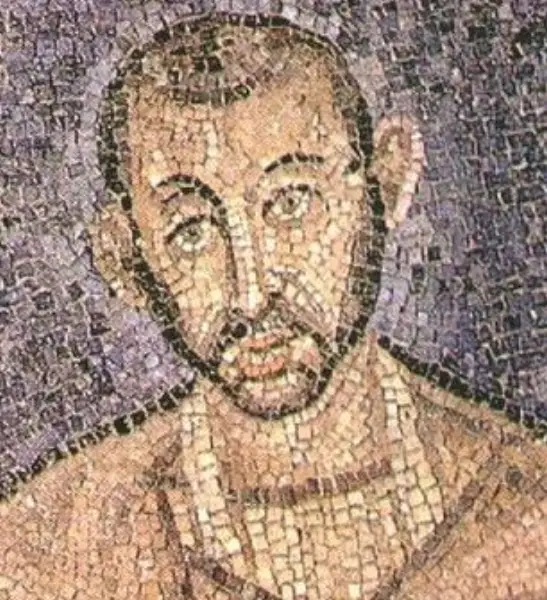
Overview
Aurelius Ambrosius was born around 339 at Augusta Treverorum (Trier), the child of a senior imperial official, and was later schooled in literature, law and rhetoric at Rome. Entering public service, he was named governor of Liguria and Emilia about 372, resident at Milan. When the city's Arian bishop died in 374, Ambrose went to the church to calm the disputed succession and the whole assembly began shouting his name as bishop - although he was not yet baptized. A week later he had been baptized, ordained and consecrated. He gave his money to the poor, studied theology with Simplician, and turned Milan into a bastion of Nicene faith, presiding over the synod of Aquileia that deposed two Arian bishops in 381. He resisted the imperial court's demands to hand a basilica to Arian congregations, and after the massacre of Thessalonica in 390 he required Emperor Theodosius to do penance before receiving communion. His preaching and patient answers to a young professor's questions drew Augustine of Hippo to the faith; Ambrose baptized him at the Easter Vigil of 387. A founder of Latin hymnody and author of a great manual of clerical ethics, he died on 4 April 397 and is venerated at the Basilica of Sant'Ambrogio in Milan.
The Complete Life
Early Life
Aurelius Ambrosius was born around 339 at Augusta Treverorum — modern Trier, then the capital of Gallia Belgica and one of the principal residences of the western imperial court. His family was Roman, Christian, and of Greek descent, comfortably placed within the imperial administration; scholars debate whether his father was the praetorian prefect of Gaul himself or an official of that administration, but the social world is not in doubt. A famous legend attached to his infancy holds that a swarm of bees settled on the sleeping child's face and left a drop of honey, which his father took as a promise of eloquence — the reason bees and beehives follow Ambrose through centuries of sacred art. His father died while the children were young, and his mother, a woman of learning and piety who probably belonged to the Aurelii Symmachi, brought the family to Rome. There Ambrose studied literature, law, and rhetoric alongside his older brother Satyrus, while his sister Marcellina received the veil of virginity from Pope Liberius himself. All three siblings would eventually be honored as saints.
§ Early life
Conversion and Vocation
Trained for public life, Ambrose entered imperial service and rose fast, holding a post as judicial councillor under the praetorian prefect Petronius Probus before receiving, around 372, the governorship of Liguria and Emilia; his seat of government was Milan, by then among the effective capitals of the western empire. His vocation arrived by accident of politics. When Milan's Arian bishop Auxentius died in 374, the succession threatened to split the city, and the governor went personally to the church to keep the peace. While he was addressing the crowd, a single voice called out that Ambrose should be bishop, and the whole assembly took up the cry. The appeal cut across the city's divisions precisely because he was acceptable to both sides — a Nicene Christian in belief who had dealt fairly with Arians in office. Ambrose himself resisted energetically: he was a new Christian, not yet baptized, with no formal theological training. He tried to hide at a colleague's house, and was given up when a letter from Emperor Gratian praising worthy appointments arrived. Within a week he had been baptized, ordained, and consecrated — the first man of the western empire's high official class to accept a bishopric.
§ Bishop of Milan
Mission and Ministry
As bishop, Ambrose immediately rebuilt his life around the office. He gave his money to the poor and donated his lands, keeping only provision for Marcellina; his brother Satyrus resigned a prefecture to manage the diocese's temporal affairs so that Ambrose could give himself to the Church. He studied theology under Simplician and set about making Milan a center of Nicene Christianity. The struggle with Arianism dominated more than half his episcopate. At the synod of Aquileia in 381, over which he presided, the Arian bishops Palladius of Ratiaria and Secundianus of Singidunum were deposed after Palladius declined to defend his position. He resisted repeated pressure from the court of the young Valentinian II to surrender basilicas for Arian worship, and when the imperial court at Milan included Arians close to the empress mother, Ambrose's popularity with the city's people proved a political weapon the court could not easily override. His relations with Theodosius I were equally firm: after the massacre of Thessalonica in 390 he excluded the emperor from communion until public penance had been done, an act that fixed for the West the principle that even Christian rulers stand under the discipline of the Church.
§ Arianism
Spirituality and Teaching
Ambrose's influence worked through three channels: preaching, writing, and song. His sermons carried the weight of a trained rhetorician now turned to scripture, and it was precisely this preaching — together with his willingness to answer, again and again, the questions of a restless professor of rhetoric named Augustine — that prepared one of the most famous conversions in Christian history; he baptized Augustine at the Easter Vigil of 387. His writings include the De officiis ministrorum, a manual of clerical ethics built on Cicero but re-founded on scripture, and the Exameron, a cycle of homilies on the six days of creation. He is also a founder of Latin hymnody: at least four hymns, among them the Advent hymn 'Veni redemptor gentium,' are securely his, written for a congregation he taught to sing when the imperial court threatened to seize its churches. His asceticism was practical rather than spectacular — almsgiving, personal poverty, the daily discipline of a public man who modeled the morals he demanded of others.
§ Introduction
Trial and Final Years
The last decade of Ambrose's life was spent consolidating what the first had won: the Nicene settlement in the West, the independence of the Church's leadership toward the court, and Milan's place as the theological capital of northern Italy. He attempted to mediate between Theodosius and the usurper Magnus Maximus, and in 395 he preached the funeral eulogy for Theodosius at Milan, the De obitu Theodosii. His own death came on 4 April 397, and his passing was mourned as the end of an era; Simplician, the teacher from whom he had learned his theology as a new bishop, succeeded him in the see.
§ Introduction
Canonization
Ambrose belongs to the pre-congregation era, honored as a saint from the moment of his death; no formal process of canonization was ever needed or held. Legends about him circulated through the empire before any biography was written, which is one reason modern historians find his exact character hard to fix. His standing was settled instead by the Church's memory: in 1298 Pope Boniface VIII declared him one of the four original Latin Doctors of the Church, alongside Augustine, Jerome, and Gregory the Great. He is venerated by the Catholic Church, the Eastern Orthodox, the Anglican Communion, and several Lutheran bodies, and his relics rest in the Basilica of Sant'Ambrogio in Milan, which bears his name.
§ Introduction
Legacy
Ambrose left the Western Church three durable inheritances. First, a model of the bishop as a public man: an aristocrat and former governor who carried the habits of Roman administration into the service of the Church and demonstrated that an emperor could be made to do penance. Second, a body of teaching — on clerical duty, on scripture, on the sacraments — that shaped Latin theology at the very moment it was taking its final form, above all through Augustine, who never stopped acknowledging what Milan had given him. Third, a sound: the Ambrosian chant and hymns that gave the Latin West congregational song. He remains patron of Milan and, in memory of the bees at the cradle, of beekeepers.
§ External links
Timeline
- 339
Born at Augusta Treverorum (Trier) into a Roman Christian family of Greek descent
§ Introduction
- 372
Appointed governor of Liguria and Emilia, with his headquarters at Milan
§ Early life
- 7 Dec 374
Chosen bishop by popular acclamation after Auxentius dies, and consecrated on 7 December
§ Bishop of Milan
- 377
Begins writing De officiis ministrorum, an ethical commentary completed by 391
§ Works
- 379
Meets Emperor Gratian for the first time during a visit to Milan
§ Gratian
- 380
Presents De Fide, a statement of orthodoxy written at Gratian's request
§ Gratian
- 381
A synod of thirty-two bishops held at Aquileia deposes the Arian bishops
§ Arianism
- 384
Sent by Valentinian II on a successful embassy to dissuade the usurper Magnus Maximus
§ Valentinian II
- 386
Ordered to hand over a Milanese church for Arian use, he refuses before the court
§ Valentinian II
- 388
Likely meets Theodosius I for the first time in Milan after his victory over Maximus
§ Theodosius
- 388
Confronts Theodosius over punishing the bishop who burned the synagogue at Callinicum
§ Attitude towards Jews
- 390
After the massacre at Thessalonica, Theodosius performs public penance at his behest
§ Theodosius
- Apr 393
With Arbogast and Eugenius marching into Italy, he withdraws to Florence
§ Later years and death
- 25 Feb 395
Preaches the funeral oration De obitu Theodosii after the emperor dies at Milan
§ Later years and death
- 4 Apr 397
Dies at Mediolanum (Milan) and is buried in the crypt of the Basilica of Sant'Ambrogio
§ Later years and death
In Their Own Words
If you demand my person, I am ready to submit: carry me to prison or to death, I will not resist; but I will never betray the church of Christ... I will die at the foot of the altar rather than desert it.
When I am at Rome, I fast on a Saturday; when I am at Milan, I do not. Follow the custom of the church where you are.
It was not by dialectic that it pleased God to save His people.
Accordingly, death is a harbor of peace for the just, but is believed a shipwreck for the wicked.
It is not death therefore that is burdensome, but the fear of death.
You are not making a gift of what is yours to the poor man, but you are giving him back what is his. You have been appropriating things that are meant to be for the common use of everyone. The earth belongs to everyone, not to the rich.
The Record
- Major works
- De officiis ministrorum (On the Duties of the Clergy)·Exameron (Six Days of Creation)·De obitu Theodosii (On the Death of Theodosius)·De excessu fratris Satyri (On the Death of His Brother)·De mysteriis·Hymns, including 'Veni redemptor gentium'
- Patron of
- Milan·Beekeepers·Bishops·Candlemakers·Students·Geese·Learning·Bologna
- Symbols
- Bishop's vestments·Bees or a beehive (the swarm that settled on his cradle)·A drop of honey, sign of his eloquence
- Canonization
- Pre-congregation (ancient cult); one of the four original Latin Doctors of the Church, declared by Pope Boniface VIII in 1298
Prayer
Bibliography
Show 7 sources
- ↑ Italian : Sant'Ambrogio [ ˌsantamˈbrɔːdʒo ] ; Lombard : Sant Ambroeus [ ˌsãːt ãˈbrøːs ] .
- ↑ "S. Paulinus in Vit. Ambr. 3 has the following: posito in administratione prefecture Galliarum patre eius Ambrosio natus est Ambrosius . From this, practically all of Ambrose's biographers have concluded that Ambrose's father was a praeto
- ↑ Two laws were recorded from this time. One of these cancelled the "law of toleration" Gratian had previously issued at Sirmium. This toleration allowed freedom of worship to all with the exception of the heretical Manichaeans , Photinians
- ↑ Recent scholarship has tended to reject former views that the edict was a key step in establishing Christianity as the official religion of the empire since it was aimed exclusively at Constantinople and seems to have gone largely unnotic
- ↑ These Christian sources have had great influence on perceptions of this period by creating an impression of overt and continuous conflict that has been assumed on an empire-wide scale, while archaeological evidence indicates that, apart f
- ↑ Romans claimed to be the most religious of peoples. [ 151 ] Their unique success in war, conquest, and the formation of an empire, was attributed to the empire maintaining good relations with the gods through proper reverence and worship
- ↑ Though both Paredi 1964 , pp. 436–440 and Ramsey 2002 , pp. 55–64 give dates for most of Ambrose's writings, the dates from Ramsey are preferred, as the publication is more recent and the author is dating the works from the perspective of
Profile text adapted from the Wikipedia article, licensed CC BY-SA 4.0.
Pray with this saint every day
Save St. Ambrose of Milan to your favorites, read the full profile, and get feast-day reminders in the Saints app.
Get the Saints AppFree on the App Store for iPhone and iPad