
1867 – 1918·Feast August 9
St. Ambrose (Gudko) of Sarapul
Bishop of Sarapul and Yelabuga, Hieromartyr
Overview
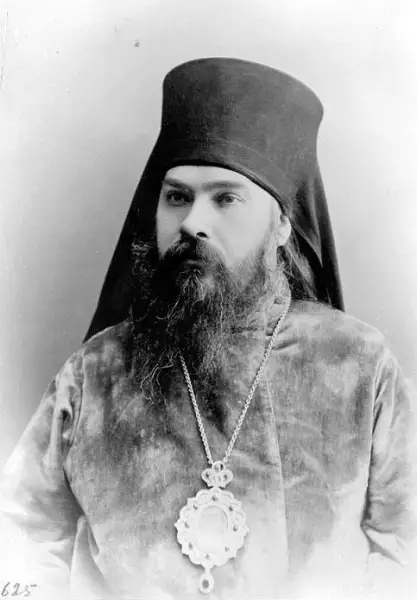
Vasiliy Ivanovich Gudko, in monastic life Bishop Ambrose, was born on 28 December 1867 in the Kholm Governorate of the Russian Empire and became bishop of Sarapul and Yelabuga and one of the first hieromartyrs of the Soviet period. He graduated from the Kholm Ecclesiastical Seminary and, in 1893, from the St. Petersburg Ecclesiastical Academy with a master's degree in theology, having been invested into monastic life in 1891 and ordained hieromonk on 30 May 1893. His career traced the missionary frontiers of the empire: headmaster of the catechist school in the Altay, head of the Korean Ecclesiastical Mission in the rank of archimandrite from 1897, superintendent of the Donskoy Ecclesiastical School in Moscow, and rector of the Volyn Theological Seminary. Consecrated in 1904 as vicar bishop of the Volyn diocese, he moved through Podolsk to Sarapul in 1914, becoming bishop of Sarapul and Elabug in 1916. There he crossed the local social democrats by excluding two liberal figures from Holy Communion, supported the preaching of Christianity among the Tatar population, and campaigned against alcohol, establishing brotherhoods against drunkenness. He was killed at Sarapul on 9 August 1918.
The Complete Life
Formation
Vasiliy Gudko was born on 28 December 1867 in the Kholm Governorate, the western borderland of the Russian Empire where Uniate and Orthodox, Pole and Ruthenian, had contended for centuries and where the church's educational system was a frontier institution. He passed through it in the standard course of the clerical caste: the Kholm Ecclesiastical Seminary, then the St. Petersburg Ecclesiastical Academy, the senior school of the empire's theology, from which he graduated in 1893 with a master's degree in theology. The monastic tonsure came in 1891, while still a student, and the priesthood in the week after his graduation, on 30 May 1893, when he was ordained hieromonk. The combination of degrees and vows marked a man the church intended to use, and the uses it found him were the hard ones: the catechist school of the Altay, the remote mining and mission territory of Siberia, where he served as headmaster from 1893, teaching the children of settlers and of the native peoples.
§ Introduction
Korea, Moscow, Volhynia
In 1897 Ambrose was named head of the Korean Ecclesiastical Mission in the rank of archimandrite, one of the youngest men ever to hold the post, at the beginning of the mission's most difficult period; Korea's gates had only just been forced open to foreign religion, and the Russian mission in Seoul was small, poor, and politically suspect to both Koreans and Western rivals. He returned to the empire in 1899 as superintendent of the Donskoy Ecclesiastical School in Moscow, a teaching post in the capital, and in 1901 became rector of the Volyn Theological Seminary, back in the western borderland of his birth. On 30 April 1904 he was consecrated Krementsky Bishop, vicar of the Volyn diocese, and began his episcopal progress: Baltsky Bishop and vicar of the Podolsky diocese in 1909, then in February 1914 to Sarapul as assistant bishop of the Vyatsky see, and from October 1916 as Bishop of Sarapul and Elabug. The Synod of those years was weighing whether to raise the Sarapul vicariate into a diocese in its own right, a plan the February Revolution overtook.
§ Vicarious bishop
Sarapul and Death
The record of Ambrose's last years shows a bishop at odds with his age in the specific ways that would cost him his life. At the end of 1916 came his conflict with Sarapul's social democrats, in the course of which he barred from Holy Communion two leading local liberals, Mikhel, who served as trustee of the parish school of Saint Nicholas, and Polyakov, an act of discipline his enemies did not forget. Many looked on him as an advocate of vigorous missionary preaching to the Tatar people across the Vyatka lands, the missionary conviction of his Altay years carried into a Muslim-majority region. And he preached against alcohol, with his blessing establishing district brotherhoods for the fight against drunkenness in Sarapul and Elabug, a work that made him beloved of the peasant families the drink was destroying and hated by the interests it fed. He was killed at Sarapul on 9 August 1918, in the first wave of the Bolshevik terror against the rural episcopate. The Russian Orthodox Church canonized him in the Jubilee Bishops' Council of 2000, among the new martyrs, keeping his feast on the day of his death.
§ Introduction
Timeline
- 28 Dec 1867
Born Vasiliy Ivanovich Gudko in the Kholm Governorate
§ Introduction
- 1891
Received into monastic life
§ Monk, Missionary, Teacher
- 1893
Finishes the St. Petersburg Ecclesiastical Academy with a master's degree in theology
§ Education
- 30 May 1893
Ordained a hieromonk
§ Monk, Missionary, Teacher
- 1893
Named headmaster of a catechist school in the Altay
§ Monk, Missionary, Teacher
- 1897
Made archimandrite and placed in charge of the Korean Ecclesiastical Mission
§ Monk, Missionary, Teacher
- 1899
Appointed superintendent of Moscow's Donskoy Ecclesiastical School
§ Monk, Missionary, Teacher
- 1901
Becomes rector of the Volyn Theological Seminary
§ Monk, Missionary, Teacher
- 30 Apr 1904
Consecrated Krementsky Bishop, vicar of the Volyn diocese
§ Vicarious bishop
- 27 Feb 1909
Translated as Baltsky Bishop, vicar of the Podolsky diocese
§ Vicarious bishop
- 14 Feb 1914
Named Sarapul Bishop, vicar of the Vyatsky diocese
§ Vicarious bishop
- 5 Oct 1916
Becomes Bishop of Sarapul and Elabug; his conflict with local social democrats begins weeks later
§ Vicarious bishop
- 9 Aug 1918
Killed at Sarapul
§ Introduction
- 2000
Canonized by the Russian Orthodox Church's Jubilee Bishops' Council
§ Introduction
The Record
- Patron of
- Missionaries·Those fighting alcoholism·Bishops under persecution
- Symbols
- Bishop's vestments·Palm of martyrdom
- Canonization
- Canonized in 2000 by the Jubilee Bishops' Council of the Russian Orthodox Church
Prayer
Profile text adapted from the Wikipedia article, licensed CC BY-SA 4.0.
Pray with this saint every day
Save St. Ambrose (Gudko) of Sarapul to your favorites, read the full profile, and get feast-day reminders in the Saints app.
Get the Saints AppFree on the App Store for iPhone and iPad