
1812-1891·Feast October 23 (New Style); July 10 (Uncovering of the Relics)
St. Ambrose of Optina
Hieroschemamonk and Elder of Optina Monastery
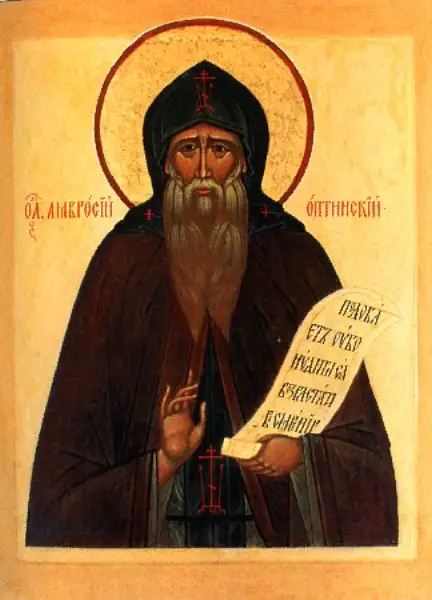
Overview
Aleksandr Mikhaylovich Grenkov, the future Ambrose of Optina, was born on 5 December 1812 at Bolshaya Lipovitsa in Tambov guberniya, the sixth of eight children of a village sexton, and given the schooling of the clerical estate: Tambov clerical school and theological seminary. In 1835, severely ill shortly before graduation, he vowed to become a monk if he recovered; he recovered, and delayed, working as a private tutor and at the Lipetsk clerical school until a meeting with the elder Hilarion of Troekurovo, who told him plainly to go to Optina. He entered the monastery in October 1839, was formed by the elders Leonid and then Makary — sharing a cell with the latter — and was tonsured in 1842, taking the name Ambrose in honor of Ambrose of Milan; he was ordained hieromonk in 1845. Cold caught on the journey to his ordination broke his health almost entirely; forced into semi-reclusion, he used the years to master the Jesus Prayer and the silence of hesychia, and to assist Makary in translating the Fathers, above all The Ladder of Divine Ascent. On Makary's death in 1860 Ambrose became Optina's principal elder, and for thirty years received an endless stream of pilgrims, seeing them even when he could no longer stand; Tolstoy and Dostoevsky came among them. In 1884 he founded Shamordino Convent, open to women too poor or sick for other houses. He died at Shamordino on 10 October 1891, and was buried at Optina.
The Complete Life
A Sexton's Son of Tambov
Aleksandr Grenkov was born into the lower clerical estate of the Russian Empire, the class that supplied the parish clergy generation after generation: his father Mikhail was the sexton of Bolshaya Lipovitsa, his grandfather had been the village priest, and of the eight children he was the sixth. At twelve he entered the Tambov clerical school and went on to the Tambov theological seminary, the standard track toward ordination. In 1835, shortly before graduation, he fell severely ill and made the classic vow of the ambivalent: if he recovered, he would become a monk. He recovered — and did not become a monk. Instead he taught, first as a private tutor in a landlord's family, then at the Lipetsk clerical school, the vow aging on him through several years of ordinary life. The resolution came through a person, not an argument: in a summer vacation he met the well-known elder Hilarion of Troekurovo, whose advice has become one of the small sayings of Russian spirituality — make for Optina and you will come away experienced; Sarov is open to you as well, yet no elders of like experience remain there. In fact, Seraphim of Sarov had just died. Hilarion added the sentence that decided the matter: they need you there.
Optina and the School of the Elders
In October 1839, aged twenty-six, Aleksandr entered Optina Monastery in Kaluga guberniya at the height of its spiritual flowering. His first guide was Starets Leonid (Leo of Optina), the founder of the elderhood there, and after him Starets Makary, with whom Ambrose shared a cell — an apprenticeship conducted at the closest possible range, the disciple watching the elder receive souls day after day. He was tonsured after only three years, in 1842, receiving the name of Ambrose of Milan; three years more and he was ordained hieromonk. On the journey to Kaluga for the ordination he caught cold, and from that point his health was so poor that he could hardly serve as a priest at all. The pattern of his whole ministry was set: a man almost too ill to stand, becoming the most visited confessor in Russia. The sharing of a cell with Makary was itself the formation: the disciple watched the elder receive souls day after day, and inherited the office by proximity.
Illness, Hesychia, and the Elderhood
Ambrose's forced semi-reclusion for several years became, in the economy the elders themselves taught, his formation. Unable to serve, he gave himself to mastering the Jesus Prayer and to hesychia — the soul's silence before God — and to the translation work of Makary's circle, which carried the Philokalic tradition into Russian: among the Church Fathers whose works he helped translate was The Ladder of Divine Ascent of John of Sinai. When Makary died in September 1860, Ambrose succeeded him as the monastery's principal elder, an office he would hold for thirty years. The sources describe a paradoxical figure: lively humor and sociable character set against stoic discipline; a body that kept failing set against a schedule no healthy man would attempt. He would receive visitors after passing the point of exhaustion, forced to lie down, and would not refuse anyone who came. Contemporaries testified to clairvoyance and gifts of healing that he tried to conceal, and to his humility in seeking counsel from others — his bishop first, and then a hidden wandering elder to whom he wrote secret letters — rather than trusting even his own gift of reasoning. Leo Tolstoy and Fyodor Dostoevsky both came to see him at Optina; the figure of Elder Zosima in The Brothers Karamazov is haunted by the memory of him, and Elder Nektary called him an earthly angel and a heavenly man.
Shamordino
Ambrose's one great institutional founding came late: in 1884 he established Shamordino Convent near Optina. The house answered a specific cruelty of the age: most Russian convents were so poor that they could survive only by receiving women of personal wealth, which left the poor, the sickly, and the blind with no place to go. Any woman who wanted to become a nun could now come, and Shamordino filled with exactly those women. Once its first abbess, Mother Sophia, had died, he traveled there in June 1890 to set the convent's affairs in order; illness then prevented any return to Optina. He died at the Shamordino cloister on 10 October 1891, old style, and was buried in the Optina poustinia; his relics rested in the monastery's Vvedensky Church until 1998, when their new home became the church honoring the Vladimir Icon of the Mother of God, where pilgrims still form the queue that once formed at his cell.
Glorification
The canonization of Ambrose belongs to the great act of memory that followed the end of the Soviet persecution. The Local Council of the Russian Orthodox Church, meeting in the millenary year of the Baptism of Rus', glorified him on 6 June 1988 under Patriarch Pimen I — the council that lifted the whole cohort of new martyrs and confessors and ancient heroes of Russian piety out of the enforced silence. The Russian Orthodox Church Abroad, which had kept the Optina cult alive in the emigration, glorified him separately on 13 May 1990, and the uncovering of his relics is commemorated on 10 July, new style 27 June. The Optina elders as a body — Leonid, Makary, Ambrose, and their successors — have become one of the most widely consulted schools of eldership in modern Orthodoxy, and Ambrose is the most consulted of them all. The millenary council of 1988 that glorified him lifted a whole cohort of the persecuted and the elders out of the silence, and the emigration's church followed in 1990.
The Elder of the Russian Novel
Ambrose's legacy is double: in the Church and in literature. In the Church, his letters and sayings, published in the Optina collections, remain working tools of spiritual direction — practical, funny, exact — and his pattern of receiving all comers defined the elderhood for the twentieth century; his spiritual descendants carried it to Athos and the diaspora. In literature, he is the most probable living source behind Dostoevsky's Elder Zosima, and the testimony of the novel's first readers confirms it: the pilgrimage to the elder is the doorway into The Brothers Karamazov, and the figure at the door was recognizable. The men and women who queue at his relics at Optina today are, in a sense, still walking into that scene — an endless procession of the exhausted, whom the sick monk received lying down. The Optina collections of his letters and sayings remain in print, and his pattern of receiving all comers defined the elderhood for the century that followed him.
Timeline
- 5 Dec 1812
Born at Bolshaya Lipovitsa, Tambov, son of the sexton Mikhail Grenkov
§ Introduction
- 1835
Falls gravely ill shortly before seminary graduation and vows to become a monk if restored
§ Biography
- Oct 1839
Enters Optina Monastery on the advice of the elder Hilarion
§ Biography
- 1842
Tonsured a monk after three years, receiving the name Ambrose in honour of Ambrose of Milan
§ Biography
- 1845
Ordained a hieromonk three years later; his health breaks after catching cold on the way to Kaluga
§ Biography
- Sep 1860
Succeeds the deceased Macarius as principal elder of Optina
§ Biography
- 1884
Founds Shamordino Convent, open to women who were poor, sickly, or blind
§ Biography
- Jun 1890
Goes to Shamordino after the first abbess dies, to set the convent's affairs in order
§ Biography
- 23 Oct 1891
Dies at the Shamordino cloister and is buried in the Optina poustin
§ Introduction
- 6 Jun 1988
Canonized by the Local Council of the Russian Orthodox Church at the Trinity Lavra of St. Sergius
§ Introduction
- 13 May 1990
Also glorified by the Russian Orthodox Church Abroad at Montreal
§ Introduction
- 1998
Relics translated to the Vladimir-icon church within the monastery grounds
§ Biography
The Record
- Major works
- Assisted translation of the Church Fathers into Russian, including The Ladder of Divine Ascent·Letters of counsel to pilgrims (preserved in Optina collections)
- Patron of
- Optina Monastery·Spiritual directors and elders·The sick
- Symbols
- Monk's habit and klobuk·Scroll (in iconography)
- Canonization
- Canonized 6 June 1988 by the Local Council of the Russian Orthodox Church (Patriarch Pimen I); also glorified by the Russian Orthodox Church Abroad, 13 May 1990
Prayer
Profile text adapted from the Wikipedia article, licensed CC BY-SA 4.0.
Pray with this saint every day
Save St. Ambrose of Optina to your favorites, read the full profile, and get feast-day reminders in the Saints app.
Get the Saints AppFree on the App Store for iPhone and iPad