
1861-1927·Feast March 29 (with the Georgian new martyrs and confessors)
St. Ambrosius the Confessor of Georgia
Catholicos-Patriarch of All Georgia
Overview
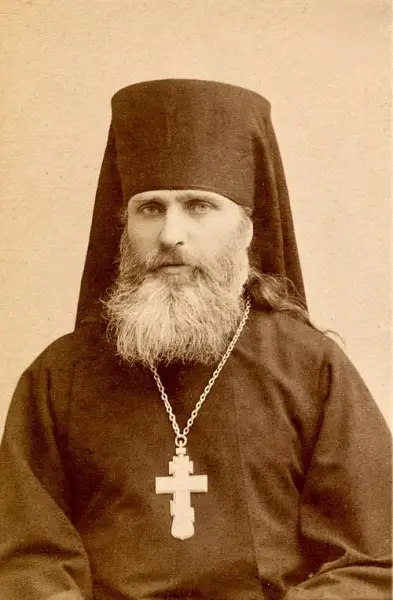
Ambrosius — born Besarion Zosime Khelaia on 7 September 1861 at Martvili in Georgia, then part of the Russian Empire — was a Georgian churchman and scholar who held the office of Catholicos-Patriarch of All Georgia between 1921 and 1927, winning his greatest renown for the resistance he offered the Soviet regime; in 1995 the Georgian Orthodox Church canonized him as Saint Ambrosius the Confessor. After completing the Tiflis Theological Seminary course in 1885, he served as a priest in Abkhazia — Sukhumi, New Athos, and Lykhny — teaching the Georgian language and, under the pseudonym Amber, publishing articles denouncing the policy of Russification. After studies at the Kazan Theological Academy, where his thesis treated the struggle of Christianity against Islam in Georgia, he was tonsured hieromonk in 1901 and raised to the rank of archimandrite. He came forward as one of the moving spirits of the Georgian autocephalist movement, which pressed for the church's independence — abolished by Russia in 1811 — to be given back; for it he was banned from serving, confined at the Troitsky Monastery in Ryazan, and — after the 1908 murder of Exarch Nikon was laid at the autocephalists' door — suspended, deported, and not acquitted until 1910. He returned to Georgia after the 1917 revolution, in which the Georgian church proclaimed its autocephaly, and in 1921 was installed as Catholicos-Patriarch, on 14 October. Under Bolshevik rule he protested the persecution of the church, was arrested and tried in 1923, and died in Tbilisi on 29 March 1927.
The Complete Life
Early Life and Formation
Besarion Khelaia was born on 7 September 1861 at Martvili, in the Kutais governorate of the Caucasus under the Russian Empire. He finished his course at the Tiflis Theological Seminary in the year 1885, and took priestly ordination in Abkhazia, ministering in Sukhumi, at New Athos, and at Lykhny, and giving instruction in the Georgian language. Over the pseudonym Amber he brought out a series of articles attacking Russification policy in Abkhazia and charging local Russian officials with fomenting anti-Georgian feeling among the Abkhaz — an early appearance of the scholarly-patriotic voice that would mark his whole career. In 1896 he enrolled at the Kazan Theological Academy, graduating in 1900 with a thesis on the struggle of Christianity against Islam in Georgia, the historical study of his church's long frontier with the Muslim world.
§ Early life and career
Monk and Autocephalist
Tonsured a hieromonk in 1901, Ambrosius returned to Georgia as archimandrite of the Chelishi Monastery in Racha, and in 1904 was transferred to the Synodal office in Tbilisi. Across the first decade of the century he rose into the front rank of the Georgian autocephalist movement, pressing for the independent Orthodox Church of Georgia — done away with by Imperial Russia in 1811 — to be restored. The case the autocephalists made was concrete: under the Russian exarchs, the Georgian church had lost some 140 million rubles' worth of property, its schools shut down, the liturgy's Georgian discouraged, twenty episcopal sees standing empty, and seven hundred forty parishes left without pastors. The 1905 conference of Georgian clergy at Tbilisi was broken up by police; Ambrosius was forbidden to celebrate the liturgy and shut away in the Troitsky Monastery at Ryazan. After the murder of Exarch Nikon in May 1908 — never solved — the Russian authorities used the crime as a pretext to remove Georgian bishops; Ambrosius was suspended and deported, acquitted only in 1910, and not allowed home until the events of 1917.
§ Autocephalist movement
Catholicos-Patriarch under the Bolsheviks
The February Revolution of 1917 gave the Georgian church its opening: on 12 March 1917 a group of Georgian clergymen proclaimed autocephaly and elected Bishop Kyrion as Catholicos-Patriarch, a move the Russian Holy Synod refused to recognize. After Georgia's short independence and the Bolshevik conquest of 1921, Ambrosius was installed as Catholicos-Patriarch of All Georgia on 14 October 1921. His patriarchate coincided with the beginning of the Soviet persecution of religion: confiscation of church property, closure of churches, pressure on the clergy. Ambrosius answered as the autocephalists had always answered — with protest and documentation, most famously in his appeal to the international community in 1922, calling the world's attention to the condition of church and nation under the new regime. For this defiance he was arrested in 1923 and put on trial, where he defended the church's conduct with the same composure he had shown before the tsar's police.
§ Autocephalist movement
Final Years
Ambrosius's last years were the aftermath of his trial: imprisonment, the wreck of his health, and release from custody when he was already dying. He died in Tbilisi on 29 March 1927 in the Georgian SSR, aged sixty-five, having held the patriarchal throne for five and a half years that encompassed the most dangerous moment the Georgian church had faced since the abolition of its independence. He was succeeded by Christophorus III.
§ Introduction
Canonization
The Georgian Orthodox Church canonized Ambrosius in 1995, in the first years after the fall of the Soviet Union, as Saint Ambrosius the Confessor — Ambrosi Aghmsarebeli — placing him at the head of the church's memory of those who had suffered for its freedom under both empires. He was glorified among the new martyrs and confessors whose cult, restored after 70 years of suppression, reconnected the restored-autocephaly Georgian church with the generation that had first reclaimed it.
§ Introduction
Legacy
Ambrosius's legacy is the independence he served for forty years — as seminarian, scholar, journalist, exiled monk, and finally patriarch. The Georgian church whose autocephaly he championed under the tsars, proclaimed in 1917, defended before the Bolsheviks in the 1920s, and recovered in 1917-1943 and after 1991, remembers him as its confessor: the scholar-priest who argued the case in print and then paid for it in person. His life spans the whole arc of modern Georgian church history, from Russification to recognition, and his canonization in 1995 sealed that history with the church's own judgment of sanctity.
§ Introduction
Timeline
- 7 Sep 1861
Born Besarion Khelaia at Martvili, then part of the Russian Empire
§ Introduction
- 1885
Graduated from the Tiflis Theological Seminary and ordained a priest in Abkhazia
§ Early life and career
- 1896
Enrolled at the Kazan Theological Academy
§ Early life and career
- 1900
Graduated from the Kazan Theological Academy, having written a thesis on Christianity and Islam in Georgia
§ Early life and career
- 1901
Tonsured a hieromonk, then made archimandrite of the Chelishi Monastery in Racha
§ Early life and career
- 1904
Transferred to the Synodal Office in Tbilisi and named archimandrite of the Monastery of the Transfiguration
§ Early life and career
- 1905
After police broke up the Tbilisi clergy conference he was barred from the liturgy and confined at Ryazan's Troitsky Monastery
§ Autocephalist movement
- 28 May 1908
After Exarch Nikon was murdered in Tbilisi, he was suspended from serving and deported to Russia
§ Autocephalist movement
- 1910
Acquitted over the Nikon murder affair
§ Autocephalist movement
- 12 Mar 1917
Georgian clergymen proclaimed the church's autocephaly in Tbilisi and elected Kyrion Catholicos-Patriarch
§ Autocephalist movement
- 1917
Consecrated Metropolitan of Chkondidi and afterwards transferred to Abkhazia
§ Autocephalist movement
- 14 Oct 1921
Elected Catholicos-Patriarch of All Georgia, succeeding the late Leonid
§ Catholicos Patriarch of All Georgia
- 7 Feb 1922
Sent a memorandum to the Genoa Conference protesting the Soviet occupation of his country
§ Catholicos Patriarch of All Georgia
- Feb 1923
Arrested with the whole Patriarchal Council and imprisoned by the Bolshevik authorities
§ Catholicos Patriarch of All Georgia
- Mar 1924
Staged public trial ended with an eight-year prison sentence and confiscation of his property
§ Catholicos Patriarch of All Georgia
- 1926
Released from prison together with several other clerics
§ Catholicos Patriarch of All Georgia
- 29 Mar 1927
Died in Tbilisi in the Georgian SSR
§ Introduction
- 1995
Canonized by the Georgian Orthodox Church as Holy Archpriest Ambrosius the Confessor
§ Canonization
- 2013
Posthumously awarded the title and Order of National Hero of Georgia
§ Canonization
The Record
- Major works
- The Struggle of Christianity against Islam in Georgia (thesis)·Journalistic articles under the pseudonym Amber
- Patron of
- The Georgian Orthodox Church·Church independence and persecuted Christians
- Symbols
- Patriarchal vestments and mitre·Cross of the confessor
- Canonization
- Canonized in 1995 by the Georgian Orthodox Church as Saint Ambrosius the Confessor
Prayer
Bibliography
Show 12 sources
- 1 2 (in Georgian) Marine Khositashvili, წმიდა მღვდელმთავარი ამბროსი აღმსარებელი (ხელაია) ( The Holy Archpriest Ambrosius the Confessor (Khelaia)) Archived February 8, 2007, at the Wayback Machine , „საპატრიარქოს
- ↑ David Marshall Lang (1962). A Modern History of Georgia , London: Weidenfeld and Nicolson, p. 177.
- ↑ David Marshall Lang (1962). A Modern History of Georgia , p. 109. London: Weidenfeld and Nicolson, p. 177, Werth, p. 86
- ↑ Paul Werth, Georgian Autocephaly and the Ethnic Fragmentation of Orthodoxy, p. 96
- ↑ Paul Werth, Georgian Autocephaly and the Ethnic Fragmentation of Orthodoxy, p. 74; David Marshall Lang (1962). A Modern History of Georgia , p. 109. London: Weidenfeld and Nicolson, p. 178
- ↑ David Marshall Lang (1962). A Modern History of Georgia , p. 109. London: Weidenfeld and Nicolson, p. 178.
- ↑ It was not until 1943 that the Russian Orthodox Church recognized the autocephaly of the Georgian Patriarchate and the relations between the two co-religionist churches were restored.
- ↑ David Marshall Lang (1962). A Modern History of Georgia , p. 109. London: Weidenfeld and Nicolson, p. 241; Janin, p. 164.
- ↑ Tchantouridze, Lasha. Russia Annexes Georgia. Georgian Patriarch’s Letter to the 1922 Genoa Conference . The Canadian Journal of Orthodox Christianity . Volume III, No 3, Fall 2008
- ↑ Erwin Iserloh, Hubert Jedin (1980), History of the Church , p. 478. Seabury Press, ISBN 0-8245-0013-X .
- ↑ "Samson Dadiani" . Biographical Dictionary of Georgia (in Georgian). National Parliamentary Library of Georgia . Retrieved May 10, 2024 .
- ↑ David Marshall Lang (1962). A Modern History of Georgia , p. 109. London: Weidenfeld and Nicolson, p. 241
Profile text adapted from the Wikipedia article, licensed CC BY-SA 4.0.
Pray with this saint every day
Save St. Ambrosius the Confessor of Georgia to your favorites, read the full profile, and get feast-day reminders in the Saints app.
Get the Saints AppFree on the App Store for iPhone and iPad