
c. 287-c. 305·Feast April 2
St. Amphian
Martyr of Caesarea (Amphianus, Aphian)
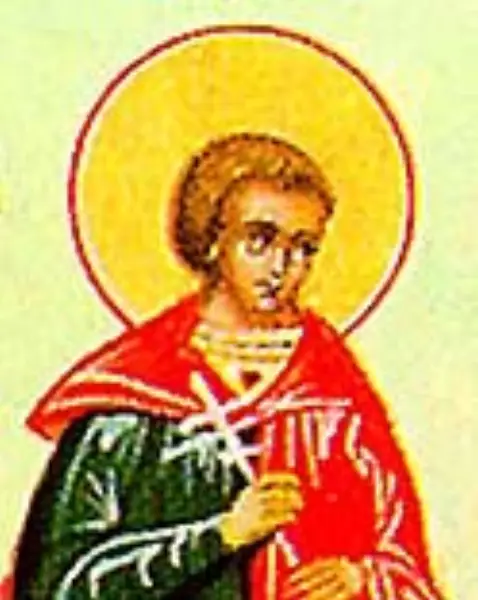
Overview
Amphian — Latin Amphianus, Greek Amphianos, also Aphian — was a young Christian from a wealthy and distinguished family of Lycia, martyred at Caesarea Maritima in or around 305 during the persecutions of the emperor Galerius. Educated in rhetoric, law, and philosophy at the famous school of Berytus in Phoenicia, he became a Christian while away at school, and pulled back to Cappadocia when his parents refused his appeals. In Caesarea he placed himself under the scholar Pamphilus, then expounding Holy Scripture, and lived in the house of Eusebius, the future historian. At eighteen, without telling anyone his purpose, he entered the temple where the prefect Urbanus was offering sacrifice, seized the outstretched hand presenting the incense, and reproached the magistrate for his idolatry. Iron claws, clubs, and a slow fire failed to kill him, so he was drowned in the sea, stones lashed to his feet; Eusebius, who saw it happen, tells how an earthquake rocked the city and how the sea gave his body back to the shore.
The Complete Life
Early Life
Amphian was born around 287 in Lycia, the mountainous province of southwestern Asia Minor, into a family both wealthy and distinguished. His parents gave him the best education the empire offered: rhetoric, law, and philosophy at the famous school of Berytus — Beirut — in Phoenicia, the law school of the Roman East, where ambitious families sent their sons to study. It was during his student years abroad that he accepted the Christian faith, one of those quiet university conversions that the empire's persecutors never fully understood. When he returned and tried to bring his own household to the faith, his parents resisted; and rather than remain in conflict at home, Amphian withdrew to Cappadocia, where the church of the confessors was strong, and made his way from there to Caesarea. Of the years between Berytus and Caesarea the record keeps silence; the sources pick him up again in the Palestinian capital, a student of a different school.
§ Origins
Disciple of Pamphilus
At Caesarea Maritima Amphian found Pamphilus, the presbyter then expounding Holy Scripture to a circle of students, whose house served the Palestinian church as a seminary; the young man joined his circle of disciples. His lodging was the home of Eusebius — the same Eusebius who would become the Church's first historian and who would later record his friend's death as an eyewitness. The intimacy of the names is moving: the future historian housed the future martyr, and the scholarship of the one and the protest of the other belonged to a single community. Of the public protest that would cost him his life Amphian said nothing beforehand; the accounts suggest he prepared for it in silence. Eusebius's house was the lodging of scholars and, at the end, of martyrs: from it Pamphilus taught, from it Amphian walked to the temple, and from its circle came the account of his death, written by the historian who had housed him.
§ Martyrdom
The Protest and Martyrdom
His legend puts him at just eighteen on the day he walked into the temple at Caesarea while prefect Urbanus was offering sacrifice, caught the magistrate's outstretched, incense-laden hand, and denounced the idolatrous rite — a gesture at once symbolic and physical, the sacrifice stopped in mid-air. The guards hurled themselves on him, tortured him savagely, and threw him still bleeding into a dungeon. On the following day he faced the prefect again, was raked with iron claws, clubbed, and held over a slow fire, and finally returned to his cell. Three days later his guards pulled him from prison a final time and drowned him in the sea, stones lashed to his feet. Eusebius, who stood witness, swears that at that very hour an earthquake convulsed the city and that the sea cast his body back onto the shore — the Gospel story of the storm obeying a greater will, echoed over one young man's body.
§ Martyrdom
Feast and Commemoration
Amphian is honored as a martyr both by Catholics and by Eastern Orthodox Christians; his death is placed in the persecutions of Emperor Galerius, on 2 April in or about the year 305. The Eastern Orthodox calendar keeps his feast on 2 April together with Aedisius — sometimes given as his brother — who by the parallel tradition died a martyr after rebuking the governor's idolatry in the same city. In the old martyrologies his feast stood on 5 April, but the Bollandists, sifting the traditions, give 2 April as the correct date, and the modern calendars have followed them. Both churches keep him as he died: very young, a scripture student of the house of Eusebius, a confessor whose protest was made not at his trial but in the temple itself.
§ Introduction
Legacy
Amphian's legacy is the single gesture: a student's hand closing on a magistrate's wrist. Of the thousands of martyrdoms Eusebius recorded, this is the one most remembered for its act rather than its endurance — the interruption of a state ritual by a boy too young, the tradition says, to be wise. His story traveled with the Martyrs of Palestine into the martyrologies of East and West, and his name is invoked wherever conscience is young and the cost of speech is high. He stands beside his teacher Pamphilus and his host Eusebius in the memorial of the church of Caesarea, the community that taught with books and died with gestures. Trained for the bar of Berytus, he is remembered for a single speech made in a temple, and the calendars of East and West have kept it for seventeen centuries.
§ External links
Timeline
- 287
Born in Lycia to a wealthy and distinguished family
§ Introduction
- 2 Apr 305
Put to death at Caesarea Maritima under Galerius, sunk in the sea with stones fastened to him
§ Introduction
The Record
- Patron of
- Youth who act on conscience·Students far from home
- Symbols
- Palm of martyrdom·Stones and the sea
- Canonization
- Pre-congregation martyr of the Galerian persecution
Prayer
Profile text adapted from the Wikipedia article, licensed CC BY-SA 4.0.
Pray with this saint every day
Save St. Amphian to your favorites, read the full profile, and get feast-day reminders in the Saints app.
Get the Saints AppFree on the App Store for iPhone and iPad