
died c. 304 (traditional)·Feast June 25 (with St. Alban at St Albans)
St. Amphibalus
Priest and Martyr
Overview
Amphibalus is the name given to the Christian priest of the story of St. Alban, the first martyr of Britain, who was sheltered by Alban at Verulamium, converted him, and was saved when Alban exchanged clothes with him and died in his place. The earliest sources, the Passio Albani of the fifth century, Gildas and Bede, tell of the priest but do not name him and do not report his death; his name, which is simply the Latin word for the cloak that Alban put on, appears first in Geoffrey of Monmouth's twelfth-century History of the Kings of Britain, and may have originated in a misunderstanding of the text. According to Matthew Paris and the St Albans tradition, the Romans later caught the priest and martyred him as well. His cult in its full form was created in the twelfth century at St Albans Abbey, where the monk William of St Albans wrote a new Life giving the priest a leading role, and where his body was discovered at Redbourn in 1177, giving the abbey a second shrine. Scholars from Levison onward have treated the details as medieval elaboration; the church has kept the feast.
The Complete Life
The Name and the Problem
Amphibalus presents the student of the saints with a rare case: a figure whose historicity is bound up with a word. The story of Alban, Britain's protomartyr, is old and well attested: a Christian priest, fleeing the persecution of Diocletian, was given shelter by Alban at Verulamium; Alban was moved by the priest's prayer and teaching, was converted, and when the soldiers came, put on the priest's cloak and let himself be arrested and executed in his stead. The fifth-century Passio, Gildas and Bede all tell it so, but none of them names the priest or reports his fate. The name Amphibalus appears first in Geoffrey of Monmouth around 1136. It is possible he was recording a name in popular use; it is also possible, as scholars have long suspected, that the name arose from a misreading of the Latin, the cloak, amphibalus, that Alban wore being taken for the priest's own name. The priest's later career, his capture, his journeys and his martyrdom, are medieval additions.
§ Introduction
The Twelfth-Century Cult
The full cult of Amphibalus was the work of St Albans Abbey in the second half of the twelfth century, above all of the monk William of St Albans, who during the abbacy of Simon, 1167 to 1183, wrote an elaborate new version of the story of Alban in which the priest, now firmly named, plays the leading part. The texts, as Wilhelm Levison observed, are composed of borrowings from other saints' lives and have no place among the sincere acts of the martyrs. The climax came in 1177 with the inventio, the discovery of the body of Amphibalus at Redbourn near St Albans, an event that gave the abbey, then laboring under heavy debts, a second shrine whose offerings the generosity of pilgrims could enrich. Scholars have also suggested the model of St. Thomas Becket, murdered in 1170, whose spectacular cult showed every monastic house what a contemporary martyr's shrine could do. Whatever the motives, the cult took: the relics were translated to the abbey, a shrine stood beside Alban's, and the feast entered the calendars.
§ New cult invented in 12th-century
The Legend
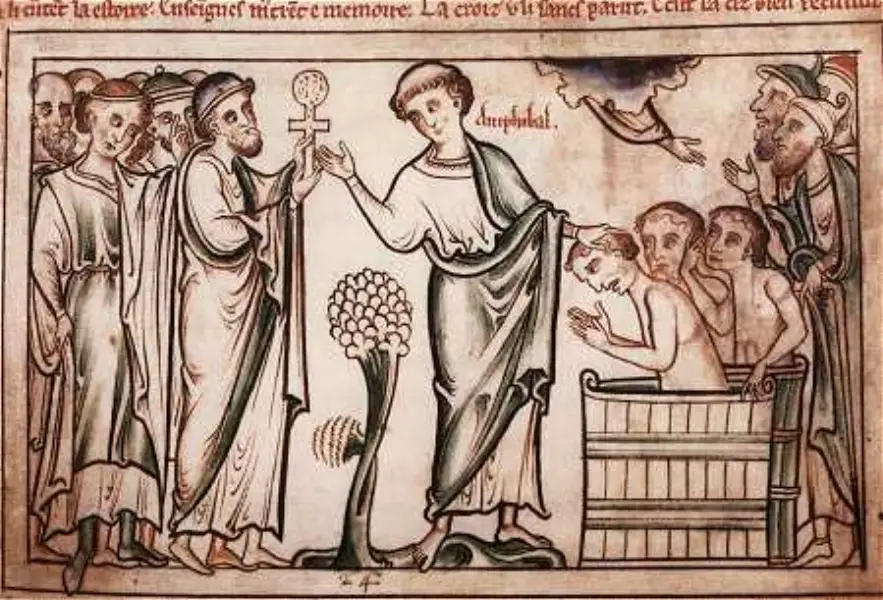
In the developed legend, the priest of the Alban story becomes a missionary bishop and martyr in his own right. Matthew Paris, the great thirteenth-century chronicler of St Albans, recounts that after Alban's death the Romans eventually caught Amphibalus and put him to death, and the fuller versions send him through Britain with companions, converting and baptizing, to a martyrdom of his own, in the course of which the converts he had made die with him. Geoffrey had already associated a church of Amphibalus with Winchester, in his tangled account of the kings Constantine, and the connection of the name with Gildas' story of a king who wore the cloak of an abbot to commit murder shows how freely the material circulated. The legend, in other words, grew by association, and its center of gravity was always the relationship the oldest sources preserve: the guest who taught, and the host who died for him, an exchange of persons at the heart of the first Christian story told in Britain.
§ Introduction
Veneration
Amphibalus' veneration was fixed in the middle ages by the authority of England's greatest abbey. His feast was kept at St Albans on 25 June, beside Alban's on 22 June, and the translation of the relics was celebrated with its own office; the two saints appear together in the abbey's wall paintings and its illuminated books, the host and the guest, the martyr and the priest who made him. The Reformation swept the shrines away, and the bones were scattered or hidden, but the memory survived in the abbey's records and in the local tradition of Hertfordshire. The modern cathedral of St Albans, the church of the revived diocese, has restored the balance: a reconstructed medieval shrine of Amphibalus, rebuilt from the surviving fragments, was dedicated in the cathedral in 1993 and now stands in the chapel of the martyrs, so that the priest whom the twelfth century gave a name keeps his place beside the martyr he converted.
§ Introduction
Legacy
Amphibalus' legacy is double and instructive. Devotionally, he has kept his place as the companion of Alban, the man whose teaching produced the first martyr of Britain, and pilgrims to St Albans honor them together. Historically, his story is one of the clearest case studies in the making of a medieval cult: an unnamed figure, a misunderstood word, a debt-burdened abbey, a discovery of relics, and within a generation a fully formed saint with a legend, a feast and a shrine, a sequence that Levison and later historians have used to teach how hagiography works. The church today can hold both truths at once, honoring the tradition that names the priest while acknowledging that the name and the career are almost certainly medieval gifts. What the oldest sources affirm remains: there was a priest, he was sheltered, he taught, and a man died in his cloak for Christ.
§ References
Timeline
- 25 Jun 304
Traditionally put to death at Verulamium, modern St Albans, during Diocletian's persecution
§ Introduction
- 1136
Geoffrey of Monmouth's Historia Regum Britanniae gives the priest sheltered by Alban the name Amphibalus
§ Geoffrey of Monmouth
- 1178
His remains and those of companions are discovered at Redbourn near St Albans, following a vision to a monk
§ Hagiography
- 1323
A falling portion of the abbey roof damages his first shrine, and it is relocated to the chancel's north aisle
§ Veneration
- 1350
The shrine is moved to the middle of the retrochoir, just east of Alban's shrine, with a stone tomb and paintings
§ Veneration
- 1872
The discovered pieces of the destroyed shrine are reassembled under Sir George Gilbert Scott
§ Veneration
- 2021
The stone shrine is restored by the Skillington Workshop and returned to view in St Albans Cathedral
§ Veneration
The Record
- Patron of
- The persecuted Christian·Priests in hiding
- Symbols
- Priest's cloak (amphibalus)·Palm of martyrdom
- Canonization
- Pre-congregation; cult formalized at St Albans in the 12th century
Prayer
Bibliography
Show 12 sources
- 1 2 McCulloch, Florence (1981). " Saints Alban and Amphibalus in the Works of Matthew of Paris : Dublin, Trinity College MS 177". Speculum . 56 (4): 767. JSTOR 2847362 .
- ↑ " Gildas On the Ruin of Britain " (PDF) . Camelot On-line . Retrieved 16 January 2017 .
- ↑ " Bede's Ecclesiastical History of the People of England " (PDF) . Camelot On-line . Retrieved 16 January 2017 .
- 1 2 Thurston, Herbert. "St. Alban." The Catholic Encyclopedia. Vol. 1. New York: Robert Appleton Company, 1907. 25 December 2012
- ↑ Levison, Willhelm "St Alban and St Albans" in Antiquity 15, 1941, pp. 337–59, at p. 346.
- ↑ Wright, Neil, The Historia Regum Britanniae of Geoffrey of Monmouth , 1984, Bern, Burgerbibliothek, MS. 568, Cambridge; trans Thorpe, Lewis Geoffrey of Monmouth: The History of the Kings of Britain , 1966, Penguin Classics; Online Latin t
- ↑ Hist. Reg. V.5
- ↑ Hist. Reg . VI.5
- ↑ Hist. Reg. XI.4
- ↑ Gildas, De Excidio et Conquestu Britanniae 28; text and trans., Winterbottom, Michael , Gildas, the Ruin of Britain , 1978, London/Chichester: Phillimore; "Gildas' On the Ruin of Britain" (PDF) . Camelot On-line . Retrieved 16 January 201
- ↑ Levison, op. cit ; Gordon-Taylor, Benjamin Nicholas "The Hagiography of St Alban and St Amphibalus in the Twelfth Century," 1991, Durham theses, Durham University. Available at Durham E-Theses Online: http://etheses.dur.ac.uk/6175/
- ↑ Levison op. cit I, 354
Profile text adapted from the Wikipedia article, licensed CC BY-SA 4.0.
Pray with this saint every day
Save St. Amphibalus to your favorites, read the full profile, and get feast-day reminders in the Saints app.
Get the Saints AppFree on the App Store for iPhone and iPad