
c. 339 - after 394·Feast November 22 (Catholic); November 23 (Orthodox)
St. Amphilochius of Iconium
Bishop of Iconium, Cappadocian Father
Overview
Amphilochius of Iconium was a fourth-century bishop and theologian, a younger member of the Cappadocian circle that included Basil of Caesarea and Gregory of Nazianzus, to whom he was probably first cousin. Born around 339/340 at Caesarea in Cappadocia to an eminent lawyer and a mother the sources praise for wisdom, he studied rhetoric and law at Antioch under Libanius and practiced at Constantinople before withdrawing to the ascetic and scholarly world around his cousin at Nazianzus. Early in 374 Basil placed him in the important see of Iconium in Lycaonia, where he served as bishop for at least two decades, aiding Basil in Cappadocian church affairs until Basil's death in 379 and attending the Council of Constantinople in 381; there Jerome heard him and spoke with him. Against the Macedonian denial of the Spirit's godhead he stood firm — Basil in fact dedicated his treatise On the Holy Spirit to him — and he also battled the Messalians in Lycaonia. A famous anecdote has him rebuke the emperor Theodosius for his son's honors with a lesson about the Father and the Son. Most of his writing is lost; eight homilies survive, including the oldest known sermon for the Feast of the Purification. He died between 394 and 403.
The Complete Life
A Cappadocian Aristocrat
Amphilochius was born around 339 or 340, probably at Caesarea in Cappadocia, into that remarkable Christian aristocracy which the fourth century raised up in the province — the milieu that produced Basil, Gregory of Nazianzus, Gregory of Nyssa, and their kin. His father was an eminent lawyer; his mother Livia the sources remember for gentleness and wisdom; and the family connection to Gregory of Nazianzus was close, probably first cousins. He was educated as his class was educated: rhetoric at Antioch under Libanius, the great pagan professor whose students included two Cappadocian Fathers and the apostate emperor Julian; then law, practiced at Constantinople. It was the career his world offered its ablest young men — and, like Basil and Gregory before him, he abandoned it at the point of success for the ascetic and theological life, withdrawing to the vicinity of his cousin at Nazianzus.
Bishop of Iconium
Early in 374 Amphilochius was consecrated to the see of Iconium — modern Konya, the Lycaonian capital where Paul had preached and where the fourth-century church still faced the Arian crisis at full strength. The appointment bears Basil's fingerprints: the bishop of Caesarea was then building a network of orthodox allies across Asia Minor, and a trusted cousin in a metropolitan see was strategy as much as honor. Amphilochius justified it. He worked alongside Basil in Cappadocian church affairs until Basil's death in 379, kept close to Gregory of Nazianzus thereafter, and in 381 traveled to Constantinople for the council that would settle the doctrine of the Spirit — where Jerome heard him and recorded the meeting. In 344, earlier, he had been chosen to draft a circular letter from a council of bishops and clergy to the churches of Ctesiphon and Seleucia, a sign of the standing he enjoyed across the Persian frontier.
The Fights of a Pastor
Three controversies fill Amphilochius's episcopate. Against the Macedonians — the 'Spirit-fighters' who denied divinity to the Holy Spirit — he wrote a treatise now lost but known to Jerome, and Basil dedicated to him On the Holy Spirit, the classic statement of the doctrine; his Epistula Synodica, issued for the bishops of Lycaonia, is the one work Bardenhewer judged genuinely his. Against the Messalians, the pray-only ascetics who rejected work and discipline, he was 'very energetic,' the old notice says, contributing to their extirpation from rural Lycaonia — a fight in which rigorous pastoral care was the weapon. And against the Arianizing court he deployed the famous anecdote: greeting the emperor Theodosius, he ignored the emperor's son Arcadius until Theodosius rebuked him, whereupon Amphilochius asked whether a man who insulted the emperor's son did not insult the emperor — and how much worse, then, to deny honor to the eternal Son of the Father. Theodosius, the story ends, understood, and ordered his son honored.
Theologian and Preacher
Amphilochius came to theology late — he began serious study only after becoming bishop — and his work shows it: little philosophical apparatus, much pastoral urgency. Georges Florovsky noted that his writing reveals no philosophical background and no particular interest in it, being contingent on the needs of a pastor fighting heresy; yet the same critic praised its 'calm and sincere faith' and a homiletic rhetoric reminiscent of Gregory the Theologian. His one significant terminological innovation was the phrase 'mode of being' (tropoi tes hyparxeos) for the Trinitarian hypostases — a step, beyond the Cappadocians, toward defining the Persons by relation rather than essence, which by the early fifth century had won general acceptance. Of his homilies eight survive, including the oldest known sermon for the Feast of the Purification — the Meeting of the Lord — a landmark in the history of that feast; the spurious 'Iambics to Seleucus' circulated under his name as an early catalogue of the biblical canon.
Last Years
The securely dated acts of Amphilochius run out in the mid-390s; he died between 394 and 403, an old man in the see he had governed for a quarter-century. He had outlived Basil by two decades and Gregory of Nazianzus by several years, and with them the heroic age of Cappadocian theology. Theodoret, writing in the next generation, described him in the most flattering terms; the councils quoted him as late as 787; Jerome listed him among the Christian exemplars of secular erudition. That a provincial metropolitan of Lycaonia should be so remembered testifies to the weight his contemporaries gave both his life and his pen.
Veneration
Amphilochius is a saint of the undivided Church, pre-congregation in the fullest sense. The Catholic Church keeps his feast on 22 November and the Eastern Orthodox Church on 23 November — the one-day divergence being the ordinary result of two calendars preserving the same tradition independently. He is patron of Konya, the modern city on the site of his see, and figures in the menologia and synaxaria of the East beside the greater Cappadocians, whose circle he closed as its youngest significant member.
Legacy
Amphilochius is the proof that the Cappadocian achievement was more than three great names. His generation had to administer the Nicene settlement — in provincial sees, against heresies old and new, with courts and councils and sermons — and he did it in Iconium for thirty years. The homily on the Meeting of the Lord alone would secure his historical importance, preserving as it does the earliest witness to a feast the whole Christian world now keeps. The phrase 'mode of being' entered the technical vocabulary of Trinitarian theology from his pen. And the anecdote before Theodosius has been retold for sixteen centuries whenever the Church has needed to say that the honor given to the Son is not separable from the honor due to the Father.
Timeline
- 339
Born at Caesarea in Cappadocia about this year, into a distinguished Christian family related to Gregory of Nazianzus
§ Introduction
- 374
Early this year he takes charge of the strategic diocese of Iconium, evidently at Basil's instigation
§ Life
- 376
Addresses an epistle to the council of Iconium held this year
§ Works
- 379
Aids Basil in Cappadocian church affairs until Basil dies this year, then stays close to Gregory of Nazianzus
§ Life
- 381
Accompanies Gregory of Nazianzus to the Council of Constantinople, where Jerome meets and converses with him
§ Life
- 394
Probably dies between this year and 403 at Iconium, where he had served as bishop
§ Introduction
- 787
Still quoted by church councils as an authority as late as this year
§ Life
The Record
- Major works
- Eight surviving homilies, including the oldest known sermon on the Meeting of the Lord (In Occursum Domini)·Epistula Synodica against the Macedonian heresy·Letter to the council of Iconium (376)
- Patron of
- Konya (Iconium)
- Symbols
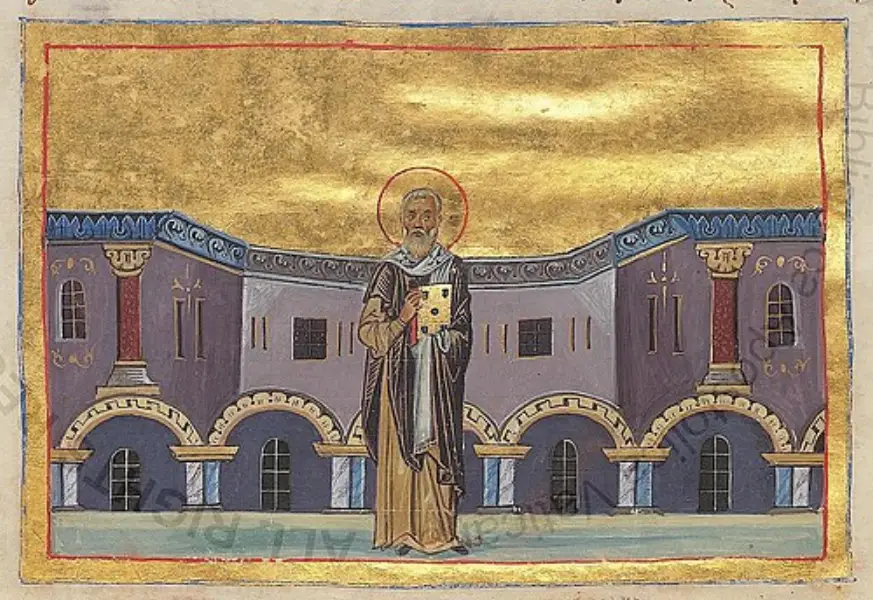
- Bishop's vestments·Gospel book
- Canonization
- Pre-congregation; venerated East and West
Prayer
Profile text adapted from the Wikipedia article, licensed CC BY-SA 4.0.
Pray with this saint every day
Save St. Amphilochius of Iconium to your favorites, read the full profile, and get feast-day reminders in the Saints app.
Get the Saints AppFree on the App Store for iPhone and iPad