
1894-1971·Feast January 1
St. Amphilochius of Pochayiv
Schema-Archimandrite and Wonderworker of Pochaiv Lavra
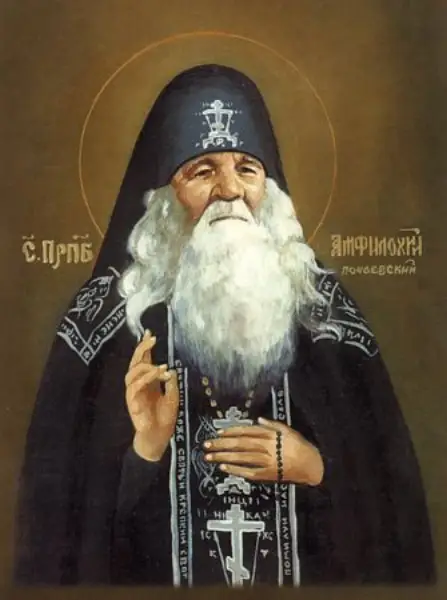
Overview
Amphilochius of Pochayiv was born Yakov Varnavovich Golovatyuk on 27 November 1894 in the forest village of Mala Ilovytsia in the Kremenets mountains of western Ukraine, then part of the Russian Empire, one of ten children of a craftsman famed as a bonesetter; the boy assisted his father in caring for the people who came for help. Drafted in 1912, he served through the First World War as a medical attendant at Tomsk and then as a field medic, was captured by the Austrians, and spent three years working for a farmer in the Alps before escaping. Back home, marriage had been his plan, yet the war turned his heart toward the religious life; in 1925 he joined the Dormition Lavra at Pochaiv, humbly serving as a carter and a member of the choir. He was tonsured in 1932 with the name Joseph and ordained hieromonk in 1936. Once the war ended, Soviet officials — eager to halt the flow of sick visitors — confined him to a psychiatric hospital, where drugs were injected into him; through the intervention of Svetlana Alliluyeva, Stalin's daughter, whom he had met at some point, he gained his freedom, though barred from the lavra, and went back to his home village, where he celebrated molebens with the water-blessing rite in his own yard. After one beating that left him dying in an icy swamp he was tonsured into the Great Schema as Amphilochius. He died on 1 January 1971, aged seventy-six.
The Complete Life
A Bonesetter's Son in the Kremenets Hills
Yakov Golovatyuk was born on 27 November 1894 in Mala Ilovytsia, the northernmost village of the Ternopil region, tucked into the Ilovetska valley seven kilometers wide beneath the Kremenets mountains, off the main roads and surrounded by forest. His father Varnava was an able craftsman — he made shoe lasts and sleighs — with a reputation as a skilled bone-setter, and Yakov, one of ten children, often assisted him in caring for the people who came to the house for help. It was the boy's first medical education, given in a village practice older than any hospital. Conscription into the Tsar's army came in 1912; during the First World War he was posted first to Lutsk and afterwards to Tomsk, tending patients at the hospital there, before serving at the front line as a medic. Taken prisoner by Austrian forces, he was dispatched to the Alps and labored on a farmer's holding for three years before finally making his escape. He came home in his thirties with a working knowledge of bodies in pain, learned in the two great schools of his century: his father's hands and the war.
The Lavra at Pochaiv
Once back home, Yakov had thoughts of marrying, yet what he had lived through at war pulled him in another direction — toward monastic life at the Pochaiv monastery. He entered the Dormition Lavra in 1925 and set himself to the ordinary work of a novice: he constructed sleighs and wheels — his father's craft again — and sang in the choir, in the spirit of humility and obedience. He received the monastic tonsure on 8 July 1932, taking the name Joseph, and on 27 September 1936 was ordained to the priesthood as a hieromonk. He spent much time praying before the miraculous icons of Pochaiv, and was appointed caretaker of the God's Mother's Foot — the rock footprint left by the apparition of the Virgin at Pochaiv around 1240, the lavra's most intimate shrine. Observing the throngs whom the young hieromonk's gift for healing attracted, the abbot — the archimandrite — gave the work his blessing and let him move into a modest cottage beside the monastery cemetery, sparing the rest of the monks any disturbance. There he spent twenty years ministering to the sick, and the tradition credited him with the gift of healing.
Psychiatric Hospital and the Village Courtyard
The Soviet regime that seized the region after the war wished to stop the constant stream of people seeking the healing monk, and when Fr. Joseph stood against their efforts to shut the lavra, he was locked up in a psychiatric hospital and drugged — the usual lot of holy men who caused trouble in Stalin's last years. He was eventually released through the good offices of Svetlana Alliluyeva, Stalin's daughter, whom he had previously met. Barred from going back to the lavra, he made his home in Ilovytsia, where he was born, alongside his nephew; over the long years that followed he kept up his service to the people, marking the occasions with a moleben of the Blessing of the Waters in his own yard. People held that God had endowed him with the grace of prophecy together with the power to work miracles. One day, local officials having stirred things up, he was badly beaten and abandoned in a freezing swamp; discovered and brought to the lavra, he seemed near death, and so received the Great Schema tonsure under the name Amphilochius, chosen in honor of Amphilochius of Iconium. His recovery came slowly; lacking a residence permit for the lavra, he went back to the village and took up his healing work once more, continuing until his death on 1 January 1971.
Glorification at Pochaiv
Amphilochius's glorification came a generation after his death, in the Ukrainian church's recovery of its twentieth-century confessors: on 23 April 2002 the Pochaiv elder schema-abbot was glorified as a saint, and his incorrupt relics were later venerated beside those of Saint Job of Pochaiv in the lavra. His cult is strongest in western Ukraine and in the Russian and Ukrainian diasporas, and his life is told as one of the standard accounts of monastic survival under the Soviet regime — the psychiatric hospital, the injections, the beating in the swamp, and the courtyard molebens that no decree could stop. The date of his death, 1 January, is his feast. His relics are venerated beside those of Saint Job of Pochaiv in the lavra, and pilgrims come to both on his feast at the new year. The village school at Trnava bears his name, and the lavra keeps his memory with Job's in the calendar of its wonderworkers.
The Healer of the Ilovetska Valley
Amphilochius's significance lies in the continuity he embodied. He joined his father's bonesetting to wartime medicine to monastic prayer, and refused to let any of the three be separated from the others; the sick who came to the cemetery house at Pochaiv, and later to the yard at Ilovytsia, met a man who had learned bodies in the Austro-Hungarian Alps and the Tsarist hospitals and learned souls at the Mother of God's Foot. His story also preserves, in unusually concrete detail, the mechanics of Soviet religious persecution at the level of a single village: the hospital, the injections, the residence permit, the paid beating. That the man survived all of it and died in his own bed, in his own village, still serving, is the point his veneration makes — and the connection by chance or providence with Stalin's own daughter, through whose good offices he went free, has kept the story alive in the telling.
Timeline
- 27 Nov 1894
Born Yakov Varnavovich Golovatyuk at Mala Ilovytsia, then in the Russian Empire
§ Early years
- 1912
Drafted into the army of the Tsar
§ Early years
- 1925
Enters the Dormition Lavra at Pochaiv, where he builds sleighs and sings in the choir
§ Joining Pochaiv Lavra
- 8 Jul 1932
Tonsured a monk and given the name Joseph
§ Joining Pochaiv Lavra
- 27 Sep 1936
Ordained a hieromonk
§ Joining Pochaiv Lavra
- 1 Jan 1971
Dies aged seventy-six after decades of healing ministry
§ Joining Pochaiv Lavra
- 23 Apr 2002
Glorified as a saint of the Ukrainian Orthodox Church
§ Joining Pochaiv Lavra
The Record
- Patron of
- Pochaiv Lavra·Healers and the sick·The confessors under persecution
- Symbols
- Monk's schema·Crosier of a schema-archimandrite
- Canonization
- Glorified as a saint by the Ukrainian Orthodox Church on 23 April 2002
Prayer
Profile text adapted from the Wikipedia article, licensed CC BY-SA 4.0.
Pray with this saint every day
Save St. Amphilochius of Pochayiv to your favorites, read the full profile, and get feast-day reminders in the Saints app.
Get the Saints AppFree on the App Store for iPhone and iPad