
1st century·Feast October 31 (Roman Martyrology); October 31 with the Seventy (Eastern Orthodox)
St. Ampliatus
Disciple of St. Paul and St. Andrew, of the Seventy
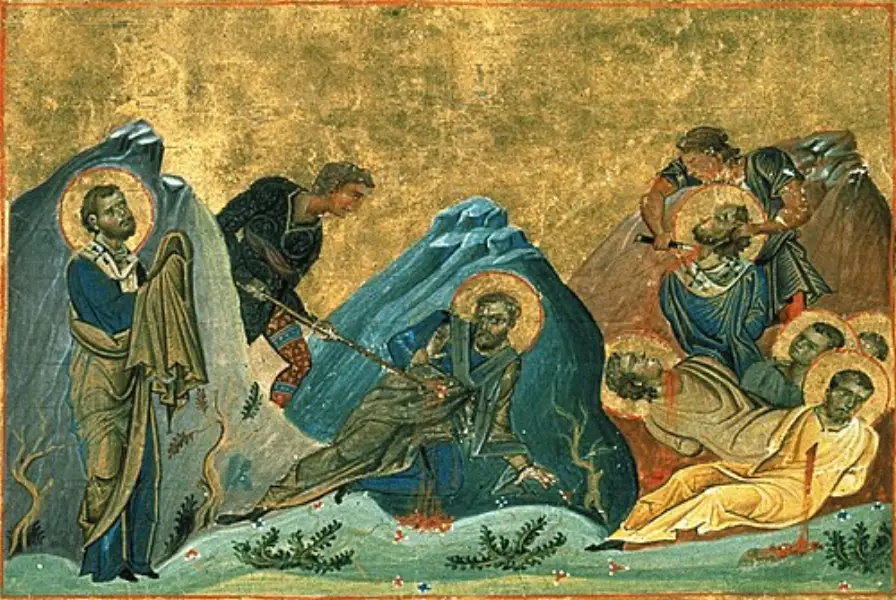
Overview
Ampliatus, Amplias in the King James Version, Ampliatus in the Greek, is a Roman Christian whom the apostle Paul greets by name in the letter to the Romans: the apostle's word of loving greeting to Ampliatus, which is the whole of the personal record the New Testament keeps of him, and a record with an unusual warmth in it. The Eastern Orthodox Church counts him among the Seventy Disciples of Luke's gospel and keeps him in that number on 31 October with Stachys, Urban, Narcissus, Apelles, and Aristobulus, whose hymns entreat the merciful God together. The tradition relates that he and his companions later joined themselves to the apostle Andrew, and ultimately died as martyrs, and a further strand has him serve as bishop of Odessos, modern Varna on the Bulgarian coast, a see in the lands around the Euxine where Andrew's mission and the Black Sea church's memory overlap. The Roman Martyrology commemorates him on 31 October. Beyond the greeting of Paul and these traditions of his afterlife, nothing certain is known of him, and his importance lies precisely in his obscurity: a beloved disciple whose name the New Testament preserved, around whom the churches built their memory.
The Complete Life
A Name in Romans
The historical Ampliatus is one sentence long. In the sixteenth chapter of Romans, amid the long roll of Paul's greetings to the church of the capital, stands the command that Ampliatus be greeted, loved as he is in the Lord. The name itself carried a certain social charge in first-century Rome: Ampliatus was common among slaves and freedmen of the great houses, and many readers have seen in the greeting one of the humbler members of the Roman church singled out with singular affection. Paul's letters preserve perhaps two dozen such names, the human residue of his mission, and Ampliatus is one of the few of them whose cult the later church developed. The warmth of the phrase, my dear friend, my beloved, gave the tradition its starting point: a man loved by an apostle for his work in the Lord was remembered as a saint of the apostolic age itself, when there was as yet no Christianity but the communities the apostles gathered.
§ Introduction
Of the Seventy
The Eastern Church's elaboration of Ampliatus places him among the Seventy, the larger company of disciples Luke describes being sent out by the Lord, whose membership the tradition assembled from the names of the New Testament and the early legend. With Stachys, whom the Orthodox honor as the first bishop of Byzantium, and Urban, Narcissus, Apelles, and Aristobulus, Ampliatus is commemorated on 31 October, the menology giving them a common troparion, the apostles of the Seventy entreating the merciful God for the forgiveness of our transgressions. The further tradition sends him east: he and his companions attached themselves to the apostle Andrew, whose mission ranged over the Black Sea world, and Ampliatus may have served as bishop of Odessos, modern Varna, one of the coastal Greek cities of what is now Bulgaria. The notice is late and unverifiable, but it fits the pattern by which the Black Sea churches traced their succession to Andrew's circle, and it gave Varna's ancient see an apostolic patron.
§ Introduction
Memory
Ampliatus stands in both the Eastern and Western calendars, the Roman Martyrology entering him on 31 October, the same day the Byzantine church keeps him with his companions of the Seventy, one of the small agreements of the two traditions that go back to a common ancient source. His iconography, following the menologion portraits, shows him among the apostolic disciples, an old man with the scroll. For the modern reader he carries a particular lesson, since his entire scriptural footprint is a single greeting: the church of Rome in Paul's lifetime contained people known to us only as loved, and the whole of their biography, in the deepest record there is, is that an apostle loved them in the Lord. The Ampliatus of the later tradition, bishop and martyr of the Euxine, is the church's refusal to let such a man remain a sentence, and the Ampliatus of the epistle remains the standard by which the elaboration is measured.
§ Introduction
In Their Own Words
Greet Ampliatus, whom I love in the Lord.
The Record
- Patron of
- Lay disciples·Bishops of the early church
- Symbols
- Scroll of Romans·Palm of martyrdom
- Canonization
- Pre-congregation (apostolic-era cult)
Prayer
Bibliography
Show 4 sources
- ↑ Bible Gateway website, Romans 16:8, " 8 Greet Ampliatus, my dear friend in the Lord. " (NIV)
- ↑ Monks of Ramsgate. "Ampliatus, Urban and Narcissus". Book of Saints , 1921. CatholicSaints.Info. 13 June 2012 This article incorporates text from this source, which is in the public domain .
- ↑ "Varna And Environs", Balkan Heritage Field School
- ↑ "Roman Martyrology October, in English" .
Profile text adapted from the Wikipedia article, licensed CC BY-SA 4.0.
Pray with this saint every day
Save St. Ampliatus to your favorites, read the full profile, and get feast-day reminders in the Saints app.
Get the Saints AppFree on the App Store for iPhone and iPad