
294 – 356·Feast October 4
St. Amun
Desert Father and Founder of Nitrian Monasticism
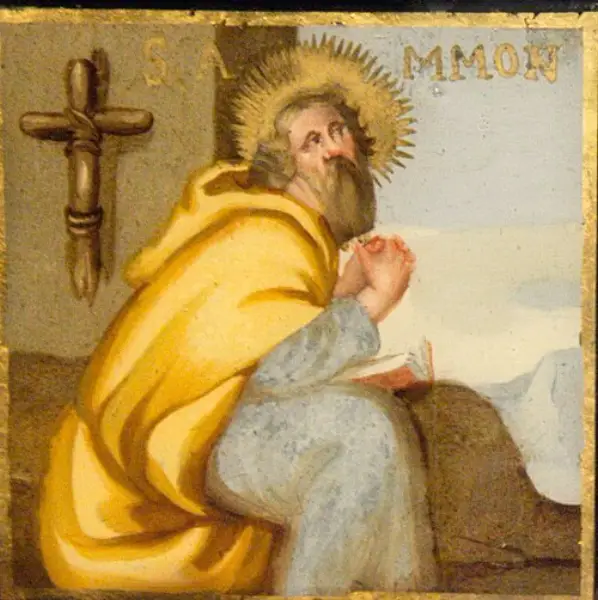
Overview
Amun, known also as Ammon, Ammonas, Amoun, or Ammonius the Hermit, lived as an ascetic in fourth-century Egypt and raised up a monastic brotherhood that ranked among the most renowned in the land. He was born at Mariotis in 294. In his twentieth year his family compelled him into wedlock, yet he won from his bride to join him in a vow of perpetual chastity, invoking the authority of Saint Paul's teaching. After eighteen years of such companionship they separated by her wish: she established a convent in her own house, while he withdrew to Scetis and Nitria, south of Lake Mareotis, where he spent twenty-two years in ascetical solitude. There his holiness drew disciples, and he gathered solitary hermits under his direct supervision, forming one of the first monasteries of the Nitrian Desert, traditionally identified with the settlement known as Kellia. He cooperated with Anthony the Great, whose biographer Athanasius records that Anthony saw the soul of Amun carried by angels to heaven. He died at Scetes, aged sixty-two, before Anthony himself. His writings and his example won him enduring honour among the ascetics of the Egyptian desert.
The Complete Life
Chaste Marriage and the Call to the Desert
Amun's path to holiness began within a marriage he had not chosen. Pressed into wedlock by his family at the age of twenty, he resolved not to abandon the ascetical ideal, and by appeal to the teaching of Paul's First Epistle to the Corinthians he persuaded his young bride to join him in a mutual vow of chastity. For eighteen years the two lived together as brother and sister in spirit, a household joined in continence rather than in conjugal life. At her wish the union was at last dissolved in practice: she converted her own house into a convent and became its head, while he withdrew altogether from worldly society. He retired to Scetis and Nitria, the desolate region south of Lake Mareotis, where he would spend twenty-two years in prayer, fasting, and solitude. Even in the desert he did not forget her entirely; tradition records that he visited his sister-wife twice a year, a touching sign that his renunciation was marked by tenderness rather than hardness of heart. From these years of quiet perseverance his reputation for sanctity began to spread throughout Egypt.
§ Life
Founding a Monastery in the Nitrian Desert
In the Nitrian Desert Amun accomplished the work for which he is chiefly remembered. Desert monasticism in Egypt had at first been the affair of solitary individuals, each hermit struggling alone under his own rule; Amun gathered these solitaries under his direct supervision and formed them into a stable community, thus transforming eremitical zeal into monastic order. Tradition credits him as the first hermit to establish a monastery in the region, the settlement of cells known as Kellia near Nitria; though the claim cannot be verified with certainty, it is beyond dispute that his piety and fame drew others to settle the district, making it one of the great nurseries of Egyptian monasticism. He cooperated closely with Anthony the Great, the father of monasticism, and their mutual esteem linked the movement of Nitria with the solitary tradition of the inner desert. In his person the two currents of early monastic life — the lonely combat of the hermit and the disciplined fellowship of the coenobium — were joined, and the communities that sprang from his example shaped the ascetical culture of Egypt for centuries.
§ Life
Ascetical Writings
A body of ascetical teaching has been handed down under Amun's name. The most celebrated is the collection known as the Rules of Asceticism, short chapters or kephalaia numbering seventeen or nineteen according to the recension; the Greek original survives in manuscript, and the text became widely known through the Latin version published by Gerardus Vossius in the seventeenth century. Alongside these stand the Twenty-two Ascetic Institutions attributed to the same Amoun, or perhaps to another writer bearing the same name, which likewise exist in manuscript. A collection of his letters is preserved in the Patrologia Orientalis, and a further work, the Instructions: Counsel to Novices, has come down in Greek, Latin, and English versions, offering practical guidance to beginners in the monastic life. These writings give a glimpse of the wisdom with which he directed souls: terse, practical counsels formed in the desert and addressed to those seeking to prayer, fasting, and purity of heart. Whether composed entirely by his own hand or shaped by his disciples, they carry the authority of one of the earliest masters of Egyptian monasticism.
§ Works
Death and Passing into Glory
Amun died at Scetes in Egypt at the age of sixty-two, worn out by the austerities and labours of his long desert life. His death occurred before that of Anthony the Great, from whom a surviving epistle addressed to Amun has been preserved. The most cherished memory of his passing comes from Anthony himself, who declared that he saw the soul of Amun borne by angels to heaven — a testimony recorded by Athanasius in his Life of Anthony, and one that fixed the reputation of Amun's sanctity in the memory of the whole monastic world. The chronology of his final years has been debated, with ancient sources preserving different reckonings of the year of his death, but the fact of his holy end was never in doubt. He was buried among the ascetics of the desert he had helped to populate, and his tomb became part of the spiritual geography of Scetes, the region he had chosen and sanctified by his long residence there.
§ Life
Veneration Across the Churches
The cult of Amun spread quickly and endured across the divided churches of Christendom. He is venerated today in the Catholic Church, the Eastern Orthodox Church, the Oriental Orthodox Church, and the Anglican Communion. In the Eastern Orthodox and Catholic churches his feast is kept on 4 October, while the Byzantine tradition likewise observes that day; the Episcopal Church in the United States remembers him on 8 November. The Coptic Orthodox Church, heir of the desert in which he laboured, keeps his feast on 20 Pashons, corresponding to 15 May of the Julian calendar. Athanasius of Alexandria mentioned him in his Life of Anthony the Great, ensuring that his name would travel with the story of Egyptian monasticism through every subsequent age. He is numbered among the Desert Fathers, the first generation of ascetics whose sayings and institutions shaped Christian monastic life from Egypt to Ireland. The monastery tradition he began at Kellia and Nitria endured for centuries as a centre of prayer and learning, and his ascetical writings continued to be copied, translated, and read wherever monks sought counsel in the spiritual combat.
§ Life
Timeline
- 294
Born at Mariotis in Roman Egypt.
§ Saint Ammonas
- 314
Compelled by his family to marry at the age of twenty, he persuaded his bride to share a vow of chastity.
§ Life
- 332
After eighteen years of chaste marriage, separated from his wife at her wish and retired to Scetis and Nitria.
§ Life
- 356
Died at Scetes in Egypt at the age of sixty-two, before Anthony the Great.
§ Saint Ammonas
In Their Own Words
I saw the soul of Amoun borne by angels to heaven.
The Record
- Major works
- Rules of Asceticism (seventeen or nineteen kephalaia)·Twenty-two Ascetic Institutions·Letters (Patrologia Orientalis, vol. 10/6)·Instructions: Counsel to Novices
- Patron of
- Desert Fathers·monastic founders
- Symbols
- monastic habit·desert cave·scroll of ascetical rules
- Canonization
- Pre-congregation canonization; venerated in the Catholic, Eastern Orthodox, Oriental Orthodox, and Anglican churches
Prayer
Bibliography
Show 9 sources
- Herbermann, Charles, ed. (1913). "St. Ammon". Catholic Encyclopedia. New York: Robert Appleton Company.
- Christie, Albany James (1867). "Ammonas". In William Smith (ed.). Dictionary of Greek and Roman Biography and Mythology. Vol. 1. Boston: Little, Brown and Company. p. 145.
- Smith, William, ed. (1870). "Ammonas". Dictionary of Greek and Roman Biography and Mythology.
- Sozomen, Historia Ecclesiastica i. 14
- Socrates Scholasticus, Historia Ecclesiastica iv. 23
- Palladius, Historia Lausiaca c. 7
- "Saints of the Day for the Blessed Month of Bashans". icopts.org. The Coptic Orthodox Church.
- Curtin, D. P. (1 September 2022). Instructions: Counsel to Novices. Dalcassian Publishing Company. ISBN 9781960069665.
- Gerardus Vossius, Biblioth. PP. Ascetica vol. ii. p. 484, Paris 1661
Profile text adapted from the Wikipedia article, licensed CC BY-SA 4.0.
Pray with this saint every day
Save St. Amun to your favorites, read the full profile, and get feast-day reminders in the Saints app.
Get the Saints AppFree on the App Store for iPhone and iPad