
died 25 December 304·Feast December 25 (Roman and Syriac calendars vary; also 22 December Greek, 28 September Syriac)
St. Anastasia of Sirmium
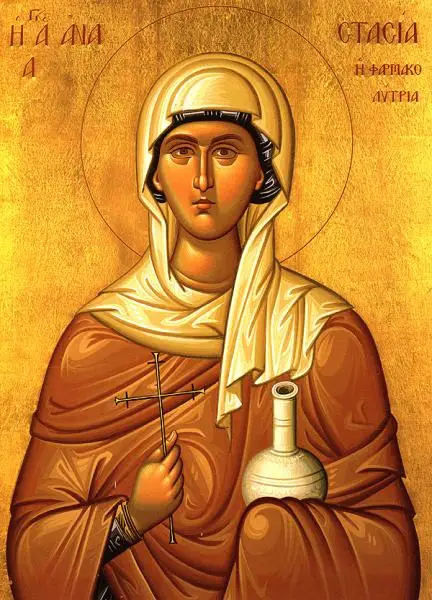
Virgin and Martyr, the Pharmakolytria
Overview
Anastasia, who died on 25 December 304 at Sirmium in the province of Pannonia Secunda, modern Serbia, is a martyr of the persecution of Diocletian of whom little is reliably known except the fact of her martyrdom and the city that kept her memory. The Eastern Church venerates her as the Pharmakolytria, the Deliverer from Potions, and she has long been invoked as a healer and exorcist. A passio not earlier than the sixth century makes her a Roman patrician, daughter of Praetextatus, pupil of St. Chrysogonus, whom she followed to Aquileia, and a visitor of the Christian prisoners of Sirmium, beheaded on the island of Palmaria; the whole account is legendary, as the modern students of the text agree. What is certain is the martyr and her Sirmian cult, the ancient Roman church of Sant'Anastasia that bears her name on the Palatine, her insertion in the Roman Canon by the end of the fifth century, and the unique privilege, before the twentieth-century reforms, of a commemoration in the second Mass of Christmas Day. She is one of the seven women martyrs named in the Canon.
The Complete Life
The Historical Core
Of the historical Anastasia almost nothing survives, and that near-nothing is itself significant: a martyr of that name died for the faith at Sirmium, the great military city on the Sava, in the persecution of Diocletian, and the church of that city remembered her. Everything else belongs to the legendary passio that grew up centuries later. That text makes her a Roman of patrician family, the daughter of a vir illustris named Praetextatus, taught in the faith by Chrysogonus, a priest martyred at Aquileia; it sends her to Sirmium to visit the confessors in prison, and gives her a death by beheading on the island of Palmaria on 25 December, the very day the church keeps her. The Catholic tradition adds that her mother was St. Fausta of Sirmium. From the Bollandists onward, scholars have judged the account wholly legendary, resting on no historical basis whatever: a composite assembled out of the names of real churches and real martyrs of two cities. The name Anastasia, resurrection, was too apt for a martyr to resist elaboration.
§ Introduction
The Legend's Shape
The legendary Anastasia is a patroness and visitor of prisoners, and this, more than the patrician setting, is the devotional core the tradition built. In the passio she ministers to the Christians held in the prisons of the persecution, bringing food, comfort and courage, the work that the Roman church associated with several of its widows and matrons of the era of the great trials. Her connection with Chrysogonus, whose church of San Crisogono stands in Trastevere, anchored her in the Roman topography, and her journey to Sirmium anchored her in the Pannonian, the two centers between which her cult was divided. The death on Palmaria, an island, gave her legend its final exile image. That she is remembered in the East as the Pharmakolytria, the deliverer from potions, reflects a reading of her intercession as protection against poison and sorcery, and made her the patroness of those who compound medicines, a patronage that has outlasted the legend that carried it.
§ Introduction
The Roman Cult
Anastasia's cult reached Rome from Sirmium, if not in fact then in form, through a church: the basilica of Sant'Anastasia al Palatino, built in the late third or early fourth century, probably by a Roman woman of that name, stands at the foot of the Palatine and appears in the acts of the Roman synod of 499 as the Titulus Anastasiae. In time the church came to be dedicated to the martyr of Sirmium, and from the church her name passed into the deepest structures of the Roman liturgy: she is one of the seven virgin martyrs, with the Blessed Virgin, named in the Roman Canon of the Mass, an honor roll whose members were fixed by the end of the fifth century. More remarkably still, the old Roman rite gave her a place at Christmas: the second, daytime Mass of 25 December was at an early stage celebrated in her titulus, and the commemoration of Anastasia remained attached to that Mass into the twentieth century, so that every year, at the heart of the nativity, the church remembered a martyr of the Danube frontier.
§ In the West
Relics and Shrines
Her relics have had several homes, as befits a saint of two worlds. Theodorus Lector reports that under the patriarchate of Gennadius, 458 to 471, the body of the martyr was translated to Constantinople and laid in a church that had previously been called Anastasis, Resurrection, and that took her name thereafter, the church whose ruins stand today in the modern city. The Roman basilica kept its own tradition, and the cathedral of Zadar in Dalmatia, which claims her relics, has made her the patron of the city and the see, her feast kept with processions on the Adriatic. The Martyrologium Hieronymianum records her on 25 December not only for Sirmium but for Constantinople, and the Syriac and Greek calendars keep their own dates. The diffusion, confusing to the historian, was the medieval church's way of saying that a martyr belongs to everyone who invokes her.
§ In the West
Canonization
Anastasia belongs to the most ancient stratum of the church's memory, canonized by no process but by inclusion in the Canon itself. Her name in the Roman Canon, her titulus on the Palatine, her place in the Hieronymianum and in the Constantinopolitan tradition: these are the acts of recognition of the undivided church, and they have never been revised. She is venerated in the Catholic Church, the Eastern Orthodox, the Oriental Orthodox and the Eastern Catholic churches, each keeping its own day, December in the West and the Slav lands, autumn in the Syriac tradition. The liturgical reforms of the twentieth century removed her special commemoration from the Christmas daytime Mass and adjusted her cult in the general calendar, but her place among the saints was never in question, and her basilica in Rome, restored again and again, remains one of the most ancient places of Christian worship in the world.
§ Introduction
Legacy
Anastasia's legacy runs wider than her slender history would predict. In the East she is the Pharmakolytria, invoked in the prayers of healing and exorcism, and the patroness of pharmacists and physicians, a patronage the modern healing professions have inherited and kept. In the West her name stands in the Canon of the Mass, recited daily for fifteen centuries, and her basilica on the Palatine, a cardinal's titulus, has linked her to the government of the church. At Zadar she is the civic patron, her feast the city's day. Historians know her as a lesson in how the early church's memory worked: a name, a city, a date, and then the slow growth of a story that gave the name a life. What the church has loved in her, from the Canon to the Christmas Mass to the pharmacy, is the idea the name itself carries: resurrection, the martyr's answer to the world's worst.
§ In the West
Timeline
- 281
Born at Rome, according to the traditional date
§ Introduction
- 25 Dec 304
Beheaded on the island of Palmaria on 25 December, remembered as a martyr of Sirmium
§ Introduction
- 458
Relics transferred to Constantinople during the patriarchate of Gennadius (458–471), a church there taking her name
§ In the West
- 499
A Roman church, the Titulus Anastasiae, already bears her name in the synod acts
§ Hagiography
- 1976
Some relics returned from Zadar to Sremska Mitrovica in Serbia and placed before the cathedral's main altar
§ In the West
- 2012
Relics enshrined at a Chalkidiki monastery near Mount Athos were stolen and have not been recovered
§ In the East
The Record
- Patron of
- Pharmacists and apothecaries·Doctors and healers·Against poison
- Symbols
- Flask or potion·Cross·Palm of martyrdom
- Canonization
- Pre-congregation; named in the Roman Canon of the Mass
Prayer
Bibliography
Show 12 sources
- ↑ Curtin, D. P. (July 2015). Jacobite Arab Synaxarium- Volume I . Dalcassian Publishing Company. ISBN 9781088061237 .
- ↑ Butler, Alban; Burns, Paul (1 January 1995). Butler's Lives of the Saints . A&C Black. p. 192. ISBN 978-0-86012-261-6 .
- ↑ "St. Anastasia, the Deliverer from Potions" . Antiochian Orthodox Christian Archdiocese.
- ↑ G. H. Lampe , A Patristic Greek Lexicon , Oxford (Clarendon Press), 1961, p. 1472.
- ↑ Smith, Philip (1867). "Anastasia" . In William Smith (ed.). Dictionary of Greek and Roman Biography and Mythology . Vol. 1. Boston: Little, Brown and Company . p. 158.
- ↑ 1976 Ordinary of the Mass in the Ambrosian Rite .
- ↑ ed. De Rossi and Duchesne, Acta Sanctorum , 2 November.
- ↑ Hist. Eccles., II, 65.
- ↑ Zrno, Ivica (18 January 2021). "Proslava svete Anastazije mučenice u Srijemskoj Mitrovici" . Ðakovačko-osječka nadbiskupija . Retrieved 25 December 2024 .
- ↑ Холодюк, Анатолий. "Мощи великомученицы Анастасии Узорешительницы в Баварии" . ПРАВОСЛАВИЕ. RU . Retrieved 25 December 2024 .
- ↑ The Great Horologion or Book of Hours . Boston: Holy Transfiguration Monastery. 1997. p. 354. ISBN 0-943405-08-4 .
- ↑ L. Rydén, "A Note on Some References to the Church of St. Anastasia in Constantinople in the Tenth Century," Byzantion, 44 (1974), 198-201
Profile text adapted from the Wikipedia article, licensed CC BY-SA 4.0.
Pray with this saint every day
Save St. Anastasia of Sirmium to your favorites, read the full profile, and get feast-day reminders in the Saints app.
Get the Saints AppFree on the App Store for iPhone and iPad