
died 576·Feast March 10; 26 Tobi (Coptic)
St. Anastasia the Patrician
Hermit of Scetis, Lady-in-Waiting to Empress Theodora
Overview
Anastasia the Patrician, who flourished in the sixth century and died in 576, was a Byzantine courtier who became a hidden hermit of the Egyptian desert. She waited on the Byzantine empress Theodora as a lady-in-waiting, and — Theodora having grown jealous of her — drew the notice of the emperor Justinian I, who may have pursued her. To avoid trouble, Anastasia left Constantinople for Alexandria in Egypt, arriving at a place called Pempton near the city, where she founded a monastery that would later be named after her. There she lived with monastic discipline, weaving cloth to support herself. After Theodora's death in 548 Justinian tried to have her brought back to Constantinople, but to no avail; instead Anastasia fled to Scetis, seeking help from Abba Daniel, the hegumen of the monastery there. To safeguard her, Daniel settled her in a laura eighteen miles out in the desert, dressed as a male monk, living as a hermit at a time when that life was permitted only to men; he visited her weekly and had one of his disciples supply her with jugs of water. She dwelt in seclusion for twenty-eight years. Aware of her approaching death in 576, she wrote a message for Abba Daniel on a shard of broken pottery and set it by the mouth of her cave; the disciple found the ostracon reading 'Bring the spades and come here.' Daniel came, gave her communion and heard her last words, and only after her death revealed her full story to his disciple. Her tale survives in the Copto-Arabic Synaxarion and in a tale of Daniel of Scetis.
The Complete Life
Court of Theodora
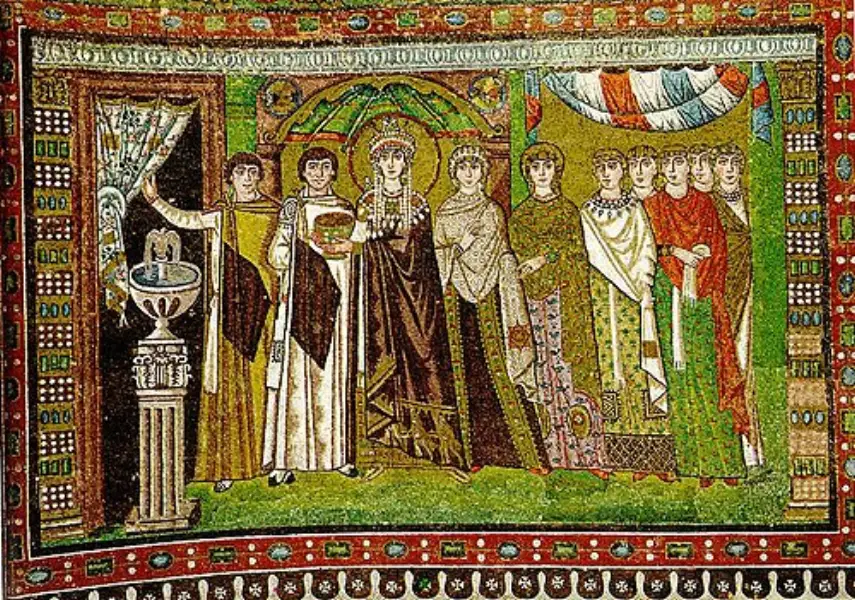
Anastasia was a patrician lady of Constantinople, a lady-in-waiting to the empress Theodora, the formidable consort of Justinian I. The court of Theodora was a place of scrutiny and survival: the empress kept watch over her husband's household with an attention the imperial laws on the rank of actresses and the fall of ministers had made famous. Anastasia's beauty or favor drew Justinian's pursuit — the sources are cautious, saying he may have pursued her — and Theodora grew jealous of her. Rather than become the object of an imperial triangle, Anastasia chose flight, and the court lost her to Egypt.
§ Introduction
Pempton and the Monastery
Anastasia left for Alexandria and settled at Pempton, a place near the city, where she founded a monastery that would later bear her name. She lived there with monastic discipline, supporting herself by weaving cloth — the ordinary labor of the Egyptian desert monasteries, where the brothers wove baskets and mats to sell in the city. She might have ended her days there in obscurity; instead, after Theodora's death in 548, Justinian attempted to have her return to Constantinople. To no avail: Anastasia instead left Pempton for Scetis, the desert of Macarius, and put herself under the protection of Abba Daniel, the hegumen of the monastic community there.
§ Introduction
Twenty-Eight Years in the Desert
Daniel's solution to the problem of an aristocratic woman in the desert was radical discretion: he settled her in a laura — a monastic cell — eighteen miles from Scetis, dressed as a male monk, at a time when the hermit's life was permitted only to men. Once a week he would come to her, and he made sure that a disciple of his kept her stocked with jugs of water. Twenty-eight years Anastasia passed in seclusion inside that cell, her identity shared with Daniel alone. In 576, feeling her death draw near, she put a few words to Daniel on a shard of broken pottery and left it at the mouth of the cave; the disciple arriving with the water found the ostracon reading 'Bring the spades and come here.' Daniel understood, came with his disciple, gave her holy communion, and heard her last words; only after her death did he reveal the full story of who the hidden monk had been.
§ Introduction
Veneration
Anastasia's story comes down in a single recension of the Copto-Arabic Synaxarion, and in a tale from Daniel of Scetis, the collection of the elder's stories preserved in the Egyptian monastic tradition. She is venerated in the Catholic Church, the Eastern Orthodox Church, and the Oriental Orthodox churches, with her feast on 10 March in the Byzantine and Western calendars and on 26 Tobi in the Coptic calendar — the death date that the Ethiopic Life of Daniel of Scetis gives.
§ Introduction
Legacy
Anastasia is the most complete surviving example of the 'transvestite nun' tradition of late antiquity — the women who, barred from the desert by their sex, entered it disguised as monks and were revealed only at their deaths. Her story, told through the trustworthy figure of Abba Daniel and preserved on potsherds and in synaxaria, balances the escape from imperial power with the discipline of concealment: the court beauty who became an unknown hermit and was commended by the church precisely for the hiddenness the world would have called waste. The monastery she founded at Pempton kept her name for centuries.
§ Introduction
Timeline
- 548
After Empress Theodora's death, Justinian tries in vain to recall her to Constantinople
§ Introduction
- 548
Flees to Abba Daniel at Scetis, who hides her in a desert cell dressed as a monk
§ Introduction
- 576
Near death after twenty-eight years of seclusion, she leaves Daniel an ostracon reading 'Bring the spades'
§ Introduction
- 576
Daniel comes at her summons, gives her communion, and records her final words; she dies
§ Introduction
The Record
- Patron of
- Anastasiou Monastery, Alexandria (named for her)
- Symbols
- Monk's habit worn in disguise·Weaver's shuttle·Ostracon
- Canonization
- Pre-congregation; venerated in the Catholic, Eastern Orthodox, and Oriental Orthodox Churches
Prayer
Bibliography
Show 6 sources
- 1 2 Coptic Orthodox Church Network. 'Commemorations For Toba 26,' Lives Of The Saints . Accessed 28 Jan 2021.
- 1 2 3 4 5 6 7 8 9 10 11 12 Laura Swan, The Forgotten Desert Mothers (2001, ISBN 0809140160 ), pages 72-73
- ↑ Anne Commire, Deborah Klezmer. Women in World History: A Biographical Encyclopedia (1999, ISBN 0787640808 ), page 274.
- 1 2 "St. Anastasia the Patrician of Alexandria", Antiochian Orthodox Christian Archdiocese
- ↑ Coquin, Rene Georges. "Anastasia, Saint", The Coptic Encyclopedia , Vol. I, MacMillan (1991)
- ↑ Vivian, Tim. Witness to Holiness: Abba Daniel of Scetis . Cistercian Publications, 2008.
Profile text adapted from the Wikipedia article, licensed CC BY-SA 4.0.
Pray with this saint every day
Save St. Anastasia the Patrician to your favorites, read the full profile, and get feast-day reminders in the Saints app.
Get the Saints AppFree on the App Store for iPhone and iPad