
died 609·Feast Not recorded in the source; cult ancient in East and West
St. Anastasius II of Antioch
Patriarch of Antioch and Martyr
Overview
Anastasius II of Antioch, called the Younger to distinguish him from his predecessor of the same name, became Greek Patriarch of Antioch in 599 and was killed in 609 during an uprising in the city. His short patriarchate is remembered for one thing above all: his opposition to and suppression of simony, the buying and selling of church offices, a campaign he conducted with the support of Pope Gregory the Great, whose correspondence with the East shows the two prelates in alliance on the reform of the clergy. The circumstances of his death belong to the confused violence of Antioch in 609: the city's Jewish community, which was under threat of forced conversion to Christianity, rose in revolt, and local Monophysite Christians, who rejected the council of Chalcedon and had their own grievances against the Chalcedonian patriarch, were in rebellion at the same time. When the revolt broke out, Anastasius reportedly perished in the flames, though the accounts leave room to suspect that Monophysites rather than Jews were behind his death. He was honoured as a martyr, and both East and West keep his memory.
The Complete Life
Early Life
Nothing is recorded of Anastasius before his elevation to one of the great sees of Christendom. Antioch, the city where the disciples were first called Christians, had been governed since the sixth century by a succession of patriarchs caught between the imperial church of Constantinople and the large Monophysite population of Syria, who maintained their own hierarchy in opposition to the official one. The see to which Anastasius was called in 599 was therefore both honourable and exposed: its patriarch represented Chalcedonian orthodoxy and imperial order to a population substantially at odds with both. He was called the Younger to distinguish him from Anastasius I, his predecessor, under whom the see had already known faction and dispute. Whatever his origins and formation, he brought to the throne of Antioch a reformer's temper, and it is this, rather than any recorded biography, that the tradition of his life transmits as his character.
Mission
The mission of Anastasius as patriarch was reform, and the particular object of his reform was simony. The buying and selling of holy things, of ordinations and offices, had become one of the chronic diseases of the sixth-century church, and at Antioch, a wealthy see in a wealthy city, the temptation was correspondingly great. Anastasius set himself against the traffic, and in this he had an ally of the first rank: Pope Gregory the Great, who from Rome was conducting a parallel campaign against simony in the West and beyond it. The cooperation of the pope of Rome and the patriarch of Antioch over the discipline of the Syrian clergy is one of the quiet but real demonstrations of the church's unity in that age before the later schisms. To suppress simony was to attack a source of income and influence that powerful men held dear, and a patriarch who did so made enemies. It is impossible to read the record of his death without asking whether his reform had contributed to the hatreds that exploded in 609, though the sources do not say so directly.
Final Years
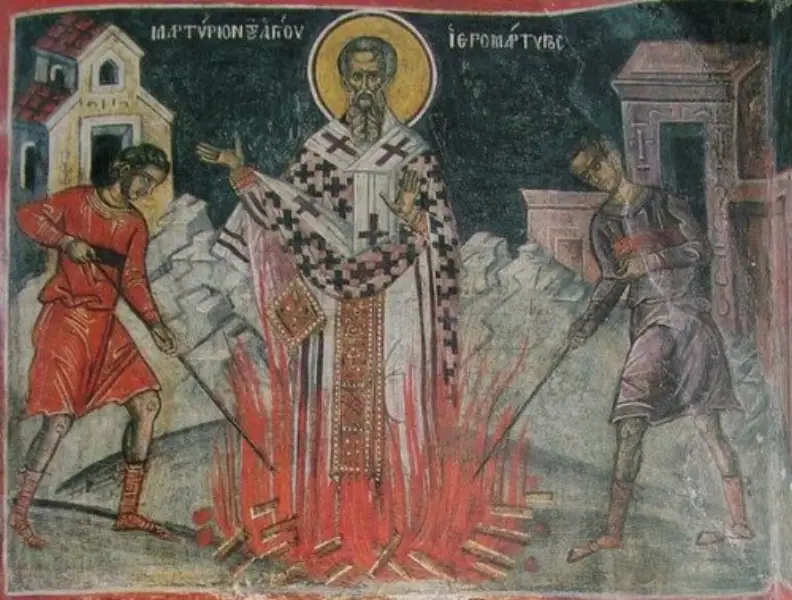
Anastasius died in 609, in the course of an uprising at Antioch whose causes were religious and political at once. The Jewish community of the city had risen under the threat of forced conversion to Christianity, an outrage that had been pressed elsewhere in the empire and that no community could accept quietly. At the same time the local Monophysites, hostile to the Chalcedonian hierarchy that Anastasius headed, were engaged in a revolt of their own. In this convergence of violence the patriarch was seized and, the tradition says, burned alive. The sources that blame the Jewish rising have been questioned, and it is possible that the Monophysite rebels were the actual authors of his death; the earliest accounts do not settle the matter, and modern historians hold the question open. His killing, whatever its immediate agents, was the destruction of a bishop by the fury of his city, and the church received it as martyrdom. The date of his death is given only by the year, and the place of his burial is not recorded.
Cult and Canonization
Anastasius was honoured as a martyr from the time of his death, in the manner of the pre-congregation church: by the memory and liturgy of his own patriarchate and by the acceptance of that memory in the wider church. Both the Byzantine East and the Latin West came to keep his feast, and the Menologion of Basil II, the great Byzantine collection of saints' lives, preserves his commemoration with an image that shows the manner of his death. The cult of a murdered patriarch required no process: it was the spontaneous verdict of the churches that a bishop killed in a religious uprising, whatever the politics of the hour, had died for his office. His predecessor and namesake complicated his memory by occupying the same liturgical space, which is why the style of 'the Younger' became attached to him, but his own identity as the martyr of 609 was never lost.
Legacy
The legacy of Anastasius II is twofold. As a reformer he belongs to the small company of sixth-century prelates who made the fight against simony their own, with Gregory the Great as their chief; his cooperation with Rome is remembered as a mark of what the undivided church could do when its patriarchs and popes worked together. As a martyr he bears witness to the price of leadership in a divided city, where religious communities set against one another by imperial policy turned their desperation on the nearest symbol of the order they hated. His death has also been a caution to history: the earliest blaming of Antioch's Jews for his murder has been weighed by later scholars, who note that the Monophysite rebels had equal motive and opportunity. The honest memory of Anastasius therefore includes both his holiness and the ambiguity of the record, and his cult continues in the calendars of East and West as that of a patriarch who would not sell the gifts of God and who died in the tumult he had not made.
Timeline
- 550
Born around the middle of the sixth century
§ Introduction
- 599
Succeeded Anastasius of Antioch as Greek Patriarch of Antioch, and fought simony with Pope Gregory the Great's backing
§ Introduction
- 609
Burned alive, by report, during an uprising at Antioch in which Jews and Monophysites revolted
§ Introduction
The Record
- Major works
- Suppression of simony in the patriarchate of Antioch·Correspondence and cooperation with Pope Gregory the Great
- Patron of
- Antioch (ancient see)
- Symbols
- Patriarchal vestments·Palm of martyrdom·Flames (attribute of his death)
- Canonization
- Pre-congregation; ancient cult as patriarch and martyr
Prayer
Profile text adapted from the Wikipedia article, licensed CC BY-SA 4.0.
Pray with this saint every day
Save St. Anastasius II of Antioch to your favorites, read the full profile, and get feast-day reminders in the Saints app.
Get the Saints AppFree on the App Store for iPhone and iPad