
died 22 January 628·Feast January 22
St. Anastasius of Persia
Monk and Martyr (Magundat)
Overview
Anastasius of Persia, born Magundat, was a Zoroastrian soldier of the Sasanian army who converted to Christianity and died a martyr in 628. The son of a magus named Bavi, from the city of Ray, he served in the army of Khosrow II and took part in the capture of Jerusalem, when the True Cross was carried off to Ctesiphon. Contact with the relic prompted him to inquire into the Christian religion; he experienced a conversion, left the army, went to Jerusalem, was baptized by Modestus, taking the name Anastasius in honour of the resurrection, and became a monk. Once he had passed seven years in monastic observance, he traveled to Caesarea, then under Sasanian rule, and there he publicly interrupted the Zoroastrian priests and mocked their religion. Arrested by the local marzban, he was tortured to make him abjure and taken to a place called Barsaloe (Bethsaloe) near the Euphrates, where Khosrow's magian hierarchy held out its highest honours if only he would abandon Christianity. His refusal came, and on 22 January 628 he was strangled and beheaded together with seventy others. His body, thrown to the dogs but left untouched, was carried to Palestine, then Constantinople, and finally to Rome, venerated at the abbey of Tre Fontane. A Greek Passio was written about him; Bede knew a Latin translation and tried to improve it.
The Complete Life
The Son of a Magus
Magundat — his baptismal name would come later — was born at Ray, the great city south of modern Tehran, the son of a magus named Bavi: a priestly household of the Zoroastrian religion that was the state cult of Sasanian Persia. He entered the army of Khosrow II, and in 614 he took part in the campaign that changed his life: the Persian capture of Jerusalem, in which the city was stormed, its churches burned, and the relic of the True Cross carried off to the Sasanian capital, Ctesiphon. A soldier of the victors, standing in the wreckage of the holy places and hearing of the Cross his army had looted, began to ask what the Christians said about it. The tradition presents the inquiry as the soldier's own; it was, in any case, the beginning of the end of his Persian allegiance.
§ Biography
Baptism and the Monastery
Magundat's questions led him out of the army and to Jerusalem itself. There he was received into the Church by Modestus, the custodian who was rebuilding the devastated holy places, and at baptism took the name Anastasius — anastasis, resurrection — in honour of the resurrection of Christ whose city he had helped to sack. He then became a monk in the Jerusalem lavras, serving seven years of monastic observance under the tradition of the desert fathers as the Persians had received it. The convert's path ran from the cult of fire to the veneration of the Cross, by way of the discipline of the cloister; and it ended, as the Persian convert's path in Persian territory usually ended, in confrontation. When those seven years were over he made his way to Caesarea, then under Sasanian control, and there in front of everyone he interrupted the Zoroastrian priests and made sport of their religion.
§ Biography
Torture and Death
For the public insult to the state religion, Anastasius was arrested by the local marzban — the Persian military governor — and taken prisoner. He was cruelly tortured to make him abjure; the torment continued after he was carried down to a place near the Euphrates called Barsaloe by the Greek account, Bethsaloe according to the Bollandists. There the offer was made formal: the highest honours in the service of King Khosrow as a magus, if he would renounce Christianity. It was, in effect, an offer to come home — the priest's son restored to the priestly class at the king's own favour. Anastasius refused. With seventy others he was strangled and beheaded on 22 January 628, months before Khosrow's own fall. The body, thrown to the dogs, was left untouched by them; the touch was read as the martyr's last testimony, and the corpse was reverently recovered.
§ Biography
Relics, Passio, and Feast
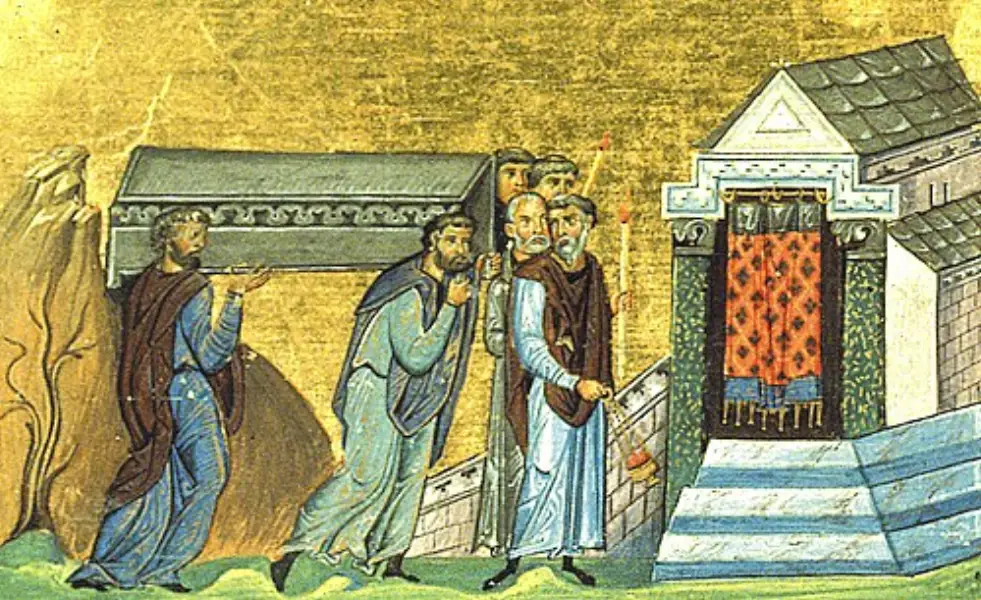
The relics of Anastasius travelled farther in death than the soldier had in life: from the scene of his martyrdom to Palestine, on to Constantinople, and at last to Rome, where they are venerated at the abbey of Tre Fontane on the Ostian way — the Persian magus's son ending at the site of Paul's execution. A Greek Passio was written to tell his story, and it travelled as far as the Anglo-Saxon world: a Latin adaptation, possibly the work of Archbishop Theodore of Canterbury himself, was available to Bede, who found the translation unsatisfactory and took it upon himself to improve it; no manuscript of Bede's revision survives, though one copy lasted as late as the fifteenth century. His feast is 22 January, kept in the Orthodox, Eastern Catholic and Roman calendars alike. He is honoured as the model of the convert who pays for his conversion with his life, and as one of the last great martyrs of the pre-Islamic Persian world.
§ Veneration
The Record
- Patron of
- Converts (by tradition)
- Canonization
- Pre-congregation (ancient cult)
Prayer
Bibliography
Show 5 sources
- ↑ "Monastic Martyr Anastasius the Persian", OCA
- 1 2 3 Campbell, Thomas. "St. Anastasius." The Catholic Encyclopedia Vol. 1. New York: Robert Appleton Company, 1907 This article incorporates text from this source, which is in the public domain .
- ↑ Payne 2015 , p. 195.
- ↑ Την πλάνην αφέμενος, την των Περσών νουνεχώς, τη πίστει προσέδραμες, τη του Χριστού ευσεβώς, σοφέ Αναστάσιε, όθεν και εν ασκήσει, διαπρέψας ενθέως, ήθλησας υπέρ φύσιν, και τον όφιν καθείλες διό διπλώ στεφάνω, θεόθεν εστεφάνωσαι. https://w
- ↑ Laistner & King, Hand-list , p. 87.
Profile text adapted from the Wikipedia article, licensed CC BY-SA 4.0.
Pray with this saint every day
Save St. Anastasius of Persia to your favorites, read the full profile, and get feast-day reminders in the Saints app.
Get the Saints AppFree on the App Store for iPhone and iPad