
died after 700·Feast April 21
St. Anastasius Sinaita
Abbot of Sinai, Writer and Church Father
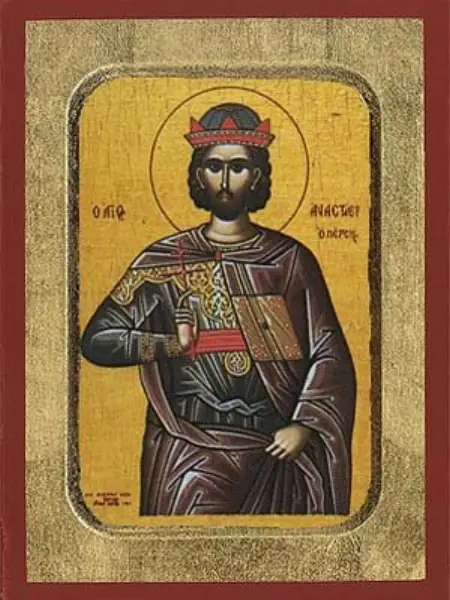
Overview
Anastasius of Sinai, Anastasius Sinaita, who died sometime after the year 700, was a Greek author, priest, and abbot of Saint Catherine's Monastery on Mount Sinai, honored as a saint and church father in the Roman Catholic and Eastern Orthodox churches. What is known of his life is gathered almost entirely from his own works. He wrote in the questions-and-answers mode of catechesis, in sermons and exegesis, was fond of tracing the etymologies of Christian terms, deeply read in the Bible and the patristic literature, and possessed by an interest in the natures of God and man, above all in the person of Christ. His chief works are the Viae Dux or Hodegos, the Guide Along the Right Path, a defense of the Chalcedonian creed against the Monophysites; the Quaestiones et Responsiones, a body of pastoral answers to laypeople on spiritual, sacramental, marital, and charitable questions, together with an eyewitness account of Islam's advance into Sinai and Egypt and of its effect on Christian life; and, probably, the Hexaemeron, an allegorical commentary in twelve books on the Genesis creation story. In antiquity he was often confused with Anastasius I of Antioch, and the authorship of several works under his name remains disputed.
The Complete Life
Alexandria and Sinai
Anastasius was born at Alexandria, the great Greek city of Egypt whose catechetical school had made it, for five centuries, one of the intellectual capitals of Christianity. Of his formation nothing certain is known beyond what his works display: a complete Greek education, an encyclopedic command of the Bible and the fathers from Clement and Origen to the Gregories and Pseudo-Dionysius, and the habit of exact definition that Alexandria taught its churchmen. His career carried him from the city to the mountain: he became a priest, and then abbot, of the monastery of Saint Catherine at Sinai, the fortified house at the foot of the mount of the law that Justinian had built a century before, and one of the pilgrimage centers of the world, standing at the crossing of the routes between Egypt, Palestine, and Arabia. He governed it in the decades after the Arab conquest, when the world around the mountain changed rulers, and he died after the year 700, leaving a body of writing that made the little monastery one of the centers of Greek theology in the dark century between the last fathers and the iconoclast controversy.
§ Major works
The Hodegos and the Defense of Chalcedon
Anastasius's principal dogmatic work is the Viae Dux, the Hodegos of the Greek title, the Guide Along the Right Path, a defense of the creed of Chalcedon, written above all against the Monophysites, whose arguments had never ceased in the lands of the East. The book assembled the christological teaching of the church into a manual of controversy, defining the two natures of Christ against every form of confusion and absorption, and it became, in the centuries that followed, a standard arsenal of the Chalcedonian side; the author's readiness to work out and state his own positions on disputed church questions led, the manuscripts show, to later commentaries, emendations, and perhaps censorship of parts of his works. In antiquity Anastasius of Sinai was constantly confused with his contemporary namesake, Anastasius I of Antioch, bishop and writer, and a modern canon of his genuine works has been established only tentatively, with spurious sections lurking even inside it. The Hodegos stands at the canon's center: the mountain abbot's contribution to the long argument about the person of Christ.
§ Major works
The Questions and the Hexaemeron
The most human of Anastasius's works is the Quaestiones et Responsiones, one of the finest examples of a popular genre, the shepherd's answers to the people's questions. One hundred and two or so queries reach him from laypeople and monks: on the sacraments, on marriage and its impediments, on charitable donations, on demons, dreams, and the oddities of the moral life, answered in a markedly personal voice that opens to us the everyday world of ordinary seventh-century Christians. The Questions are also a document of the first importance for the historian of early Islam, since they are an eyewitness account of the expansion of the new power into Sinai and Egypt, lands that had been predominantly Christian, and of the effect of Muslim governance on Christian life and belief. To these Anastasius probably added the Hexaemeron, twelve books on the creation story of Genesis, arguing that Moses on Sinai was inspired to prophesy, in the very text of the creation, the New Creation in Christ, Adam standing for Christ and Eve for the Church, an allegorical counterpoint to Basil's more literal Hexaemeron, drawing on the whole allegorical tradition from Origen onward.
§ Major works
Legacy
Anastasius is venerated as a saint by the Roman Catholic and Eastern Orthodox churches, his feast falling on 21 April, and modern patristic scholarship has restored him to his place as one of the significant Greek writers of the seventh century, the century from which few great names survive. His influence ran through the defense of Chalcedon, where the Hodegos was read for centuries; through pastoral theology, where the Questions carried the practice of the desert fathers into the print of the catechism; and through the tradition of Genesis commentary, where the Hexaemeron's typology of Adam and Christ fed the medieval exegesis of the creation. He is also, for the modern historian, a source without substitute: the Christian priest who stayed at Sinai through the conquest and described, in answer to his people's questions, what it was to live as the church of the defeated. His works, disputed, censored, and sometimes mislabeled under another Anastasius's name, have needed a century of scholarship to reassemble; the man they reassemble is worth the trouble.
§ Major works
The Record
- Major works
- Viae Dux (Hodegos), Guide Along the Right Path·Quaestiones et Responsiones (Questions and Responses)·Hexaemeron (twelve books on Genesis)·Homiliae i–iii de creatione hominis·Narrationes
- Patron of
- Theologians·Monks of Sinai·Readers of Scripture
- Symbols
- Monk's habit and writing scroll·Mount Sinai
- Canonization
- Pre-congregation (ancient cult in the Catholic and Eastern Orthodox churches)
Prayer
Bibliography
Show 10 sources
- ↑ J. J. Munitiz, "Foreword," in Kuehn-Baggarly 2007, IX.
- ↑ Weiss 1965, XX.
- ↑ Kuehn-Baggarly 2007, XIII-XXIII.
- ↑ Uthemann 2006, 326-330.
- ↑ J. Munitiz, "Foreword," in Kuehn-Baggarly 2007, IX.
- ↑ Uthemann 2006, 313-4.
- ↑ Haldon 1992, 116-8.
- ↑ Richard-Munitiz 2006, LI; Haldon 1992, 124-5.
- ↑ Haldon 1992, 115-6, 130-2.
- ↑ Kuehn-Baggarly 2007, XIII.
Profile text adapted from the Wikipedia article, licensed CC BY-SA 4.0.
Pray with this saint every day
Save St. Anastasius Sinaita to your favorites, read the full profile, and get feast-day reminders in the Saints app.
Get the Saints AppFree on the App Store for iPhone and iPad