
late 2nd or early 3rd century·Feast September 24 (September 25 in Milan)
St. Anathalon
First Bishop of Milan
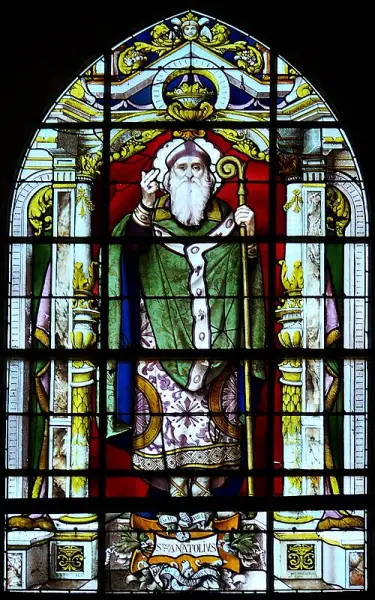
Overview
Anathalon, also called Anatalius or Anatolius, was the first recorded bishop of Milan, who lived at the end of the second century or the beginning of the third. Almost nothing is known of his life or episcopate except that he bore a Greek name, that he governed the church of Milan, and that he died during a pastoral visitation to Brescia, which lay within his jurisdiction; a later tradition also made him the first bishop of Brescia. He is honored as a saint in the Catholic and Eastern Orthodox churches, with his feast on 24 September, kept in Milan on 25 September to avoid a clash with the local feast of St. Tecla. Medieval texts added legendary details: Paul the Deacon's treatise on the bishops of Metz made him a pupil of St. Peter who sent him to Milan, while an eleventh-century Historia Dataria made him a disciple of Barnabas, and another legend credited him with building a church of the Savior over a temple of Mercury where San Giorgio al Palazzo now stands. His relics were discovered at Brescia in 1268 and now rest in the Old Cathedral there.
The Complete Life
Early Life
Anathalon's origins are lost, and the one personal fact the historians retain is linguistic: his name is Greek, of a type common among the clergy of the western church in its first centuries, when Greek was still a living language of the Christian communities of Rome, Milan and the Po valley. Milan in his era was the second city of Italy, the seat of the imperial court in the West at intervals, a cosmopolitan place through which the traffic of the empire passed, and its Christian community, attested from the middle of the second century, reflected that mixture. That the first bishop whose name the Milanese church preserved was a Greek-speaker tells us something of the congregation that elected him. He governed the see at the end of the second or the beginning of the third century, the era of the apologists and of the church's gradual emergence from the shadows of illegality, when the bishop of a great city was already a public figure with the care of a scattered and mixed people.
§ Introduction
Episcopate
The one recorded circumstance of Anathalon's episcopate is its ending: he died during a pastoral trip to Brescia, the city at the foot of the Alps that belonged to the jurisdiction of Milan before it had a bishop of its own. The detail, though brief, is precious: it shows the earliest phase of the northern Italian church, in which the bishop of the metropolis made visitations of the dependent communities, confirming, ordaining and governing in person, in the pattern by which the great apostolic sees mothered the smaller churches around them. That a bishop of Milan should die on such a journey, and be kept in memory at Brescia, gave the smaller city a claim on him, and the later tradition, which made him the first bishop of Brescia as well as of Milan, is an extension of that claim rather than a record. His death on 24 September became his feast, and both cities have kept it, in Milan on the following day.
§ Introduction
Burial and Relics
Anathalon was buried, and the older place of his veneration in Milan was the basilica ad Concilia Sanctorum, the basilica of the assembly of the saints, a church no longer extant that stood near the present church of San Babila in the heart of the city. There the Milanese honored their first bishop for centuries. The Brescian tradition ran in parallel, and in 1268, in the era of the great relic discoveries, his remains were discovered at Brescia and brought to the church of Saint Florian; in 1472 they made a second translation, to the Old Cathedral of Brescia, the beautiful Romanesque duomo vecchio, where they remain. The division of relics between claims was the medieval church's ordinary solution, and Anathalon, claimed by the two cities his ministry had joined, ended as the joint possession of both, the first father of Milan sleeping in Brescia's oldest church.
§ Veneration
Canonization
Anathalon's sanctity was never processed; it was inherited. The church of Milan, which would become one of the greatest of the West and produce Ambrose, counted its bishops from him, and the early episcopal lists, which the medieval historians elaborated, carried his name at the head. The legends that grew around that head, his discipleship under Peter in Paul the Deacon's eighth-century account, or under Barnabas in the eleventh-century Historia Dataria, and his founding of a church of the Savior over a temple of Mercury, are the Middle Ages' way of giving the first bishop an apostolic pedigree, and the historians read them accordingly. The cult itself needed no such help: feast on 24 September in the general calendars, 25 September in Milan, where the local love of St. Tecla had already taken the earlier day, liturgy being the arbiter of such courtesies.
§ Life
Legacy
Anathalon's legacy is the church of Milan itself, one of the oldest and most storied of the West. He stands at the head of a line that runs through Mirocles and Eustorgius to Ambrose, to Charles Borromeo and to the twentieth century, and the ambrosian rite, that most distinctive of western liturgies, is the inheritance of the church he first governed. His double commemoration at Brescia fixed him also in the memory of the smaller city, and his relics in the duomo vecchio make him part of one of the loveliest ensembles of Romanesque architecture in Italy. For the historian he is a boundary marker: the moment when the Christianity of the Po valley emerges into the record with a name and a see. For the believer he is the first of a countless line of pastors, remembered for almost eighteen centuries chiefly, and sufficiently, for having been their beginning.
§ External links
Timeline
- 200
Serves as first recorded Bishop of Milan, at the end of the second or early third century
§ Life
- 24 Sep 200
Dies at Brescia during a pastoral trip, on the traditional date later kept as his feast
§ Veneration
- 1268
His relics are discovered at Brescia and translated to the church of Saint Florian
§ Veneration
- 1472
Relics translated to the Old Cathedral of Brescia, where they remain
§ Veneration
The Record
- Patron of
- Milan and Brescia
- Symbols
- Bishop's vestments·Church keys
- Canonization
- Pre-congregation; ancient cult at Milan and Brescia
Prayer
Bibliography
Show 5 sources
- ↑ Ruggeri, Fausto (1991). I Vescovi di Milano . Milano: NED. p. 7. ISBN 88-7023-154-2 . (in Italian)
- 1 2 3 4 Arduino, Fabio (10 May 2005). "Sant' Anatalo (Anatalone) di Milano Vescovo" . Santi e Beati (in Italian) . Retrieved 20 October 2011 .
- ↑ Hutchison-Hall, John (Ellsworth), "24th September (OS): Anathalon of Milan" , Orthodox Saints of the Pre-Schism See of Rome
- ↑ Cazzani, Eugenio (1996). Vescovi e arcivescovi di Milano . Milano: Massimo. pp. 9– 10. ISBN 88-7030-891-X . (in Italian)
- 1 2 Pasini, Cesare (1987). "Castriziano di Milano, santo (sec. IV)". Dizionario della Chiesa Ambrosiana . Vol. 1. Milano: NED. p. 140 – 141. ISBN 88-7023-102-X . (in Italian)
Profile text adapted from the Wikipedia article, licensed CC BY-SA 4.0.
Pray with this saint every day
Save St. Anathalon to your favorites, read the full profile, and get feast-day reminders in the Saints app.
Get the Saints AppFree on the App Store for iPhone and iPad