
died 1205
St. Anders of Slagelse
Priest of Slagelse, 'Hellig Anders' (local cult, never canonized)
Overview
Anders of Slagelse, known in Danish as Hellig Anders — Holy Anders — was a priest of Saint Peter's Church in Slagelse, Denmark, in the late twelfth and early thirteenth centuries. Though Rome never enrolled him among the canonized, he was venerated by the local people as a saint, a devotion that survived the Danish Reformation itself. Returning from pilgrimage to the Holy Land, he is said to have received a vision of a rider on a white horse who carried him home in time to celebrate Easter with his parishioners, then transported him to the shrine of Santiago de Compostela and the shrine of Saint Olaf in Norway. After these journeys he was believed to heal the lame and the blind through prayer. A friend of King Valdemar II, he once won a wager in which the king promised him all the territory he could circle on a nine-day-old foal during the time the king bathed; a dropped glove near Landsgrav was said to have become a healing spring visited into the eighteenth century. He died in 1205 and was buried at Saint Peter's.
The Complete Life
A Parish Priest of Zealand
Almost nothing historical is recorded of Anders before his fame. He was priest of Saint Peter's Church in Slagelse, one of the older towns of Zealand, in the decades around 1200 — the age of Absalon and Valdemar the Victorious, when Denmark was becoming a great Baltic power and its church a richly endowed institution. Parish priests of that era appear in records only as names in charters, if at all, and Anders appears in none. What made him unforgettable was not documentation but story: a set of legends so well fitted to their landscape that they kept his memory alive through the Reformation, which extinguished almost every native Danish cult, and into the folk tradition of the modern era.
The Pilgrim Priest
The first cluster of legend makes Anders a pilgrim of the classic kind. He had gone to the Holy Land — Jerusalem being the farthest goal a medieval Dane could name — and while returning, homesick for his parish at Easter, he was met by a man on a white horse who carried him home in time for the feast. The same rider then took him to Compostela and to the shrine of Saint Olaf at Trondheim, the great pilgrimage axis of the medieval North, before returning him to Slagelse. Whether the tale began as a dream, a retelling of a real journey, or pure invention cannot be known; its function is clear. It presented Anders as a man whom God carried, and whose love for his parishioners reached across the map.
Healer and King's Friend
The legends then turn local. After his journeys Anders was believed to heal the lame and the blind through prayer — the standing gift of the northern holy man. He was a friend of King Valdemar II, and the most domestic of all his legends belongs to that friendship: the king, half in jest, promised him as much parish land as he could circle on a nine-day-old foal during the time the king bathed. Anders rode so far and well that a squire had to hurry the king out of his tub, and in the rush Anders let fall a glove near Landsgrav, where — the story says — a spring promptly welled up, visited for its healing properties into the eighteenth century. The tale works on every level at once: a joke about the king's bath, a serious claim about land for the parish, and a landscape consecrated by a glove.
Death and Burial
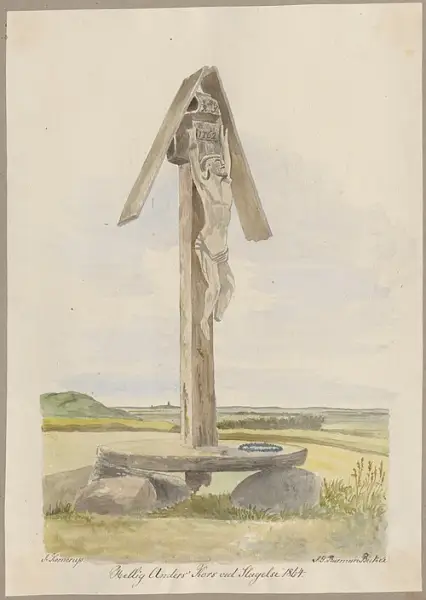
Anders died in 1205 and was buried at Saint Peter's, the church he had served. No vita was written for him, no shrine industry developed, no canonization process was opened — his is the rare case of a cult that never sought institutional confirmation and did not need it. The memory lived where it had always lived, in Slagelse and the villages around, attached to the spring and to the cross later raised in his memory, and it outlasted the church's own reversals.
A Cult Without a Process
The sources state the anomaly plainly: Anders was never formally made a saint by Rome, yet devotion to him persisted among local practitioners even beyond the Reformation. In Lutheran Denmark, where the shrines were emptied and the saints' days suppressed, Hellig Anders remained a folk saint — a man the people continued to call holy on their own authority. Scholars of Danish sanctity treat him as a prime example of the unofficial, popular canon that ran beside the official one: canonization by use rather than by decree.
Legacy
Anders's legacy is written on the map of a small Danish region: the cross raised in his memory, the spring at Landsgrav visited for centuries, and the standing of his name in Slagelse. He represents the whole class of medieval parish priests whose holiness was remembered by neighbors rather than by institutions — men whose miracles were small, local, and durable. For the historian he is evidence that the Danish Reformation, thorough as it was, could not reach every spring and every story; for the Church he is a question politely left open, about what it means when the people canonize and the hierarchy does not.
The Record
- Patron of
- Slagelse
- Symbols
- Priest's vestments·White horse (the miraculous rider)
- Canonization
- Never formally canonized; local veneration continued after the Reformation
Prayer
Profile text adapted from the Wikipedia article, licensed CC BY-SA 4.0.
Pray with this saint every day
Save St. Anders of Slagelse to your favorites, read the full profile, and get feast-day reminders in the Saints app.
Get the Saints AppFree on the App Store for iPhone and iPad