
1752–1834·Feast May 13
St. André-Hubert Fournet
Priest, Founder with St. Jeanne-Élisabeth Bichier des Ages
Overview
André-Hubert Fournet (1752–1834) was a French priest, the reluctant son of a devout mother, who became one of the great churchmen of the Restoration and co-founder, with Jeanne-Élisabeth Bichier des Ages, of the Daughters of the Holy Cross, Sisters of St Andrew. Born at Saint-Pierre-de-Maillé in Vienne on 6 December 1752 to Pierre Fournet and Florence Chasseloup, he found religion a bore, ran away from his studies at Poitiers, joined the army, and was pulled out of it by his mother; he said flatly that he would never be a priest or a monk. The influence of his uncle Jean, a rural pastor, changed his mind, and he was ordained in 1776, succeeding his uncle as parish priest of his hometown in 1781. He refused the Revolutionary oath, carried on his now illegal ministry in secret, was arrested on Good Friday 1792, declined a carriage to jail because Christ carried his cross on foot, escaped — at one point taking the place of a dead man on a bier — and fled to Spain. Returning in 1797, he met Bichier des Ages in 1798 and drew up the rule for her new congregation. He multiplied food for the community, the tradition says, more than once. Retiring from parish duties in 1820, he directed the order until his death on 13 May 1834 at La Puye.
The Complete Life
The Reluctant Vocation
Fournet was born on 6 December 1752 at Saint-Pierre-de-Maillé in the Vienne, to Pierre Fournet and Florence Chasseloup, with his uncle Antoine baptizing him in the parish church on the following day. At least one sister belonged to the household, and a cousin, Julien Augustin Chasseloup de Châtillon, went on to die a general of the Revolution. His childhood religion, by his own account, was boredom: most things bored him and religion was one of them. The boredom grew into resistance because his mother kept pressing him toward the priesthood; time after time he declared that neither priest nor monk was what he meant to become. At Poitiers he pursued legal and philosophical studies, fled his school in a gesture of rebellion, and entered the armed forces — from which his mother retrieved him once she had found him. A job held no interest for him, and his poor handwriting limited what he could look for. The man who turned him was not his mother but his uncle Jean Fournet, a rural pastor, whose life made visible what argument could not; he decided for the priesthood and was ordained in 1776.
§ Life
A Parish Priest in Revolution
In 1781 he was made parish priest of his own hometown, succeeding the uncle whose example had converted him — to his mother's pleasure. The Revolution made the quiet cure a criminal. He refused the oath required by the Civil Constitution of the Clergy, and carried on the pastoral work the law now forbade, celebrating in hiding the Masses and confessions the state had abolished. On Good Friday, 6 April 1792, he was arrested for his activities. The record keeps his one famous sentence: offered a carriage to jail, he turned it down, reasoning that where Jesus Christ had borne his cross, his followers ought to go the same way, on their own two feet. He escaped — at one point, the tradition says, assuming the place of a dead man on a bier, the most clandestine of the refractory priests' many disguises — and fled to Spain, where the émigré clergy of the west of France gathered at Bilbao and in the Basque country.
§ Life
Founder with Bichier des Ages
Fournet returned to France in 1797, when the Directory's persecution relaxed. In 1798 he made the acquaintance of Jeanne-Élisabeth Bichier des Ages, the young noblewoman who was gathering women to serve the sick and teach the children of the countryside ruined by the Revolution. He became her director and collaborator, and drew up the monastic rule the new congregation would follow: the Daughters of the Holy Cross, Sisters of St Andrew, whose mother house was fixed at La Puye. The tradition credits him with multiplying food for the sisters and their charges on a number of occasions — the classic sign of the founder who feeds what he founds. The congregation devoted itself to teaching and nursing, and grew through the nineteenth century into one of the standard congregations of the west of France.
§ Introduction
La Puye
In 1820 Fournet gave up his parish duties, though he went on guiding the new order until he died, and he spent those years living with his sister. His last decade was the serene old age of a man who has seen the church he served underground become the church of the restored Bourbon monarchy — the Daughters of the Holy Cross teaching openly in villages where, twenty-five years earlier, he had said Mass in barns with sentries at the door. He died on 13 May 1834 at La Puye, aged eighty-one, and was buried at the mother house he had ruled in all but name.
§ Introduction
Beatification and Canonization
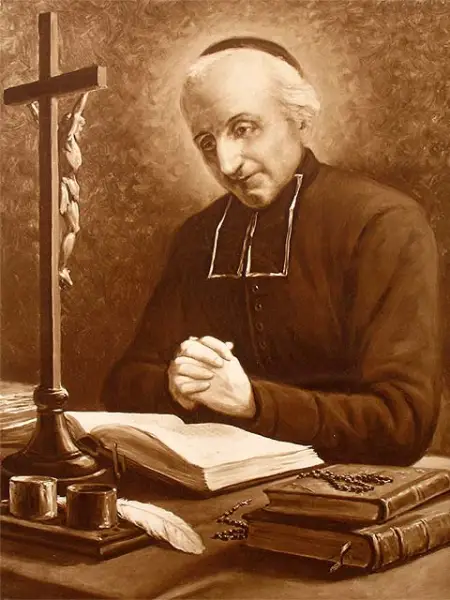
On 19 July 1877, under Pius IX, the sainthood cause began, its informative and apostolic processes conducted at Poitiers; Benedict XV declared him Venerable on 10 July 1921 on the confirmation of his heroic virtue; Pius XI confirmed two miracles and beatified him on 16 May 1926, and confirmed two more and canonized him on 4 June 1933 — the whole process, from opening to canonization, fifty-six years, with the same pope for beatification and canonization seven years apart. His feast is 13 May, the day of his death, and his attributes are the book of the hours and the crucifix: the prayer and the sacrifice of a lifetime that ran from boredom to sanctity by way of an uncle's example and a revolution's jails.
§ Sainthood
Timeline
- 6 Dec 1752
Born at Saint-Pierre-de-Maillé in Vienne, and baptized by his uncle Antoine the next day
§ Life
- 1776
Ordained a priest, won over by the example of his uncle Jean, a rural pastor
§ Life
- 1781
Made parish priest of his hometown, succeeding his uncle
§ Life
- 6 Apr 1792
Arrested on Good Friday for refusing the Revolutionary oath and continuing his pastoral work in secret
§ Life
- 1792
Escaped from France and fled to Spain
§ Life
- 1797
Returned to France from exile
§ Life
- 1798
Met Jeanne-Élisabeth Bichier des Ages and helped establish her congregation, drawing up its rule
§ Life
- 1820
Retired from parish duties and went to live with his sister, while continuing to direct the new order
§ Life
- 13 May 1834
Died at La Puye, aged eighty-one
§ Introduction
- 19 Jul 1877
His sainthood cause was opened under Pope Pius IX, making him a Servant of God
§ Sainthood
- 10 Jul 1921
Declared Venerable by Pope Benedict XV upon confirmation of his heroic virtue
§ Sainthood
- 16 May 1926
Beatified in Saint Peter's Basilica by Pope Pius XI after confirmation of two miracles
§ Sainthood
- 4 Jun 1933
Canonized in Saint Peter's Basilica by Pope Pius XI
§ Introduction
The Record
- Major works
- Rule of the Daughters of the Holy Cross (Sisters of St Andrew)
- Patron of
- Daughters of the Holy Cross·Priests who resisted the Revolution (by devotion)
- Symbols
- Book of the Hours·Crucifix
- Canonization
- Beatified 16 May 1926 by Pius XI; canonized 4 June 1933 by Pius XI
Prayer
Bibliography
Show 4 sources
- 1 2 3 4 "Saint André-Hubert Fournet" . Saints SQPN. 6 August 2012 . Retrieved 11 November 2016 .
- 1 2 3 4 "May 13: St. Andrew Fournet" . Holy Spirit Interactive. Archived from the original on 11 November 2016 . Retrieved 11 November 2016 .
- 1 2 3 "San Andrea Hubert Fournet" . Santi e Beati . Retrieved 11 November 2016 .
- ↑ Pontiff canonizes religious martyr; Andre-Hubert Fournet, Victim in French Revolution, Attains Sainthood in St. Peter's. 50,000 attend ceremony De Valera, Dollfuss and Many Other Notables Present -- Insane Man Interrupts Ritual. New York
Profile text adapted from the Wikipedia article, licensed CC BY-SA 4.0.
Pray with this saint every day
Save St. André-Hubert Fournet to your favorites, read the full profile, and get feast-day reminders in the Saints app.
Get the Saints AppFree on the App Store for iPhone and iPad