
1256-1315·Feast September 3
St. Andrea Dotti
Servite Priest and Preacher
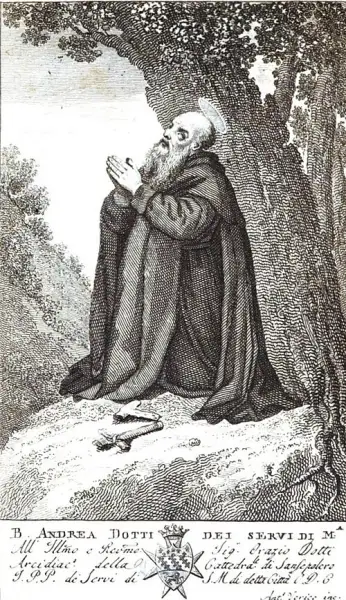
Overview
Andrea Dotti, of the noble family of that name at Borgo San Sepolcro in Tuscany, was born in 1256 and became one of the notable Servite preachers of his generation. A brother of Count Dotto Dotti, captain of the body-guard archers of Philip the Fair of France, Andrea grew up like other noblemen of his day, distinguished by courage in combat. The turn of his life came in 1278, when Philip Benizi, the great prior general of the Servite Order, preached at the opening of the order's general chapter in Borgo: the young nobleman was so struck that he asked admission on the spot, was received by the General in person, and was soon ordained priest. His zeal showed itself principally in preaching and penance. He held various offices of honor in the order, and by charity and persuasion brought over to the order a whole company of the hermits living at Vallucola; his appointment as procurator of Sansepolcro, with charge of those monks, followed in 1295. Many visions were vouchsafed him and many miracles were credited to him. After long years of preaching he retired to a hermitage, renewed his austerities, and died there on 31 August 1315, his cult being formally authorized by Pope Pius VII in 1806.
The Complete Life
A Nobleman of Borgo San Sepolcro
Andrea Dotti was born in 1256 at Borgo San Sepolcro — the town in the upper Tiber valley whose name commemorates the Holy Sepulchre relic kept there — into a family of the local nobility. His brother Dotto became Count Dotti, captain of the archers of the royal body-guard of Philip the Fair of France, an office that placed the family in the international aristocracy of the late thirteenth century. Andrea's own youth followed the standard course of his class: the older notice says plainly that he grew up like many another nobleman of his day, distinguished by courage in combat. Nothing in the record of his early years points toward the cloister; he was a fighting man of a fighting caste, and the conversion that changed him was sudden, external, and complete. The family's standing at the French court, and the town on the Tiber that kept his name, frame the whole of his career between the court and the cloister.
Philip Benizi's Sermon
The hinge of Andrea's life was a sermon. In 1278 the Servite Order held its general chapter at Borgo San Sepolcro, and Philip Benizi — the prior general whose government gave the Servites their classical shape, and who would himself be canonized — preached at the chapter's opening. Young Dotti was in the congregation, and the effect was immediate: he asked on the spot to be admitted to the Servite Order. Philip received him personally, and Andrea was ordained priest soon after. The scene belongs to a recognizable thirteenth-century pattern — the noble soldier converted by a mendicant preacher at a public occasion — but its consequences in Andrea's case were unusually durable, for he not only stayed but became, in time, one of the order's trusted officers. Philip Benizi, the general who received him, was himself the effective second founder of the Servites, and the reception of a noble convert was a public gain for the young order.
Preacher, Procurator, Shepherd of Hermits
Andrea's ministry ran on two tracks, preaching and government. In the pulpit his zeal showed itself chiefly in preaching and penance, and the older lives credit him with a great many authenticated miracles and vouchsafed visions — the conventional but not empty testimony of a reputation for sanctity that survived among people who had heard him. In government he filled various positions of honor in the order, and in 1295 he was appointed procurator at Sansepolcro, entrusted with the monks at Vallucola. His achievement there was characteristic: by his charity and zeal he drew into the order a large company of hermits living at Vallucola, absorbing an informal eremitical community into the Servite structure not by command but by persuasion. It is the one act of his recorded career that shows his method. The pattern of his ministry — preaching in the towns, governing in the order, reconciling hermits — was the standard Servite work of the generation after Philip Benizi's death.
The Hermitage
After long years of itinerant preaching Andrea did what a number of Servites and Franciscans of the age did: he withdrew. Retiring into a hermitage, he renewed the penances of his novitiate and died there on 31 August 1315, in the neighborhood of his native Borgo. He was laid to rest in a church of his native town, and the cult at his tomb grew to the point that, nearly five centuries later, Pope Pius VII formally authorized it on 29 November 1806 — an equivalent beatification in the modern idiom. The liturgical calendars of the Servite order keep his feast on 3 September, and the older Catholic Encyclopedia's article preserves the outline of his life. His last years of renewed penance in the hermitage closed a life that had kept, to the end, the discipline of the soldier he had once been trained to be. The cult at his tomb in Borgo San Sepolcro grew for nearly five centuries before the formal confirmation of 1806 ratified what the town had always believed.
Memory of a Convert Preacher
Andrea Dotti's afterlife has been modest and local, as his life was. The town that keeps his name also keeps the tradition of his burial; the Servite order keeps his feast; the standard dictionaries — Holweck, the Catholic Encyclopedia via McGinnis's notice, and the Italian Santi e Beati compilations — carry short entries that agree on the outline: noble birth, the 1278 conversion under Philip Benizi, the offices, the hermits of Vallucola, the hermitage, the 1806 confirmation. His interest for the historian is as a case study in the recruiting power of the thirteenth-century mendicant revival, which could take a body-guard officer's brother and make him a shepherd of hermits; his interest for the Church is the pattern of his method, charity and zeal rather than jurisdiction. The Servite calendars and the older encyclopedias — Holweck, McGinnis, the Italian Santi e Beati — keep the same outline, which is nearly all the record there is.
Timeline
- 1256
Born at Borgo San Sepolcro in Tuscany into a noble family, brother of Count Dotto Dotti
§ Introduction
- 1278
Struck by Philip Benizi's sermon at the Servite general chapter at Borgo, asked admission to the order and was received
§ Life
- 1295
Appointed procurator of Sansepolcro, given charge of the monks living at Vallucola
§ Life
- 31 Aug 1315
Died at Borgo San Sepolcro in the hermitage to which he had withdrawn; laid to rest in a church of his hometown
§ Life
- 29 Nov 1806
Pope Pius VII authorized his cult, an equivalent beatification
§ Life
The Record
- Major works
- Reports of visions and revelations (not extant as writings)
- Patron of
- Borgo San Sepolcro, Italy·The Servite Order
- Symbols
- Servite habit·Preacher's cross
- Canonization
- Cult confirmed (equivalent beatification) by Pope Pius VII on 29 November 1806
Prayer
Profile text adapted from the Wikipedia article, licensed CC BY-SA 4.0.
Pray with this saint every day
Save St. Andrea Dotti to your favorites, read the full profile, and get feast-day reminders in the Saints app.
Get the Saints AppFree on the App Store for iPhone and iPad