
c. 1360-c. 1430·Feast January 29 (also July 4; with synaxes on 13 June, 6 July, 22 August)
St. Andrei Rublev
Venerable Monk and Iconographer
Overview
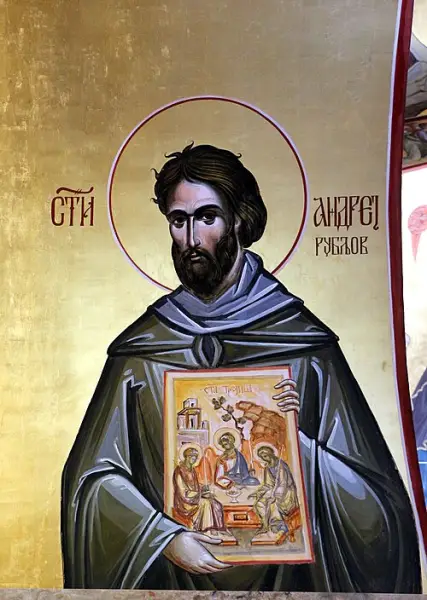
Andrei Rublev, born about 1360 and dying about 1430 at the Andronikov Monastery in Moscow, is considered the greatest of medieval Russian painters of Orthodox icons and frescoes, and is venerated as a saint. Little of his life survives — even his birthplace is unknown. He most likely resided at the Trinity Lavra of St. Sergius near Moscow while Nikon of Radonezh led it as hegumen in the years after Sergius's death in 1392. He is first mentioned in 1405, decorating the Cathedral of the Annunciation in the Moscow Kremlin with Theophanes the Greek and Prokhor of Gorodets, his name last on the list of masters as the junior. Together with Daniel Chorny he decorated the Dormition Cathedral at Vladimir in 1408, and the two worked on the Trinity Cathedral of the Lavra from 1425 to 1427. The one work scholars authenticate as wholly his, the icon of the Trinity, dates to about 1410: taking the Hospitality of Abraham as his source, he dropped Abraham and Sarah, and by subtle composition turned the scene into a pure contemplation of the Mystery of the Trinity. In his art the highest asceticism combines with the classic harmony of the Byzantine manner; his figures are always peaceful and calm, and his style became the ideal of Orthodox iconography.
The Complete Life
Early Life
Almost nothing of Rublev's origins survives: where he was born is unknown, and his dates are approximations — born about 1360, died between 1427 and 1430. He probably lived at the Trinity Lavra of St. Sergius near Moscow, in the generation after the great saint of the Russian north, under Nikon of Radonezh, who led the house after Sergius's death in 1392. That monastic setting — the hesychast stillness of the Sergian revival — is the necessary context of everything he painted; his art has been read ever since as the Sergian spirituality made visible.
§ Introduction
Training and Career
He is first heard of in 1405, among the masters decorating the Cathedral of the Annunciation in the Moscow Kremlin — in company with Theophanes the Greek, the great Byzantine painter who had moved to Russia, and Prokhor of Gorodets. Rublev's name stands last of the three, junior in rank and age; Theophanes is considered to have trained him. In 1408, with Daniel Chorny, he painted the Dormition Cathedral at Vladimir; between 1425 and 1427 the two painted the Trinity Cathedral in the Trinity Lavra. After Daniel's death Rublev transferred to the Andronikov Monastery in Moscow, where his final work, the Saviour Cathedral frescoes, was painted. Also thought his is a miniature in the Khitrovo Gospels.
§ Career
The Trinity
The only work authenticated as entirely Rublev's is the icon of the Trinity, painted around 1410 and now returned to the Holy Trinity Lavra, installed in its original position on the iconostasis of the Trinity Cathedral. It drew on the older Hospitality of Abraham iconography from Genesis 18: Rublev took out the figures of Abraham and Sarah, so that the three angelic visitors stand alone in a composed circle, and through subtle composition and symbolism changed the subject to the Mystery of the Trinity itself. In Rublev's art two traditions combine: the highest asceticism of the Russian monastic revival and the classic harmony of Byzantine mannerism. His characters are always peaceful and calm. In time his art was seen as the ideal for painting in the Eastern Church and for Orthodox iconography generally — at the Stoglavi Sobor of 1551 his style was promulgated as the model for church painting.
§ Career
Final Years
Rublev died at the Andronikov Monastery between 1427 and 1430, having outlived his partner Daniel, and was buried there. He left no school in the documentary sense, but his manner shaped the next generation directly — Dionisy above all — and his Trinity became the most reproduced and most loved icon in Orthodoxy.
§ Career
Canonization and Veneration
The Russian Orthodox Church canonized Rublev on 6 June 1988, at the Trinity Lavra of St. Sergius, in the Local Council held for the millennium of the baptism of Rus'. His feasts are several: 29 January (commemoration of his death), 4 July (main feast in the lists of the saints of Moscow and Vladimir), 12-13 June with the synaxis of the saints of Andronikov Monastery, 6 July with the synaxis of the saints of Radonezh, and 22 August. Since 1959, his own and related works have been on display at the Andrei Rublev Museum housed in the Andronikov Monastery.
§ Introduction
Legacy
The historian Zenkovsky's judgment sets Rublev beside Epiphanius the Wise, Sergius of Radonezh and Stephen of Perm as marks of Russia's spiritual and cultural revival in the late fourteenth and early fifteenth centuries; his icons, which express 'the spirit of complete serenity and humility' in harmonious color, are for Russians the supreme achievement of religious art and the fullest expression of Russian spirituality. In 1966 the film of Andrei Tarkovsky made his name world-historic — the one Soviet-era film to treat Christianity as an axiom of Russia's identity. The canonization of a painter in 1988 completed the argument: Rublev's icons are not about sanctity; in the Orthodox judgment they are sanctity at work.
§ Death and legacy
Timeline
- 1360
Born, probably near Moscow; his birthplace is in fact unknown
§ Introduction
- 1405
First mentioned: decorated icons and frescoes for the Cathedral of the Annunciation, Moscow Kremlin, with Theophanes the Greek and Prokhor of Gorodets
§ Early life
- 1408
With Daniel Chorny, painted the Dormition Cathedral at Vladimir
§ Career
- 1410
Painted the icon of the Trinity, about this time, his only work authenticated as entirely his
§ Career
- 1425
With Daniel Chorny, painted the Trinity Cathedral in the Trinity Lavra of St. Sergius, working until 1427
§ Career
- 1430
Died at Moscow's Andronikov Monastery between 1427 and this year
§ Death and legacy
- 1551
The Stoglavi Sobor of this year held up Rublev's manner of painting icons as the standard for church art
§ Death and legacy
- 1959
The Andrei Rublev Museum opened at the Andronikov Monastery, displaying his and related art
§ Death and legacy
- 1966
Andrei Tarkovsky released his film Andrei Rublev, loosely based on the painter's life
§ Death and legacy
- 6 Jun 1988
Canonized by the 1988 Local Council of the Russian Orthodox Church at the Trinity Lavra of St. Sergius
§ Introduction
- 22 Jun 2024
The Trinity icon was returned to the Holy Trinity Lavra and installed on the iconostasis of Holy Trinity Cathedral
§ Career
The Record
- Major works
- The Trinity icon (c. 1410)·Frescoes of the Dormition Cathedral, Vladimir (1408)·Frescoes of the Trinity Cathedral, Trinity Lavra (1425-27)·Frescoes of the Saviour Cathedral, Andronikov Monastery·Miniatures in the Khitrovo Gospels (attributed)
- Patron of
- Iconographers and artists
- Symbols
- Clothed as an Orthodox monk, holding an icon·The Trinity (Hospitality of Abraham)
- Canonization
- Canonized on 6 June 1988 by the 1988 Local Council of the Russian Orthodox Church at the Trinity Lavra of St. Sergius
Prayer
Bibliography
Show 12 sources
- ↑ The Getty Union Artist Name List prefers "Rublyov", but "Rublev" is more commonly found.
- ↑ "Saint Andrey Rublyov | Iconography, Mosaic, Fresco | Britannica" . www.britannica.com . Retrieved 2026-09-01 .
- ↑ The concise encyclopedia of Eastern Orthodox Christianity . Chichester: Wiley. 2014. p. 403. ISBN 9781118759332 .
- ↑ "Venerable Andrew Rublev the Iconographer" . www.oca.org .
- ↑ "Orthodox Calendar. HOLY TRINITY RUSSIAN ORTHODOX CHURCH, a parish of the Patriarchate of Moscow" . HOLY TRINITY RUSSIAN ORTHODOX CHURCH, a parish of the Patriarchate of Moscow . Retrieved 2024-05-09 .
- ↑ "Святейший Патриарх Кирилл возглавил принесение иконы Святой Троицы, написанной преподобным Андреем Рублевым, в Троице-Сергиеву лавру и совершил в обители всенощное бдение" . Русская православная церковь: Официальный сайт Московского Патр
- 1 2 Saint Herman Calendar 2006 . Platina CA: Saint Herman of Alaska Brotherhood. 2006. pp. 12, 56.
- ↑ "Главная" . fond.ru . Archived from the original on July 21, 2006.
- ↑ "Moscow Patriarchate Glorifies Saints" , Orthodox America , vol. IX, no. 82, August 1988, archived from the original on 2008-07-05 , retrieved 2008-03-16
- ↑ Hoberman, Jim. " Andrei Rublev " . The Criterion Collection . Retrieved 2007-12-06 .
- 1 2 Zenkovsky, Serge A. (1963). Medieval Russia's Epics, Chronicles, and Tales . Dutton. p. 205.
- ↑ "January 29, 2015. + Orthodox Calendar" . orthochristian.com . Retrieved 2022-07-16 .
Profile text adapted from the Wikipedia article, licensed CC BY-SA 4.0.
Pray with this saint every day
Save St. Andrei Rublev to your favorites, read the full profile, and get feast-day reminders in the Saints app.
Get the Saints AppFree on the App Store for iPhone and iPad