
1521–1608·Feast November 10
St. Andrew Avellino
Theatine Priest, Reformer of the Clergy
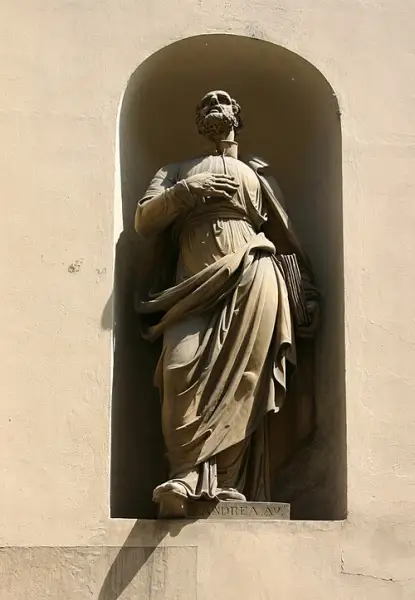
Overview
Andrew Avellino, born Lancelotto at Castronuovo in Basilicata in 1521, was an Italian Theatine priest who gave the Counter-Reformation Church one of its models of the reformed clergy. Educated in the humanities and philosophy at Venice — where, a handsome youth pestered by admirers, he took ecclesiastical tonsure to protect his chastity — he went on to Naples, took a doctorate in canon and civil law, and was ordained priest at twenty-six, practising as a lawyer in the archiepiscopal court. Commissioned by the archbishop to reform a scandalous convent, he restored its discipline by example and untiring zeal, and one night was assaulted and severely wounded by men who had been meeting the nuns clandestinely. Taken to the Theatine house to recover, he resolved to give himself entirely to God and entered the young order founded by Gaetano dei Conti di Thiene, taking the name Andrew at his investiture on the vigil of the Assumption in 1556. Master of novices for ten years and then superior, he founded Theatine houses at Milan and Piacenza and many more across Italy, directed countless souls, counted Lorenzo Scupoli and Charles Borromeo among his friends and penitents, and died of a stroke at the altar on 10 November 1608, at the beginning of Mass.
The Complete Life
A Lawyer of Naples
Lancelotto Avellino — the baptismal name he would change on entering religion — was born in 1521 at Castronuovo in the Basilicatan hills, a small town of the province of Potenza. His elementary schooling done at home, he was sent to Venice for the humanities and philosophy. The sources dwell on one detail of those years: the young man was handsome, and his chastity was repeatedly put at risk by women who admired him; to get out of their way he accepted ecclesiastical tonsure — the shaved crown that marked a man as clerical. The gesture is a small window into the world of the sixteenth century, in which the clerical state functioned as both a vocation and a refuge. Naples came next: there he read canon and civil law, graduated as a Doctor of Laws, and at twenty-six was ordained to the priesthood. For some years he held office as a lawyer at the ecclesiastical court of Naples: a career, in other words, entirely made — and one he was about to lose by his own competence.
§ Life
The Wound That Converted a Lawyer
A convent whose laxity had turned into open scandal was the reason the archbishop of Naples sent him there. By his own example and untiring zeal Avellino brought back the house's religious discipline — though the work cost him many and great difficulties. Men of the town who had made a habit of secret meetings with the nuns were enraged by his interference, and one night he was attacked and badly wounded. The Theatines took him into their monastery to heal, and the convalescence turned into a retreat: there he made up his mind to give himself wholly to God, and joined the Order of Theatines, lately founded by Gaetano dei Conti di Thiene — the order of regular clerics whose whole program was the reform of the priesthood that Avellino had just been wounded attempting. On the vigil of the Assumption 1556, aged thirty-five, he was invested and took the name Andrew.
§ Life
Master of Novices, Founder, Director of Souls
Once his novitiate was finished, leave was granted him to make a pilgrimage to the tombs of the apostles and martyrs in Rome; on coming back he was appointed master of novices, an office he filled for ten years until his election as superior. Because his zeal for strict religious discipline and the purity of the clergy was joined to deep humility and sincere piety, the General of the order chose him to found two new houses, one at Milan and one at Piacenza; placed over several of these new foundations, he drew sinners and heretics back to the faith with such prudence in the guidance of souls and such persuasive preaching that crowds of disciples gathered about him. Among them was Lorenzo Scupoli, the author of The Spiritual Combat, the great ascetical classic of the age. Charles Borromeo numbered among his close friends, consulted him on the church's weightiest business, and asked him to found the Theatine house in Milan; with Paolo Burali d'Arezzo he implemented the reforms of the Council of Trent in the diocese of Piacenza.
§ Life
Death at the Altar
Avellino lived to be eighty-seven, still preaching, hearing confessions, visiting the sick and writing — his letters filled two volumes at Naples in 1731, his other ascetical works five more in 1734. On 10 November 1608, at the very start of the Holy Sacrifice of the Mass, apoplexy struck him down; having received Holy Viaticum, he died. The manner of his death fixed his patronage: he is invoked especially against sudden death — the death without preparation that the pious of every century have feared — and in modern times for the protection of stroke victims. Naples' great Theatine church, San Paolo Maggiore, holds his remains, and his body is still displayed there.
§ Introduction
Beatification and Canonization
His cause moved with the speed the age reserved for its obvious cases: beatified in 1624 by Urban VIII, only sixteen years after his death, and canonized in 1712 by Clement XI. The double process made him one of the standard saints of the Counter-Reformation — the lawyer-turned-reformer whose wounded body and disciplined life argued the case for the reformed clergy that the Council of Trent had legislated. He is venerated as patron of Naples and Sicily and of Badolato, and his feast is kept on 10 November. His continuing appeal is easy to see: a professional man who gave up a made career, a reformer who paid for reform in blood, and a priest whose last act on earth was to begin Mass — the whole of the Counter-Reformation ideal of the secular priest in one Theatine habit.
§ Introduction
Timeline
- 1521
Born Lancelotto at Castronuovo in Basilicata
§ Life
- 14 Aug 1556
Invested in the Order of Theatines on the vigil of the Assumption, taking the name Andrew
§ Life
- 10 Nov 1608
Stricken with apoplexy while beginning Mass; dies after receiving the Viaticum
§ Death
- 1624
Beatified by Pope Urban VIII, sixteen years after his death
§ Death
- 1712
Canonized by Pope Clement XI
§ Death
The Record
- Major works
- Letters (2 vols., Naples, 1731)·Ascetical works (5 vols., 1734)
- Patron of
- Naples·Sicily·Badolato·Invoked against sudden death·Invoked for stroke victims
- Symbols
- Theatine habit; dying at the altar
- Canonization
- Beatified 1624 by Urban VIII; canonized 1712 by Clement XI
Prayer
Bibliography
Show 6 sources
- 1 2 3 Ott, Michael. "St. Andrew Avellino." The Catholic Encyclopedia Vol. 1. New York: Robert Appleton Company, 1907. 13 June 2018
- 1 2 "Lives of the Saints: November: 10: St. Andrew Avellino" . sacred-texts.com . Retrieved 2024-02-02 .
- ↑ Holweck, Frederick George (1924). A Biographical Dictionary of the Saints: With a General Introduction on Hagiology . B. Herder. p. 72.
- 1 2 "St. Andrew Avellino", General Curia dei Chierici Regolari Teatini
- ↑ Attwater, Donald and Catherine Rachel John. The Penguin Dictionary of Saints . 3rd edition. New York: Penguin Books, 1993. ISBN 0-14-051312-4 .
- ↑ Hollingsworth, Gerelyn. "St. Andrew Avellino", National Catholic Reporter , November 10, 2011
Profile text adapted from the Wikipedia article, licensed CC BY-SA 4.0.
Pray with this saint every day
Save St. Andrew Avellino to your favorites, read the full profile, and get feast-day reminders in the Saints app.
Get the Saints AppFree on the App Store for iPhone and iPad