
died 1900·Feast July 9
St. Andrew Bauer
Franciscan Brother and Martyr
Overview
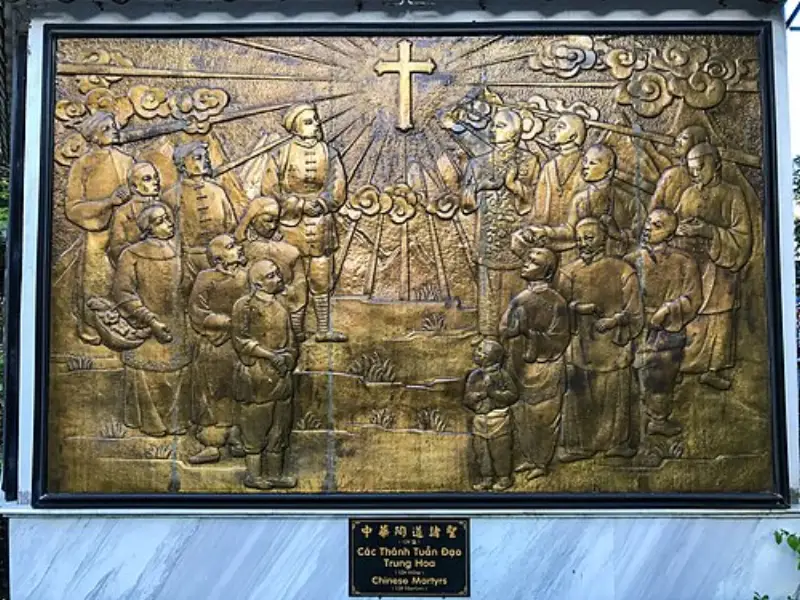
Andrew Bauer, a German religious brother of the Franciscan Friars Minor, served the mission at Taiyuan in Shanxi. He was not a priest but a friar of the hidden labors, sharing the work of a community led by Bishops Gregorio Grassi and Francis Fogolla in a province where, by the summer of 1900, the Boxer uprising had turned anti-foreign feeling into open killing. When the Boxer uprising — born of drought, flood, and anti-foreign fury in northern China — reached Shanxi in the summer of 1900, the provincial authorities turned it upon the Christians of the capital. Bauer was martyred on 9 July 1900 in the massacre at Taiyuan, one Franciscan among the whole Franciscan family — bishops, priests, sisters, seminarians, and laypeople — who died together that day. John Paul II canonized him on 1 October 2000 among the 120 Martyr Saints of China.
The Complete Life
Conversion and Vocation
Andrew Bauer was a German Catholic who found his vocation not in the priesthood but in the lay brotherhood of the Franciscan Friars Minor. That choice set the shape of his whole life: brothers in that order took the same vows of poverty, chastity, and obedience as the priests, but gave themselves to the practical work that kept a friary and a mission alive — cooking, building, farming, porter's duty, the care of guests and of the poor who came to the gate. In the Germany of Bismarck's Kulturkampf, religious life was itself under pressure, and the decision to enter it was a counter-cultural one. For a German brother of that generation, the Franciscan path also opened toward the foreign missions, which the Order had renewed in China after the persecutions of earlier centuries had thinned its ranks there. Bauer offered himself for that work, crossing two continents for the sake of a province he had never seen, and was attached to the Franciscan mission in Shanxi, northern China, where Catholicism had been planted in the seventeenth century and had survived everything since.
Mission and Ministry
In Shanxi, Bauer served at Taiyuan, the provincial capital, in the community gathered around Bishop Gregorio Grassi, the vicar apostolic, and his coadjutor Bishop Francis Fogolla. The friars' house there supported a busy mission: a cathedral and parish life for the city's Catholics, schools and workshops, an orphanage for the abandoned children that famine always produced, and above all the seminary where young Chinese Secular Franciscans studied for the priesthood of their own church. A lay brother's labor underlay all of it. The community's bread, buildings, repairs, laundry, and gate were a brother's charge, and the Chinese Christians the friars served came to know the foreign religious not as distant clergy but as the men who shared their courtyard, their food, and their weather. By 1900 the vicariate counted thousands of baptized Catholics and catechumens across the province, a church sustained in daily being by exactly this quiet, material fidelity that left no trace in any archive.
Trial and Final Years
The summer of 1900 brought catastrophe. The Boxer uprising, fed by drought, failed harvests, and fury at foreign interference in China, spread through the northern provinces with the declared aim of driving out foreigners and destroying the Christians associated with them. In Shanxi the movement found a ruthless patron in the provincial governor, Yuxian, who had already made an example of the mission of Shouyang and who now ordered the foreign missionaries in the capital put to death. On 9 July 1900, at the governor's residence in Taiyuan, the executions were carried out: Bishops Grassi and Fogolla, the priests Elias Facchini and Théodoric Balat, and Brother Andrew Bauer, together with the seven Franciscan Missionaries of Mary and a company of Chinese seminarians, catechists, and lay faithful who had refused every offer of life in exchange for apostasy. The whole Franciscan family of Taiyuan — bishops, priests, brother, sisters, and students — died in a single day, and the city's Christian quarter was left to bury what it could.
Canonization
The martyrs of the Boxer summer were not forgotten. Local Catholics gathered what they could of the remains and the memory, testimony was collected while witnesses still lived, and the cause of the China martyrs moved slowly through the decades that followed. On 24 November 1946, Pope Pius XII beatified the martyrs of the uprising, Bauer among them. More than half a century later, on 1 October 2000, Pope John Paul II canonized him at Rome as one of the 120 Martyr Saints of China — bishops, priests, brothers, sisters, seminarians, and laypeople, eighty-seven of them Chinese, who died for the faith between 1648 and 1930. The canonization was deliberately collective: it honored the Chinese church and its foreign servants in a single act, refusing to separate the two communities whose blood had been mingled.
Legacy
Bauer's legacy is the recognition his hidden life finally received. A brother who never preached a recorded sermon, signed no document, and governed nothing now shares an altar with bishops and scholars of the first rank, and his inclusion in the canon of the 120 makes a theological point the Church deliberately made: martyrdom does not distinguish between the visible and the invisible worker, and the sacrifice of a lifetime of unrecorded service was consummated in a single afternoon. He is remembered each year on the shared feast of the Martyr Saints of China, and among Franciscans his death at his post in Taiyuan stands as a sign that the China missions were built — and in the summer of 1900 were held — by the hands of brothers as much as by the voices of priests.
Timeline
- 9 Jul 1900
Killed at Taiyuan in Shanxi with Bishops Grassi and Fogolla and Franciscan priests in the massacre of 9 July
§ Martyrs of the Boxer Rebellion
- 1900
The Boxer Rebellion, backed by the government from June, spread violence against missionaries and Chinese Christians
§ Boxer Rebellion
- 24 Nov 1946
Beatified by Pope Pius XII among twenty-nine martyrs of China
§ Introduction
- 1 Oct 2000
Canonized by Pope John Paul II as one of the 120 Martyr Saints of China
§ Introduction
The Record
- Canonization
- Canonized by Pope John Paul II on 1 October 2000, among the 120 Martyr Saints of China
Prayer
Profile text adapted from the Wikipedia article, licensed CC BY-SA 4.0.
Pray with this saint every day
Save St. Andrew Bauer to your favorites, read the full profile, and get feast-day reminders in the Saints app.
Get the Saints AppFree on the App Store for iPhone and iPad