
1591-1657·Feast May 16
St. Andrew Bobola
Jesuit Priest and Martyr
Overview
Andrzej Bobola was born in 1591 to a noble Polish family at Strachocina in the Sandomierz region. He entered the Society of Jesus at Vilnius in 1611, was ordained a priest in 1622, and spent three decades as preacher, confessor, advisor, and superior across towns of Poland and Lithuania. From 1652 he worked as a travelling missionary in the eastern borderlands — probably stationed at Polotsk in 1655, and later Pinsk, both now in Belarus — winning so many souls that Orthodox opponents called him the hunter of souls and, later, the Apostle of Lithuania. His labours fell amid the Khmelnytsky uprising, when Cossack forces swept the Commonwealth and Jesuits were marked men. Captured at Pinsk on 16 May 1657, he was taken to Janów (now Ivanava) and killed for refusing to renounce his faith; contemporary accounts describe scourging, burning with torches, a mock crown, carved mutilations, and his unceasing prayer for the torturers until he was silenced. Buried at Pinsk and later Polotsk, his body was found incorrupt in 1701, lost from view again, recovered in Soviet Moscow in 1923, and ransomed to Rome. Beatified in 1853, he was canonized in 1938; his relics have been venerated in Warsaw since 19 June 1938.
The Complete Life
Early Life
Andrew Bobola was born in 1591 into the noble Bobola family, in Poland's Sandomierz Voivodeship, then part of the Polish–Lithuanian Commonwealth. The Bobolas were an old house — their progenitor is traced to a free peasant farmer of Silesia in the thirteenth century who rose to knightly status and founded the family seat at Bobolice — and by the fourteenth century they moved in the circles of the powerful Tarnowski family and the royal court. Andrew's own branch was prominent: his grandfather Jan was administrator of Jarosław, his uncle Andrzej became Grand Chamberlain of the Crown and royal secretary, and his father Mikołaj held the estate at Strachocina near Krosno. The exact circumstances of Andrew's birth were long disputed among armorials and biographers, but the weight of the evidence, assembled by the Jesuit historian Jan Poplatek, places him within this lineage. He grew up a son of the Commonwealth's Catholic nobility at a moment when that class supplied the Society of Jesus with many of its finest men.
Conversion and Vocation
In 1611, at about twenty years of age, Bobola entered the Society of Jesus at Vilnius, in Lithuania's grand duchy — the Commonwealth's other half, and the field where his life's work would lie. He passed through the long Jesuit formation of those years, professed solemn vows and was ordained priest in 1622. No crisis of conversion marks his path; what marks it instead is a steady migration from the colleges to the missions. For some years he served the order in the settled roles of advisor, preacher and superior of a residence, and in each of these he showed the gifts that would earn him his later nickname, the hunter of souls. But from 1652 he took up a different labour entirely, working as a country missionary in the towns and villages of Lithuania, including Polotsk (probably his station in 1655) and Pinsk, both of them now in Belarus.
Mission and Ministry
Bobola's missions were conducted among a population torn by confessional division. The lands of the eastern Commonwealth held Orthodox and Uniate Christians side by side, and the Jesuit missionaries of Lithuania worked to hold and strengthen the union with Rome, preaching missions that lasted days, reconciling penitents, and restoring lapsed communities. It was this work, in the years before and during the catastrophic wars of the 1650s, that made Bobola known as the Apostle of Lithuania. The title was not decorative: the country missions of that era were journeys through dangerous and half-empty country in the wake of invading armies, undertaken by men already marked by their office. Polotsk and Pinsk, the centres of his last years, lie in what is now Belarus; in his own day they were the eastern marchlands where the Commonwealth's authority was dissolving in war. Bobola's reputation among both Catholics and opponents was that of a preacher of unusual force, and the fury of his death would confirm how seriously his enemies took that reputation.
Trial and Final Years
On 16 May 1657, in the course of the Khmelnytsky Uprising, Bobola was captured by Cossacks of Bohdan Chmielnicki at Pinsk and killed at Janów (now Ivanava, Belarus). Several accounts of his death survive, all of them involving torture. In one, he had just finished Mass when the Cossacks entered Pinsk; kneeling, he said, 'Lord, thy will be done,' and was then stripped, tied to a tree, crowned with a mock wreath, scourged, burned with torches and mutilated — a sword carving the shape of a tonsure into his head and of a chasuble into his back — while he kept praying for his torturers until they tore out his tongue and crushed his skull. Another version has him dragged to a butcher's shop, flayed, and killed with an awl driven into his heart as a Polish rescue party neared the town. a Soviet Russian examination of the corpse in January 1923 reported finding no marks of gross mechanical violence on the parts that survived; the debate over the details has not disturbed his cult.
Canonization
Bobola's body was buried first in the Jesuit church at Pinsk and later moved to Polotsk, but by the beginning of the eighteenth century its resting place had been forgotten. In 1701 Father Martin Godebski, rector of the Pinsk College, reportedly received a vision of the martyr and ordered a search; the body was found incorrupt. The discovery revived his cult, and the cause for his beatification gathered momentum across the century. He was beatified by Pius IX in 1853, and canonised by Pius XI on 17 April 1938 — a date charged with meaning, falling as it did between the partitions that had erased Poland from the map and the Nazi invasion that would soon follow. His feast is kept on 16 May, the day of his death. The canonisation was received in Poland as a national event, and Bobola was quickly adopted as a patron of the Polish nation as much as of the Jesuits.
Legacy
Andrew Bobola's legacy rests on two pillars: the memory of the seventeenth-century religious wars of the Commonwealth's eastern marches, and the twentieth-century fate of his relics. His body, having survived the visions and searches of the eighteenth century, passed through the wars and upheavals of the twentieth — removed, hidden, transferred to Moscow and eventually restored to Rome and then to Warsaw, where it now rests in the Jesuit church on ulica Rakowiecka. As the 'Apostle of Lithuania' and the 'hunter of souls' he is invoked by the Jesuits, by Polish Catholics, and by those who work for reconciliation between the Catholic and Orthodox churches, since his mission was spent precisely on that frontier. His martyrdom, with its deliberate mockeries of the priesthood, is read as a passion directed not only against a man but against the office he bore; for that reason priests under persecution have often taken him as their model.
Timeline
- 1591
Born at Strachocina in the Sandomierz Voivodeship to a noble family of the Polish–Lithuanian Commonwealth
§ Introduction
- 1611
Entered the Society of Jesus at Vilnius, then in the Grand Duchy of Lithuania
§ Life
- 1622
Ordained a priest after professing solemn vows; afterwards served as advisor, preacher and superior of a Jesuit residence
§ Life
- 1652
Took up work as a travelling country missionary across Lithuania, serving among other places Polotsk and Pinsk
§ Life
- 1655
Probably stationed as missionary at Polotsk
§ Life
- 16 May 1657
Captured at Pinsk during the Khmelnytsky Uprising and tortured to death by Cossacks at the village of Janów
§ Life
- 1701
After Father Martin Godebski's reported vision, a search found his body at Polotsk completely incorrupt
§ Veneration
- 30 Oct 1853
Beatified by Pope Pius IX in Rome
§ Introduction
- 23 Jun 1922
His coffin was opened at Polotsk and the relics examined
§ Veneration
- 1923
Relics, taken to Moscow by Soviet authorities, were released to Father Edmund A. Walsh and delivered to the Holy See
§ Veneration
- May 1924
His relics were placed in the Church of the Gesù at Rome, the principal church of the Jesuits
§ Veneration
- 17 Apr 1938
Canonized by Pope Pius XI at Vatican City
§ Introduction
- 19 Jun 1938
His body venerated from this date at a shrine in Warsaw, with an arm remaining in Rome
§ Veneration
- 2002
The Bishops' Conference of Poland declared him a patron saint of Poland
§ Veneration
In Their Own Words
Lord, thy will be done!
The Record
- Patron of
- Poland·Archdiocese of Warsaw
- Symbols
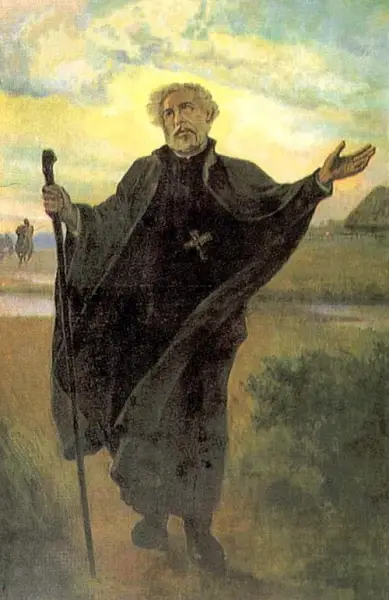
- Jesuit cassock·Crown of twigs and instruments of his torture (iconography)
- Canonization
- Beatified by Pope Pius IX on 30 October 1853; canonized by Pope Pius XI on 17 April 1938
Prayer
Bibliography
Show 12 sources
- ↑ Merrick, David Andrew (1891). Saints of the Society of Jesus: With a sketch of the Society . William H. Sadlier. p. 16 .
- 1 2 Popłatek 1936 , p. 18.
- ↑ Popłatek 1936 , p. 19.
- ↑ Popłatek 1936 , p. 19-20.
- ↑ Popłatek 1936 , p. 295-296.
- ↑ Popłatek 1936 , p. 298-299.
- ↑ Popłatek 1936 , p. 26.
- 1 2 3 4 5 This article incorporates text from a publication now in the public domain : Rudge, F. M. (1907). " St. Andrew Bobola ". In Herbermann, Charles (ed.). Catholic Encyclopedia . Vol. 1. New York: Robert Appleton Company.
- ↑ Daurignac, J. M. S. (1865). History of the Society of Jesus From Its Foundations to the Present Time (Volume II) . John P. Walsh. pp. 12– 13.
- ↑ "Who is St. Andrew Bobola? - St. Andrew Bobola Parish, Dudley, MA" . www.standrewbobola.com . Archived from the original on 4 January 2017 . Retrieved 21 August 2018 .
- 1 2 Акты о вскрытии так называемых мощей католического святого Андрея Боболи. Протокол
- 1 2 3 "Religion: Saints" . Time . 25 April 1938. (The Time article says that Walsh personally transported the Holy Relics from Moscow to Rome ; but this is apparently a mistake, both since Gallagher (1953) describes his own role as a diplom
Profile text adapted from the Wikipedia article, licensed CC BY-SA 4.0.
Pray with this saint every day
Save St. Andrew Bobola to your favorites, read the full profile, and get feast-day reminders in the Saints app.
Get the Saints AppFree on the App Store for iPhone and iPad