
1302-1373·Feast February 4
St. Andrew Corsini
Bishop of Fiesole, Carmelite
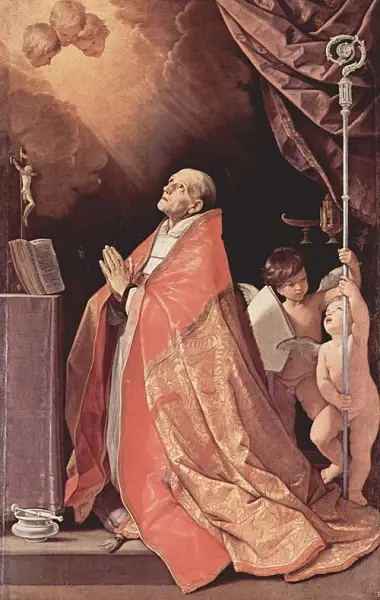
Overview
Andrew Corsini, born Andrea on 30 November 1302 in Florence to the great Corsini family, was a Carmelite friar and bishop of Fiesole from 1349 until his death. His youth was wild and dissolute, until his mother's rebuke drove him to the Carmelite church of Santa Maria del Carmine, where he made up his mind to enter the order as friar and priest. Within the order he filled a series of posts, provincial responsibilities among them, before — reluctantly — accepting the episcopate when named to Fiesole on 13 October 1349. To ready himself for the office he took on mortifications stricter than his rule demanded, and gave himself to the cause of the poor, winning renown as a peacemaker between warring cities and factions, and as a bishop of fearless reform. He died at Fiesole on 6 January 1373. Miracles were reported at his tomb, and the longstanding popular devotion led to his beatification by Eugene IV in 1440 and canonization by Urban VIII in 1629. He is the patron of Florence and Fiesole and is invoked against civil disorder and riots.
The Complete Life
Early Life
Born at Florence on 30 November 1302, Andrea belonged to the Corsini, among the great merchant-banking families of the republic. The wealth of such a house in the early fourteenth century was matched by its turbulence, and the biographical tradition says plainly that Andrew led a wild and dissolute life — the ordinary career, the tradition implies, of a well-born Florentine youth with money, nerve, and no direction. The turn came through his mother, a woman of the deep piety the age also produced in abundance: a rebuke from her — in the later tellings, delivered over the discovery of his dissipations — moved him to make for the church of Santa Maria del Carmine, where he determined to enter the Carmelites as friar and priest. The conversion of the young profligate into the stern religious is the oldest pattern in the book, and the Carmelite chroniclers told it of their bishop with relish.
§ Introduction
Carmelite and Bishop
Andrew's Carmelite life was one of rising responsibility. After his formation and ordination he exercised various roles in the order, including its governance in Tuscany, and his biographers stress the completeness of the change: the man who had wasted his youth now imposed on himself, for the rest of his life, greater mortifications than the rule required. In 1349 came the appointment to the see of Fiesole, the ancient hill diocese above Florence, and the sources all note that he accepted it reluctantly, resisting until obedience settled the matter. That reluctance was itself a datum for his cult: a man who had to be forced toward honor could be trusted with it. Consecrated around 1350 by Angelo Acciaioli, he held the see until his death — twenty-three years of governance in one of the most fractious corners of Italy. Reluctance itself became part of the case for his cult: a man who had to be pressed toward honor was not chasing it.
§ Introduction
Bishop and Peacemaker
As bishop of Fiesole Andrew made three things his business. First, the discipline of his clergy: he worked to reform the lives of his priests, insisting on residence, liturgy, and honesty, at a time when pastoral neglect was the Church's standing scandal. Second, the poor: he dedicated himself to their plight with the particular attention of a man who remembered having been selfish, and his almsgiving and care of the sick became proverbial. Third, peace: he served repeatedly as a mediator — between Florence and its rival cities, between factions within the city, and on legations for the popes at Avignon and Rome — and his reputation as a peacemaker followed him into legend and art. The strangest and most famous of his images, the bishop floating on a cloud above a battlefield, preserves the memory of a battle near Fiesole in which the saint was seen, in a vision, praying over the warring armies; the wolf and the lamb at his feet carry the same theme into the language of icons.
§ Introduction
Spirituality
Andrew's spirituality was penitential and pastoral at once. The mortifications he took on with his episcopate — beyond what the Carmelite rule demanded — were understood by his biographers as the bishop's answer to temptation: having known how easily power corrupts, he armed himself against it in his own body before exercising it over others. His care for the poor had the same autobiographical root; the tradition presents his charity as reparation, the repayment of a debt contracted in his wild years. Guido Reni's great painting of him in prayer shows the Carmelite bishop with his stole and his scourge, and the feast of his conversion-minded cult, kept by the Carmelites on 9 January, joins him to the line of religious who preached mercy because they had needed it. The image that stuck was the bishop at prayer — stole in one hand and scourge in the other — and the Order's own calendar keeps his conversion-minded feast on a date of its own, 9 January.
§ Introduction
Final Years
Andrew died at Fiesole on 6 January 1373, in the night on which the Church keeps the Epiphany — a date his biographers did not fail to read as a sign for a man whose life had been a kind of epiphany in itself. His remains were laid in the Carmelite church of Santa Maria del Carmine in Florence, where veneration of the late bishop grew so deep that miracles were reported at his tomb; the Carmine shrine became one of the city's pilgrimage centers and stayed so for centuries. The Corsini family never forgot their saint: from his tomb they drew a perpetual claim to Florentine spiritual nobility, which culminated centuries later in a Corsini pope, Clement XII, who beautified the family's memory of him. The family never let the shrine go quiet: the Corsini Chapel rose beside the tomb in 1675, and a kinsman, Pope Clement XII, later raised a chapel to him at Saint John Lateran in Rome.
§ Introduction
Canonization
Corsini's devotion — long-standing and widespread — brought his formal recognition in two stages: Pope Eugene IV confirmed his beatification on 21 April 1440, within living memory of his death, and Pope Urban VIII proclaimed him a saint on 22 April 1629 in St Peter's Basilica, close to the height of the Counter-Reformation's interest in model bishops. His feast is kept on 4 February in the general calendar, with 6 January, the day of his death, also observed, and the Carmelite order keeping him on 9 January. The canonization of a bishop remembered for reform, poverty, and peacemaking was the Church's way, in a century of religious wars, of saying what a bishop should be. The case also drew on the battlefield: the Florentine victory over the Milanese at Anghiari on 29 June 1440, within weeks of his beatification, was credited to his intercession, and petitions for canonization reached Paul II in 1465 and 1466 before Urban VIII acted in 1629.
§ Introduction
Legacy
Andrew Corsini's legacy divides between his order and his city. The Carmelites count him among their great bishops, and his iconography — cross, wolf and lamb, the floating figure over battle — belongs to the Carmelite visual tradition from Guido Reni onward. Florence and Fiesole keep him as patron, and his shrine at the Carmine, with its chapel by the Corsini, has been a civic as well as religious monument; against civil disorder and against riots he is the patron invoked, a Florentine answer to a Florentine problem. His life remains the standing Carmelite example of a wasted youth redeemed — proof, as his cult insisted, that no beginning is so bad that a vow cannot change the end. His body was found incorrupt at an exhumation in 1385, the Corsini Chapel still draws visitors to the Carmine, and a Corsini pope's chapel at the Lateran keeps the family's saint in stone. That is why Florence and Fiesole have never had to look far for their patron.
§ Introduction
Timeline
- 30 Nov 1302
Born in Florence into the noble Corsini family, one of twelve children
§ Early life
- 1318
Entered the Carmelites at Florence for his novitiate after his mother's rebuke
§ Carmelite friar
- 1328
Became a priest, offering his first Mass in a hermitage rather than amid family festivities
§ Carmelite friar
- 1332
Returned from studies at Paris and Avignon and was chosen prior of his convent
§ Carmelite friar
- 1348
Appointed the order's Tuscan Provincial at the General Chapter in Metz
§ Carmelite friar
- 13 Oct 1349
Appointed Bishop of Fiesole by Pope Clement VI, and went into hiding on hearing the news
§ Bishop
- 6 Jan 1373
Died at Fiesole on the Epiphany, as the Virgin had reportedly foretold to him at Midnight Mass
§ Bishop
- 2 Feb 1374
His body was translated to Florence under cover of evening
§ Bishop
- 1385
Found incorrupt when his tomb was exhumed
§ Bishop
- 21 Apr 1440
Beatified by Pope Eugene IV
§ Veneration
- 29 Jun 1440
Invoked before the Battle of Anghiari, where Florence defeated Milan on 29 June
§ Veneration
- 22 Apr 1629
Canonized by Pope Urban VIII in Saint Peter's Basilica
§ Veneration
- 1675
The Corsini family built a chapel for his remains at Santa Maria del Carmine
§ Veneration
The Record
- Patron of
- Florence and Fiesole·Diplomats·Against civil disorder and riots
- Symbols
- Holding a cross·Wolf and lamb at his feet·Floating on a cloud above a battlefield·Mitre and Carmelite habit
- Canonization
- Beatified 21 April 1440 by Pope Eugene IV; canonized 22 April 1629 by Pope Urban VIII
Prayer
Bibliography
Show 12 sources
- ↑ Sadliers' Catholic Directory, Almanac and Ordo . D. & J. Sadlier & Company. 1849. p. 38.
- 1 2 3 "Saint Andrew Corsini" . Saints SQPN. 20 July 2017 . Retrieved 12 October 2017 .
- 1 2 3 Fiesole, Italy (1373) miracle hunter, 2015
- ↑ The British Magazine and Monthly Register of Religious and Ecclesiastical Information, Parochial History, and Documents Respecting the State of the Poor, Progress of Education, Etc . J.G. & F. Rivington. 1843. p. 286.
- 1 2 3 4 "St. Andrew Corsini, Bishop (Feast)" . Order of Carmelites. 9 January 2017. Archived from the original on 12 October 2017 . Retrieved 12 October 2017 .
- 1 2 3 Campbell, Thomas (1907). "St. Andrew Corsini" . The Catholic Encyclopedia . Vol. 1. Robert Appleton Company . Retrieved 10 June 2016 .
- ↑ Weekly Orthodox Journal of Entertaining Christian Knowledge . W. E. Andrews. 1832. p. 175.
- 1 2 3 Duffy, Patrick. "St Andrew Corsini (1302-73)", Catholic Ireland , 4 February, 2012
- 1 2 3 "St. Andrew Corsini", Faith ND
- 1 2 "Saint Andrew Corsini", Sanctoral
- ↑ And today we celebrate... Thursday January 9 Saint Andrew Corsini a father to the poor aleteia.org, Silas Henderson
- ↑ Vision of Saint Andrew Corsini by Giacomo Zoboli in the Church of Gesù Bambino all'Esquilino by Maurilio Lovatti.
Profile text adapted from the Wikipedia article, licensed CC BY-SA 4.0.
Pray with this saint every day
Save St. Andrew Corsini to your favorites, read the full profile, and get feast-day reminders in the Saints app.
Get the Saints AppFree on the App Store for iPhone and iPad